Published: July 7, 2026
In an era defined by the inexorable shift toward electrification, automated dual-clutch transmissions, and computer-assisted driving dynamics, the Texas-based performance laboratory Hennessey Special Vehicles has delivered a defiant, gasoline-fueled middle finger to the status quo. This weekend, at the prestigious Goodwood Festival of Speed, the world finally witnessed the official unveiling of the Venom F5-M—a hypercar that manages to be both an engineering anomaly and a purist’s ultimate fantasy.
With a staggering 2,031 horsepower delivered exclusively through a six-speed gated manual transmission, the F5-M is not merely a vehicle; it is a statement of intent. It is a machine built for the driver who believes that the soul of high-performance motoring is found in the physical connection between man, machine, and the mechanical throw of a gear lever.
The Mechanical Behemoth: Unpacking the "Fury"
At the heart of the Venom F5-M lies the centerpiece of Hennessey’s engineering prowess: the 6.6-liter twin-turbocharged V-8 engine, affectionately and appropriately dubbed "Fury." While initial announcements in September 2024 projected an output of 1,817 horsepower, the final production specification represents a massive leap forward. The engine now produces a mind-bending 2,031 hp, a 214-hp increase over the initial estimates.

This output places the F5-M in a rarefied echelon of automotive history. Currently, it stands as the third most powerful production vehicle on the planet, surpassed only by the hybrid-electric Koenigsegg Gemera (2,300 hp) and the all-electric Rimac Nevera R (2,107 hp). However, unlike its rivals, which utilize advanced electrification to bridge the performance gap, the F5-M achieves its figures through pure, high-boost internal combustion, making its power delivery significantly more visceral and, for many, more desirable.
Chronology of a Hypercar
The journey to the F5-M has been a carefully orchestrated campaign by Hennessey Special Vehicles to redefine the limits of the combustion engine.
- September 2024: Hennessey first teases the F5-M concept. The initial specifications promise a revolutionary manual-transmission hypercar with 1,817 horsepower, aiming to capture a market segment left behind by modern supercars.
- Late 2024 – Early 2026: Hennessey’s engineering team undergoes an intense period of R&D, focusing on strengthening the transmission and drivetrain to handle the massive torque loads of the Fury V-8 without sacrificing the tactile feel of the gear changes.
- Mid-2026: Finalization of the adaptive suspension system, a first for the Venom F5 lineup, specifically tuned to handle the unique weight distribution and dynamics of the manual-only platform.
- July 7, 2026: The official public debut at the Goodwood Festival of Speed, where the production-spec vehicle is presented to a global audience, confirming the 2,031-hp output and the limited production run of 12 units.
Engineering Sophistication: More Than Just Power
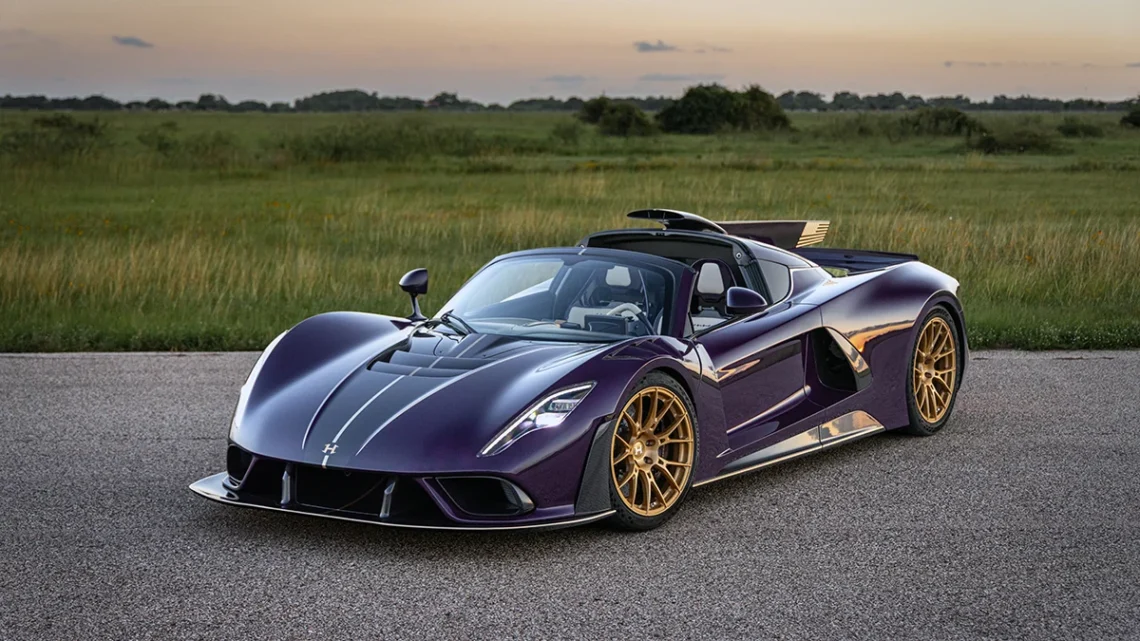
While the headline figure is the 2,031-hp output, the F5-M represents a significant leap in aerodynamic and chassis design for the Texas brand. Because the vehicle is built exclusively as a roadster, the engineers had to compensate for the loss of a fixed roof’s structural rigidity and aerodynamic profile.
The most striking visual element is the integrated roof scoop, which feeds air directly into the thirsty intake system of the mid-mounted V-8. Complementing this is a massive 55-inch dorsal fin that runs along the rear deck. While it adds a dramatic, race-inspired aesthetic, its primary function is critical: it acts as a stabilizer at the extreme velocities the F5-M is capable of, increasing downforce and ensuring that the rear axle remains planted during high-speed cornering.

Furthermore, the implementation of an adaptive suspension system—a first for the F5 platform—allows the car to transition from a track-focused weapon to a grand tourer with the simple adjustment of settings. This ensures that while the car is inherently "raw," it remains usable for those brave enough to drive it on the open road.
The Significance of the Gated Manual
In the hypercar world, "manual" is often considered a dirty word—a relic of the past that is objectively slower than modern sequential or dual-clutch systems. Hennessey, however, has leaned into the mechanical challenge. By installing a six-speed gated manual transmission, they have created the "undisputed king" of stick-shift performance.
There is a psychological component to this choice. A 2,000-hp car with a paddle-shift gearbox is a game of numbers; a 2,000-hp car with a manual shifter is a game of nerve. The driver must possess the technical skill to manage the power delivery, as there is no computer-controlled launch control or millisecond-perfect automated shift to save them from a heavy right foot. This creates an environment where the driver’s input is the primary variable in the car’s performance, effectively separating the enthusiast from the operator.
Official Responses and Industry Implications
John Hennessey, the founder of the company, has long maintained that the future of the automobile does not necessarily have to be silent or automated. In briefings surrounding the Goodwood debut, company representatives highlighted that the F5-M was born from customer demand. "Our clients don’t just want to go fast," one spokesperson noted. "They want to feel every bit of the effort the engine is putting in."

The implication of this release is profound. It suggests that there is a thriving, albeit niche, market for analog experiences in a digital world. While manufacturers like Ferrari, McLaren, and Lamborghini have long since abandoned the manual transmission in their high-performance segments, Hennessey is betting that a small cohort of ultra-high-net-worth individuals is willing to pay a premium for the "threat" of a manual gearbox.
At a price point of $2.65 million, the F5-M is not just a car; it is an investment in the heritage of the internal combustion engine. With only 12 units slated for production, the vehicle is destined to become an immediate collector’s item.
The Road Ahead: Why the F5-M Matters
As the automotive industry pivots toward 2030 and the looming regulatory landscape, cars like the Venom F5-M serve as essential milestones. They are the final expressions of a century of mechanical refinement. By choosing to push the "Fury" V-8 to over 2,000 horsepower, Hennessey is effectively setting a "high-water mark" for how much power can be managed by a human hand on a gear stick.
The F5-M is unlikely to be the fastest car around a track when compared to an AI-driven, all-wheel-drive electric hypercar. But that misses the point entirely. The F5-M is built for the experience of the drive—the sound of the twin turbos spooling behind the driver’s head, the mechanical click of the gate as the driver shifts into third at 100 mph, and the sheer audacity of commanding 2,000 horses with nothing but a clutch pedal and a prayer.

For the 12 individuals who secure one of these machines, they are not buying a transport device. They are buying the last, loudest, and most powerful chapter of the analog age. As the world gets quieter and more automated, Hennessey has ensured that at least one corner of the hypercar market remains gloriously, dangerously, and perfectly mechanical.
The Venom F5-M is not just a masterpiece of engineering; it is a monument to the spirit of the internal combustion engine—a beast that refuses to be tamed by software, preferring instead to be conquered by the driver.