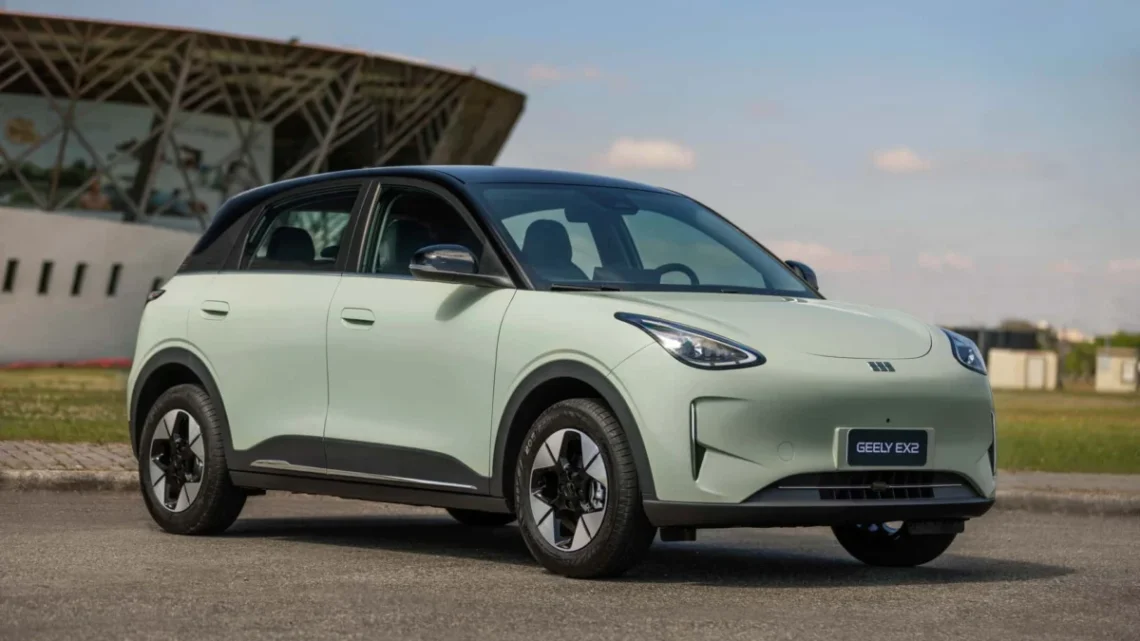
In the high-stakes theater of the Chinese automotive industry, where luxury SUVs and high-performance sedans have long vied for dominance, a quiet revolution has taken place. It is not being led by the high-tech, AI-integrated super-sedans that dominate headlines, but by a pragmatic, affordable, and intelligently designed compact hatchback: the Geely E2.
Also marketed under the badges of the Geely EX2, Geely Galaxy Xingyuan, and Geome Xingyuan, the E2 has emerged as the definitive best-selling vehicle in China for 2025—a title it has aggressively defended throughout the first half of 2026. As global automakers scramble to decode the "China formula," the E2 stands as a case study in how to capture the hearts, and wallets, of a shifting consumer base.
The Numbers Game: A Disruptor in the Rankings
While official year-end audits for 2026 are still being compiled, preliminary market analysis reveals a staggering trajectory. During the first six months of 2026, the Geely E2 moved approximately 244,000 units. To put this figure into perspective, it has systematically outperformed established titans of the industry. The Tesla Model Y, long considered the gold standard of EV sales, trailed at 215,000 units, while the much-hyped Xiaomi SU7 and the Leapmotor A10 recorded 182,000 and 171,000 sales, respectively.
This victory is not merely a matter of units sold; it is a cultural shift. In a market where New Energy Vehicles (NEVs)—encompassing pure electrics, plug-in hybrids, and range-extenders—now command an overwhelming 63 percent of all new-car registrations, the E2’s dominance signifies that Chinese consumers are pivoting away from "status symbols" toward high-value, high-utility mobility solutions.
Chronology of a Sales Phenomenon
The ascent of the Geely E2 was not an overnight occurrence. It is the result of a multi-year strategic pivot by Geely Holding Group to address the "missing middle" of the EV market.
- Early 2024: Geely identifies a saturation point in the ultra-cheap micro-EV segment (led by the Wuling Hongguang Mini) and the premium luxury segment. The engineering team begins rapid development of a B-segment platform capable of high-density LFP (Lithium Iron Phosphate) battery integration.
- Late 2024: The vehicle is unveiled to the public under various sub-brands to maximize market penetration. By segmenting the sales through the "Galaxy" and "Geome" channels, Geely effectively captures both the tech-savvy urban youth and the budget-conscious family demographic.
- January 2025: The E2 officially claims the top spot in monthly sales charts for the first time, ending the year as the nation’s best-selling model.
- Q1–Q2 2026: Despite increased competition from aggressive pricing strategies by BYD and Tesla, the E2 maintains its momentum through improved software over-the-air (OTA) updates and a reputation for reliability.
The Engineering Philosophy: Why the E2 Wins
The success of the E2 is predicated on a design philosophy that eschews the "more is better" trap. Measuring 162.0 inches in length, the car sits at the larger end of the B-segment hatchback category. By prioritizing a 104.3-inch wheelbase, Geely’s engineers have maximized the interior "living space," offering cargo and legroom metrics that shame traditional internal combustion engine (ICE) competitors of the same footprint.
A Masterclass in Pricing
The pricing strategy is arguably the car’s greatest weapon. Launching at ¥64,800 (approximately $9,000), the E2 sits in a "Goldilocks zone." It is barely more expensive than the entry-level Wuling Hongguang Mini EV, which offers significantly less range and safety, yet it significantly undercuts the BYD Seagull (known as the Dolphin Surf in some markets), which starts at ¥69,900. By positioning itself just above the budget "toy car" segment while remaining far more affordable than the Tesla Model Y’s ¥263,500 ($38,900) entry point, the E2 has effectively cornered the mass-market demographic.
Interior Tech and User Experience
The E2 rejects the trend of minimalist, screen-only interfaces that alienate older drivers. It strikes a balance with a 14.6-inch infotainment center that is paired with a clear, functional 8.8-inch digital instrument cluster. It offers creature comforts—full-LED lighting, adaptive cruise control, and a practical 13.2 cubic feet of rear cargo space—that make it a viable primary vehicle for a small family, not just a second car for city commuting.
Implications for the Global Market
The ripple effects of the E2’s success are already being felt in Europe. With European entry prices hovering around €20,900, the model is positioning itself as a direct challenger to the Renault 5 and the Peugeot 208.
However, the transition to the European market is not without its hurdles. Regulatory standards, safety crash-test requirements, and local charging infrastructure variations mean that the E2 must undergo significant adaptation. Furthermore, European consumers often prioritize driving dynamics and brand heritage, two areas where Geely must continue to prove its worth.
The broader implication for the global automotive industry is clear: the era of the "affordable electric car" is no longer a concept—it is a production reality. If the E2 can sustain its lead in China, it serves as a harbinger for a shift in global manufacturing. Traditional Western automakers are now forced to confront the fact that a $9,000–$20,000 EV can be profitable, tech-forward, and desirable.
Official Responses and Industry Outlook
While Geely’s executive team has remained relatively tight-lipped regarding specific future expansion plans, the company’s recent filings suggest a push for increased production capacity. Industry analysts suggest that Geely is leveraging the E2 to build "brand loyalty at the bottom," hoping that customers who start their journey with an E2 will eventually graduate to the company’s premium Volvo, Polestar, or Zeekr brands.
"The Geely E2 proves that, in some cases, simpler is better," says a spokesperson for the Motor1 analysis team. "By focusing on the fundamental requirements of the average commuter—range, reliability, and space—Geely has outmaneuvered competitors who were too focused on ‘wow factor’ features that the average driver rarely uses."
Conclusion: The Road Ahead
The Geely E2 is more than just a successful car; it is a symptom of a maturing electric vehicle market. It represents the transition from the "innovation phase," where EVs were gadgets for the wealthy, to the "utility phase," where EVs are the standard tool for daily transportation.
As we look toward the remainder of 2026, the question is not whether the E2 will remain the best-selling car in China, but whether any competitor can develop a platform that balances cost and capability with the same level of surgical precision. For now, the little hatchback from Geely is setting the pace, proving that in the hyper-competitive world of electric mobility, the biggest impact often comes from the most unassuming packages.
The global automotive landscape is changing, and for the moment, the steering wheel is held firmly by the Geely E2. Whether this success can be replicated on the streets of London, Paris, or Berlin remains the next great chapter in the story of the electric revolution.