Published: September 27, 2026
Curated by: HAN Shuang
Photography by: Guowei Liu
Main Facts
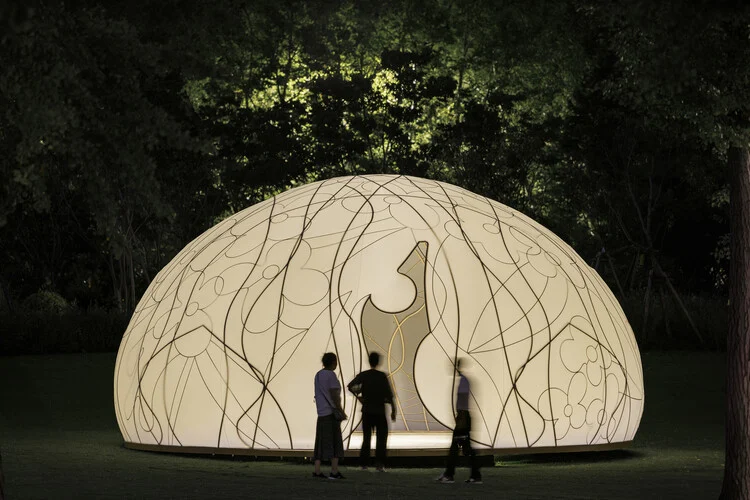
In celebration of the traditional Chinese Mid-Autumn Festival, architectural practice HCCH Studio has revealed Osmanthus Moon, a striking, short-term public art installation that merges contemporary spatial design with centuries-old cultural heritage. Curated by Han Shuang and captured through the lens of architectural photographer Guowei Liu, the project serves as both a physical pavilion and a conceptual projection.
At its core, Osmanthus Moon bridges two distinct cultural touchstones: the beloved osmanthus flower—an enduring symbol and sensory marker of the autumn season—and the spontaneous action paintings of folk "Zao Hua" (stove flower) artists, a recognized intangible cultural heritage tradition. Designed to be temporary yet impactful, the installation transforms public space into a canvas of light, shadow, and architectural storytelling, inviting visitors to reflect on the cyclical nature of time, memory, and community gathering during one of East Asia’s most revered lunar celebrations.

Chronology
Conceptualization and Heritage Research
The genesis of Osmanthus Moon began months prior to its public debut, rooted in an extensive research phase conducted by HCCH Studio. The design team immersed themselves in the rituals surrounding the Mid-Autumn Festival, studying historical documentation of moon-viewing pavilions, agricultural harvest celebrations, and the fading folk art of "Zao Hua."
Traditionally associated with rural stove decoration and auspicious domestic blessings, "Zao Hua" involves dynamic, expressive applications of colored mud and paint. HCCH Studio sought a way to translate the visceral, kinetic energy of these folk action paintings into a modern architectural installation without diluting their authenticity.
Site Planning and Materiality
As the conceptual framework solidified, the studio transitioned into site integration and material selection. Given the temporary nature of the commission, the design necessitated structural efficiency, sustainability, and high visual impact.
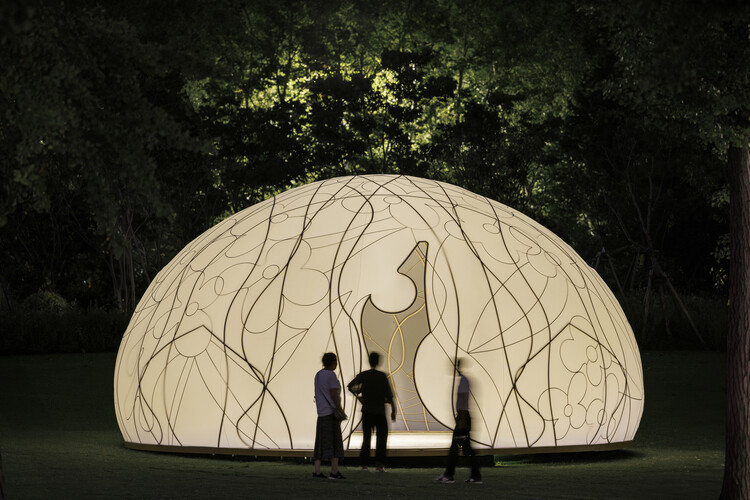
Engineered to be assembled rapidly within a public square, the installation utilizes a combination of lightweight structural framing and translucent surfaces designed to catch and refract artificial and natural light. Collaborating closely with local fabricators, the team ensured that the assembly process minimized environmental disruption while maximizing spatial intrigue.
Fabrication and Public Unveiling
Construction and final detailing took place ahead of the autumn equinox, culminating in a public unveiling timed precisely with the approach of the full moon. Guowei Liu’s documentation captures the pavilion during both the amber glow of late afternoon and the luminous clarity of night, highlighting how the structure interacts with changing daylight.
The installation officially opened to the public in late September 2026, welcoming thousands of visitors eager to experience its immersive spatial narrative.

Supporting Data
- Project Name: Osmanthus Moon
- Design Studio: HCCH Studio
- Curator: HAN Shuang
- Photographer: Guowei Liu
- Typology: Public Art Installation / Temporary Architecture
- Occasion: Traditional Chinese Mid-Autumn Festival
- Launch Date: September 27, 2026
- Key Cultural References: Osmanthus autumn motifs, "Zao Hua" (stove flower) folk art (Intangible Cultural Heritage)
Official Responses and Design Intent
According to design descriptions provided by the architects, Osmanthus Moon was conceived not merely as a decorative backdrop, but as an active participant in urban life.
"Osmanthus Moon is a short-term public art installation created to celebrate the traditional Chinese Mid-Autumn Festival," notes the design team from HCCH Studio. "It is a projection, specially as well as metaphorically, of the widely beloved traditional osmanthus pattern—a signature plant and flavor of autumn—and forms a dialogue with the action paintings of a folk ‘Zao Hua’ (stove flower) artist, an intangible cultural heritage tradition."
By framing the installation as a "projection," HCCH Studio emphasizes the duality of the structure. Spatially, it projects form, shadow, and light onto the surrounding plaza. Metaphorically, it projects historical narratives into the contemporary urban consciousness, serving as a physical manifestation of collective memory.

Curator Han Shuang underscored the importance of keeping intangible heritage alive through contemporary spatial interventions, noting that public architecture possesses a unique capacity to make historical traditions accessible, engaging, and relevant to younger generations who inhabit rapidly modernizing cities.
Implications
Revitalizing Intangible Cultural Heritage in Urban Spaces
The deployment of Osmanthus Moon highlights a growing trend among contemporary architects and designers in Asia: leveraging temporary public installations to revitalize vanishing folk traditions. As rapid urbanization alters the physical and social landscapes of modern cities, traditional practices like "Zao Hua" risk being relegated to museums or forgotten entirely.
By integrating these expressive, action-based painting techniques into an architectural dialogue, HCCH Studio demonstrates how temporary structures can serve as living archives. The installation proves that heritage preservation does not require static conservation; rather, it can thrive through dynamic, experiential reinvention.

The Rise of Experiential Public Art Architecture
Temporary installations like Osmanthus Moon signal a broader shift in urban design toward experiential placemaking. Rather than relying solely on permanent, monumental structures, cities are increasingly embracing flexible, site-specific art pieces that activate public plazas for limited durations. These interventions foster a sense of occasion, transforming everyday civic spaces into destinations for communal introspection and celebration.
Furthermore, the project highlights the vital role of architectural photography and digital curation in amplifying local interventions onto a global stage. Through the lenses of photographers like Guowei Liu and platforms like ArchDaily, localized cultural celebrations transcend their physical boundaries, sparking international conversations about the intersection of design, memory, and community.
Looking Ahead: Sustainable Temporality
As the conversation around architectural sustainability evolves, temporary installations face increasing scrutiny regarding their environmental footprint. While Osmanthus Moon is a short-term project, its success prompts broader questions about the lifecycle of public art. Future iterations of such festival-driven designs will likely need to prioritize circular material economies—ensuring that structural components are fully recyclable, modular, or repurposable after the festival concludes.

Nevertheless, HCCH Studio’s Osmanthus Moon stands as a poignant reminder of architecture’s emotional and cultural capacity. By marrying the delicate fragrance and visual metaphor of the osmanthus blossom with the raw, energetic strokes of folk heritage, the studio has crafted a fleeting yet unforgettable monument to the poetry of autumn.