
The Strategic Pivot: A Decade of Change
For the better part of the last two decades, the corporate sustainability narrative was defined by the "business case." Chief Sustainability Officers (CSOs) and board members championed environmental, social, and governance (ESG) initiatives as engines for growth, beacons for top-tier talent, and laboratories for product innovation. However, a landmark study conducted in mid-2026 by BSR and GlobeScan reveals a profound, structural shift in the DNA of corporate responsibility.
The research, which surveyed 124 sustainability professionals at companies generating at least $1 billion in annual revenue, paints a clear picture: the era of sustainability as a voluntary, innovation-led opportunity is rapidly being eclipsed by the era of sustainability as a mandatory, compliance-driven discipline. As regulatory bodies worldwide tighten their grip on reporting standards and climate disclosures, the primary impetus for sustainability has migrated from the boardroom’s growth strategy to the legal department’s risk register.
Chronology of a Transformation: 2016 vs. 2026
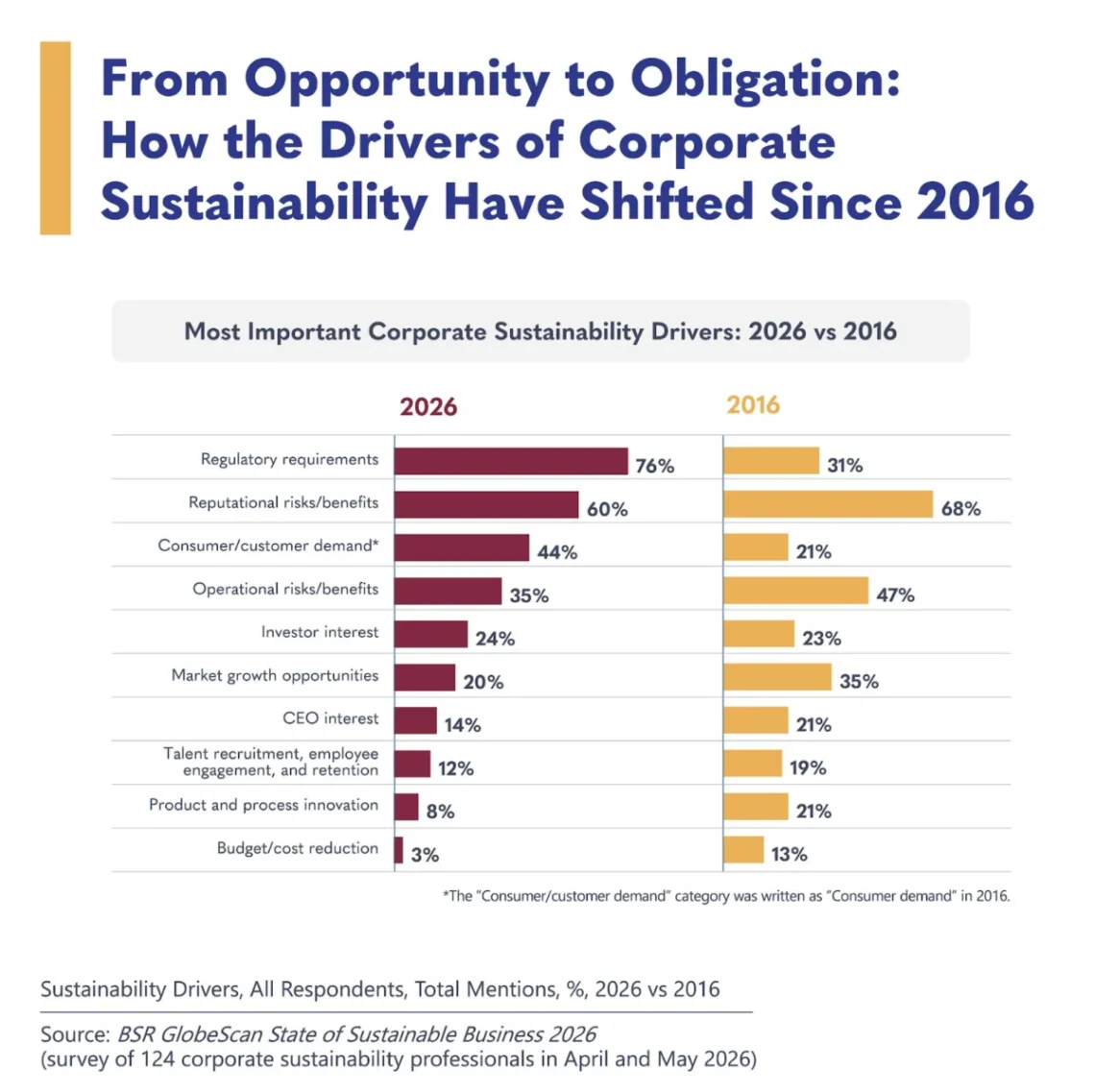
To understand the gravity of this shift, one must look back to the landscape of 2016. A decade ago, corporate sustainability was largely an exercise in reputation management and operational efficiency. The 2016 data shows that reputational risks and benefits were the primary drivers, cited by 68% of respondents, followed by operational efficiency (47%) and market growth opportunities (35%). In this environment, sustainability was a differentiator—a way to win the "war for talent" and capture "green" market share.
Fast forward to April and May of 2026, and the landscape has been fundamentally reshaped. Regulatory requirements have skyrocketed from a 31% influence factor in 2016 to a staggering 76% in 2026. This meteoric rise has effectively pushed aside the "growth" narrative. Where once companies asked, "How can sustainability make us more profitable?", they are now increasingly asking, "How can we meet the minimum requirements to operate within this new regulatory framework?"
The Declining Influence of Internal Drivers
Perhaps most concerning for proponents of corporate transformation is the broad decline in internal, forward-looking drivers. Compared to the 2016 benchmarks, the following areas have seen a marked loss in influence:
- Market Growth: The perception of sustainability as a primary engine for new market expansion has diminished.
- Innovation: Product and process innovation, once the "crown jewel" of sustainability departments, has been sidelined by the need to meet reporting benchmarks.
- Talent Retention: While sustainability remains important to employees, it is no longer viewed by leadership as the primary lever for recruitment and engagement as it was in the mid-2010s.
- Operational Cost Reduction: The "low-hanging fruit" of energy efficiency and waste reduction has matured, and the focus has shifted toward complex, systemic regulatory compliance.
Data-Driven Insights: What the Numbers Tell Us
The BSR and GlobeScan data provides an empirical look at this "Great Rebalancing." The most striking data point is the inversion of the importance of regulation versus growth.

Comparison of Primary Drivers (2016 vs. 2026)
| Driver | 2016 Importance | 2026 Importance |
|---|---|---|
| Regulatory Requirements | 31% | 76% |
| Reputational Risk/Benefit | 68% | 60% |
| Consumer/Customer Demand | 21% | 44% |
| Market Growth Opportunities | 35% | [Declining] |
| Operational Benefits/Cost | 47% | [Declining] |
The data confirms that external pressure is no longer just coming from the public; it is now codified in law. While consumer demand has seen a healthy increase (rising from 21% to 44%), it still trails far behind the coercive power of new global regulations. Interestingly, investor interest has remained largely static over the decade. Despite the rise of "ESG investing" in the media, sustainability professionals on the ground report that the investor appetite for sustainability as a core business driver has not evolved at the same pace as the regulatory environment.
Perspectives from the Field: Expert Analysis
James Morris, who leads GlobeScan’s San Francisco office, suggests that this shift is not necessarily a sign of failure, but rather a sign of "growing up." However, he warns that it comes with significant trade-offs.
"When regulation becomes the primary driver, you enter a culture of compliance," Morris explains. "Compliance is essential for setting a floor for global performance, but it rarely acts as a catalyst for the radical, disruptive innovation that our climate and social challenges require. The challenge for today’s CSOs is to satisfy the regulators without losing the entrepreneurial spirit that once defined the sustainability function."
Industry observers note that this "regulatory capture" of sustainability has led to a siloed approach. Sustainability teams are increasingly spending their time interfacing with legal, finance, and accounting departments to ensure audit-ready data, leaving less bandwidth for cross-functional initiatives that drive genuine business transformation.
Implications for the Future of Business
The transition from a "value-creation" model to a "compliance-accountability" model carries three critical implications for the next decade of corporate life.
1. The Ceiling of Compliance
Regulation is, by design, an exercise in setting minimum standards. While this prevents the "race to the bottom," it is not designed to trigger a "race to the top." Companies that treat sustainability solely as a regulatory checklist will find themselves technically compliant but strategically vulnerable. They risk missing out on the massive economic opportunities presented by the energy transition and the circular economy, which require innovation, not just adherence to rules.
2. The Resurgence of Consumer-Centric Sustainability
The rise of consumer demand—now at 44%—suggests a path forward. As regulations mandate transparency, consumers are gaining access to better data regarding product impact. This creates an opportunity for companies to move beyond compliance and lean into consumer preference. The winners of the next decade will likely be the firms that use regulatory transparency as a baseline, and then use innovation to win the hearts and minds of an increasingly informed consumer base.
3. Redefining Long-Term Value
For organizations to remain competitive, they must re-integrate the concepts of "growth" and "sustainability." If sustainability is relegated to a defensive function (compliance), it will eventually be viewed as a cost center. To maintain internal influence, sustainability leaders must pivot their narrative. They must demonstrate how complying with complex regulations creates competitive advantages—such as supply chain resilience, brand loyalty in a high-trust economy, and the ability to attract capital in an increasingly green-tilted financial market.
Conclusion: The Path Forward
The research from BSR and GlobeScan confirms a major inflection point. We are living through the formalization of sustainability. While the decline in "growth" and "innovation" as primary drivers is a sobering development, it is a natural byproduct of the maturation of the field.
The task ahead for corporate leadership is to avoid the trap of the "compliance mindset." Regulation has provided the mandate; it is now up to business leaders to provide the vision. If companies can successfully merge the rigors of compliance with the creativity of innovation, they will not only meet the requirements of 2026—they will build the resilient, competitive, and sustainable business models required to thrive in 2036 and beyond.
The data is clear: the floor has been raised. Now, it is up to the corporate sector to decide if it will settle for the floor, or if it will reach for the ceiling.
This report is based on the 2026 BSR/GlobeScan study of 124 sustainability professionals at companies with $1B+ in annual revenue. The findings reflect a global shift in corporate strategy, highlighting the transition from voluntary, value-led initiatives to a compliance-first regulatory environment.