
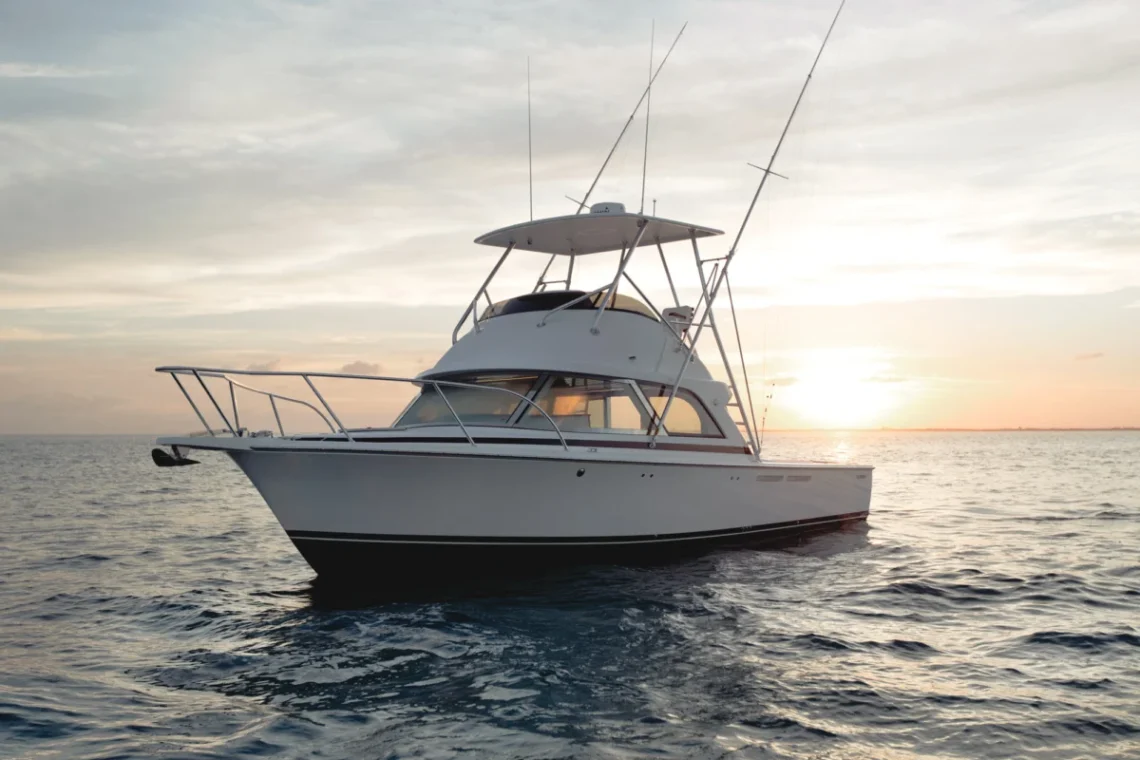
For generations, the name Bertram has been synonymous with rugged, offshore capability. Since the company’s inception, the brand has occupied a hallowed space in the marine industry, defined by the “Ray Hunt” deep-V hull design that revolutionized how boats handle heavy seas. When Bertram Yachts announced the reimagining of their iconic 35-footer in 2017, the industry held its breath. Would a modern iteration retain the soul of the original, or would it succumb to the trends of over-stylized, fragile luxury?
The answer, as evidenced by the enduring success of the platform, was a resounding validation of the brand’s heritage. The Bertram 35 is not merely a nostalgia trip; it is a masterclass in blending mid-century performance DNA with 21st-century propulsion and comfort.
Main Facts: A Vessel Built for the Blue Water
The Bertram 35, as it stands in its current era, is a dedicated fishing machine. It is designed for the owner who values performance above all else—someone who demands a boat that can run comfortably through a chop that would force lesser vessels to turn back.
At the heart of the 35’s performance are the twin 500 hp Caterpillar C7.1 engines. These powerplants provide a potent power-to-weight ratio, allowing the vessel to plane quickly and maintain a swift, efficient cruise speed. With a fuel capacity of 310 gallons, the range is more than sufficient for serious offshore canyon runs or extended coastal hops.
The deck layout is a nod to the serious angler. Standard equipment includes robust rod holders, an integrated livewell, large in-deck fish boxes, and a transom door for hauling in the day’s catch. Unlike modern “glamour” boats that prioritize interior lounge space at the expense of deck utility, the Bertram 35 keeps the cockpit clear and functional. However, the manufacturer recognized that even the hardest-core angler needs a moment of respite; the addition of engine-box cushions allows the cockpit to transition from a workstation to a lounge area in seconds.
Chronology: The Evolution of an Icon
The history of the Bertram 35 is a timeline of maritime evolution. To understand the 2017 redesign, one must look at the lineage that preceded it.
The Original Genesis (1960s-1980s)
The original Bertram 35, introduced in the mid-1960s, was the boat that put Bertram on the map as a global powerhouse. Its deep-V hull was essentially a commercial-grade platform adapted for recreational use. It was loud, it was heavy, and it was virtually indestructible.
The Innovation Gap (1990s-2010s)
As the industry shifted toward larger, beamier yachts with more interior volume, the classic 35-foot profile became a niche product. The company went through various ownership changes and strategic shifts, but the demand for a compact, high-performance offshore boat never truly vanished.
The 2017 Renaissance
In 2017, under new ownership and with a commitment to restoring the brand’s glory, Bertram launched the modern 35. The goal was to take the original Ray Hunt hull geometry—the “DNA”—and apply modern composite construction techniques. By utilizing infusion molding and advanced resins, the new 35 was lighter and stiffer than its predecessor, allowing the engines to work more efficiently.
The Current Market (2026)
Today, the Bertram 35 has cemented itself as a highly sought-after brokerage vessel. With prices currently ranging between $595,000 and $699,000 for newer models, the boat retains its value exceptionally well, proving that the market for high-quality, mid-sized sportfishing boats is as strong as ever.
Supporting Data: Engineering and Ergonomics
The brilliance of the modern 35 lies in its details. In a 2017 feature, Yachting magazine noted that the flybridge is a study in "uncluttered efficiency."
The helm is designed for the captain who wants total control. The optional teak helm pod, paired with Palm Beach controls, offers a tactile experience that connects the operator to the engines in a way that electronic joysticks simply cannot. The raised console houses multifunction displays that integrate the Cat C7.1 diagnostics with the latest in sonar and navigation technology.
Technical Specifications Summary
- Engine Configuration: Twin 500 hp Cat C7.1
- Fuel Capacity: 310 Gallons
- Hull Design: Modernized deep-V, optimized for rough-water stability
- Standard Angling Features: Integrated rod holders, livewell, in-deck fish boxes, transom door
- Optional Upgrades: Seakeeper gyroscopic stabilization, custom teak decking, tuna towers
The integration of a Seakeeper gyro into a boat of this size is a game-changer. It effectively eliminates the roll that historically plagued deep-V hulls at rest, making the 35 a legitimate family cruiser as well as a fishing platform.
Official Perspectives: The Philosophy of "Hard-Fished"
Bertram has always maintained that their boats are built to be "fished hard." This is a philosophy that permeates the design office. When you step onto a Bertram 35, you aren’t just stepping onto a boat; you are stepping into a system designed for a specific purpose.
During the launch of the 2017 model, representatives emphasized that the design team spent significant time analyzing how owners actually used their boats. They found that while owners wanted the look of a classic yacht, they demanded the reliability of a commercial vessel.
"The boat is built to be used," a spokesperson stated. "The engine-box cushions, the teak decking, the Palm Beach controls—these aren’t just aesthetic choices. They are meant to improve the experience of the person who spends their weekends on the water, whether that’s fighting a marlin or hosting friends at a sandbar."
Implications: The Legacy and the Future
What does the continued success of the Bertram 35 mean for the boating industry? It signals a shift away from the "bigger is better" mentality that dominated the early 2000s. There is a growing segment of the market—both in new sales and brokerage—that values performance, maneuverability, and the ability to trailer or dock a boat with ease.
The "Legend" Factor
The Bertram 35 serves as a bridge between generations. It appeals to the seasoned mariner who grew up admiring the original Bertrams, but it also captures the younger demographic who want a boat that looks cool and runs fast. The classic, aggressive lines of the 35 have not aged a day; they remain as timeless as a well-tailored suit.
Economic Considerations
The fact that these boats are trading for upwards of $600,000 several years after their introduction speaks volumes about the brand’s equity. While some manufacturers see depreciation as a standard part of the ownership cycle, the Bertram 35 has managed to maintain a premium status. For potential buyers, this provides a safety net; the boat is a tangible asset that is unlikely to lose its market relevance.
The Future of the Deep-V
As hull technology continues to advance, the question arises: can the deep-V be improved upon? The 35 proves that the fundamental physics of the hull are sound. By focusing on weight reduction through advanced composites and maximizing the efficiency of modern diesel engines, Bertram has proven that you don’t need to reinvent the wheel—you just need to perfect it.
Conclusion: A Timeless Investment
The Bertram 35 is a rare bird in the modern yachting world. It is a boat that refuses to sacrifice performance for vanity, and it refuses to discard the lessons of the past in favor of temporary trends.
Whether you are looking at it through the lens of a brokerage buyer scouting the market or an enthusiast looking back at the 2017 redesign, the takeaway is the same: the Bertram 35 is, and remains, a legend. It is a vessel built for those who understand that the true joy of boating isn’t found in the marina, but in the open ocean, where the ride matters just as much as the destination.
In a world of disposable technology and rapidly changing aesthetics, the Bertram 35 stands as a reminder that some things are simply built right the first time—and with a little bit of modern magic, they can stay that way forever.