To define the “Midwestern artist” is to chase a phantom. There is no singular aesthetic, no unified movement, and certainly no consensus on the geographic boundaries of the region. Is the Midwest merely the industrial rust belt, the sprawling agricultural plains, or the vibrant, lake-bound urban centers? For the artists who call this vast territory home, the Midwest is less a set of tropes—cornfields and smokestacks—and more a condition of space.
In an era where the art world is increasingly globalized and concentrated in hyper-expensive coastal hubs, the Midwest offers a rare commodity: room to breathe. With its world-class museums, prestigious academic institutions, and a cost of living that permits actual studio space, the region serves as a sanctuary for those who value creative individualism over the performative “noise” of New York or Los Angeles. By examining the practices of five distinct artists—Ellen Lanyon, McArthur Binion, Beverly Fishman, Anthony Mitri, and Kay Rosen—we can begin to see the Midwest not as a monolith, but as a diverse ecosystem of intellectual and visual exploration.
The Geography of Creativity: Why the Midwest Matters
The allure of the Midwest for the professional artist is anchored in a unique tension between accessibility and institutional excellence. Cities like Chicago, Detroit, and Cleveland function as sophisticated cultural nodes that are detached from the relentless churn of the coastal art market. This detachment allows for a different kind of rigor.
For many, the Midwest is a place where one can exist “outside the noise.” While critics often dismiss the region as “flyover country,” the reality is that the Midwest hosts some of the most influential art schools in the world, such as the School of the Art Institute of Chicago (SAIC) and the Cranbrook Academy of Art. These institutions have acted as incubators for radical departures from traditional art-world trends, fostering generations of creators who are uninterested in the fleeting fashions of Soho or Chelsea.

Chronology of Influence: Five Perspectives
The diversity of the Midwest is best understood through the life trajectories of its practitioners. These five artists represent a tapestry of arrivals, departures, and returns, showcasing how the region functions as a vital anchor for varied artistic voices.
Ellen Lanyon (1926–2013): The Chicago Imagist Legacy
Ellen Lanyon’s career provides a blueprint for the 20th-century Midwestern artist. Born in Chicago, she began her training early, sketching machine parts—a nod to the city’s industrial backbone—before honing her craft at the Ox-Bow School of Art and the SAIC. Lanyon was a central figure in the Chicago Imagists, a loose but formidable collective that operated in the 1960s and 70s with a defiant, anti-establishment spirit.
By rejecting the cool detachment of New York minimalism, Lanyon and her peers championed a surreal, narrative, and highly personal form of painting. Her 1996 work Cactus Garden encapsulates her later period: a strange, foreboding, and reverent study of the natural world that transforms the mundane into the uncanny.
McArthur Binion (b. 1946): The Geometry of Memory
Born in Mississippi and moved to Detroit in 1951, McArthur Binion’s path through the Midwest is foundational to his identity. As the first Black student to earn an MFA in painting from Cranbrook, Binion has long operated at the intersection of history and minimalism. His work—characterized by layered, imperfect, and hand-drawn grids—functions as a visual language of personal and collective heritage.

In visual:ear (2023), Binion’s deep green, moody composition highlights his mastery of color and restraint. His work suggests that the Midwest is a place where one can engage with the silence of the landscape to construct something deeply structural and profound.
Beverly Fishman (b. 1955): The Medical Landscape
Beverly Fishman’s arrival in Michigan in 1992 to head the painting department at Cranbrook marked a significant shift in her career. Her work is a sharp, clinical examination of the body in the age of pharmaceutical dominance. By translating the shapes of pills into bold, concentric bands of color, Fishman addresses the intersection of gender, addiction, and medical technology. Her work is not “Midwestern” in the rustic sense, but it is deeply connected to the region’s long history of medical innovation and industrial production.
Anthony Mitri (b. 1951): The Stillness of the Plains
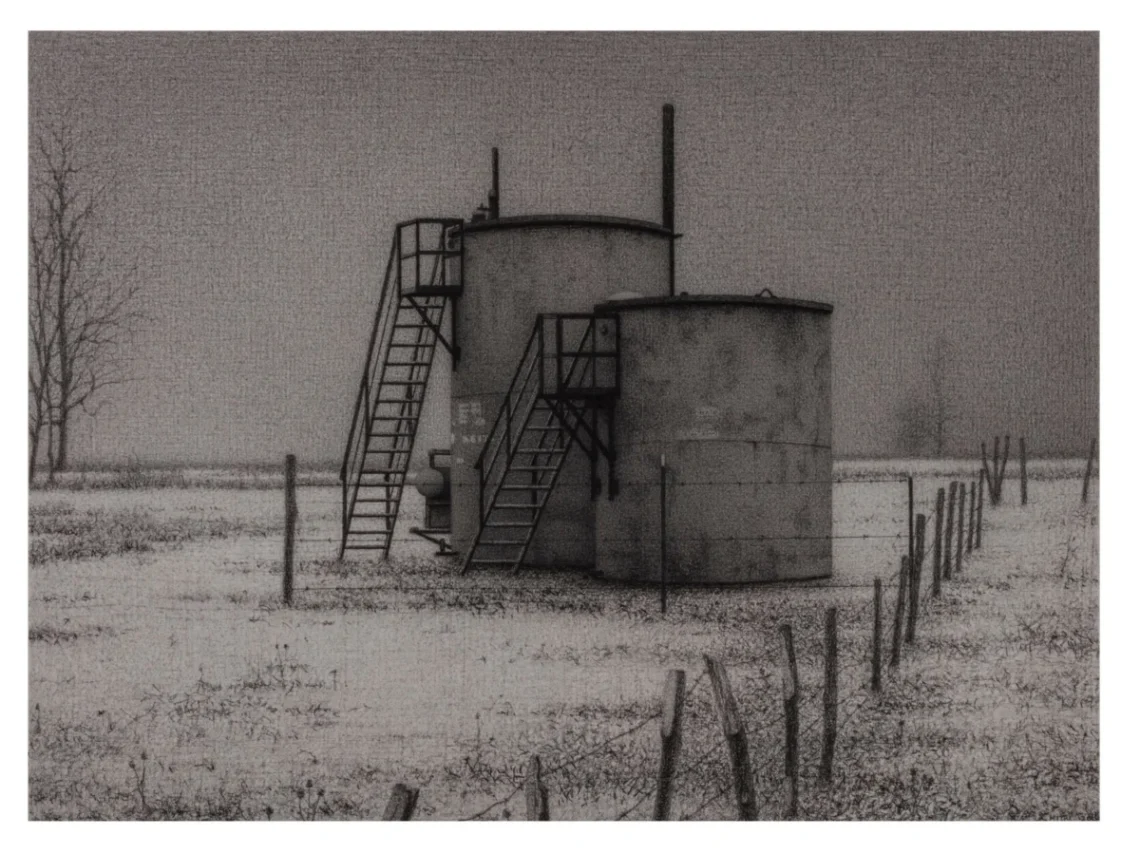
Based in Cleveland, Anthony Mitri’s practice is a meditation on memory and place. Utilizing his own photography as a structural framework, he distills the feeling of a moment—often the quiet, desolate beauty of a Midwestern winter—into drawings that feel like film stills. Snow Fence Variations (2023) is a masterclass in atmospheric rendering, capturing the stark, monochromatic essence of the region’s cold-weather months.
Kay Rosen (b. 1943): The Poet of the Midwest
Kay Rosen, born in Texas but a long-time educator at SAIC, represents the intellectual migration to the Midwest. Often referred to as the “poet of the art world,” her work sits at the intersection of text, architecture, and conceptual art. In Sweet Dreams (2011), the title is rendered as an overlapping puzzle of letters, challenging the viewer to find meaning within the abstraction. Rosen’s work demonstrates how the Midwest facilitates a type of intellectual play that is both rigorous and elusive.

Supporting Data: The Economic and Cultural Advantages
The choice to build a career in the Midwest is often supported by structural advantages that are increasingly rare.
- Cost of Living: In major coastal cities, the average rent for a studio space can rival the cost of a mortgage in the Midwest. This economic reality grants artists the time to experiment without the pressure of producing “sellable” work immediately.
- Institutional Density: The Midwest is home to the Art Institute of Chicago, the Cleveland Museum of Art, and the Detroit Institute of Arts. These museums provide a constant dialogue with art history, distinct from the temporary hype cycles of the private gallery system.
- Space: The physical reality of the region—the ability to have a large studio, a backyard, or even just a quiet neighborhood—allows for a different scale of work. Artists like Fishman and Binion have utilized this spatial freedom to scale up their practices in ways that would be prohibitive elsewhere.
Official Responses and Industry Perspectives
Gallery owners within the Artnet Gallery Network often note that collectors are beginning to look toward the Midwest with renewed interest. There is a growing fatigue with the homogenization of the coastal art scene. As one gallerist remarked, "When you visit studios in Chicago or Detroit, you aren’t seeing artists chasing the same trends. You are seeing people who have the autonomy to develop a language that is entirely their own."
This sentiment is echoed by academics who point out that the Midwest has always been a hotbed for radical art—from the Hairy Who in Chicago to the Cranbrook-led design movements. The region’s “blurriness,” often viewed as a weakness, is actually its greatest strength. It allows for a porous definition of what art can be, unburdened by the need to fit into a pre-approved cultural hierarchy.
Implications for the Future of Art
What does the future hold for the Midwestern artist? The digital age has largely dissolved the “tyranny of geography.” With the ability to connect with global collectors via platforms like the Artnet Gallery Network, an artist no longer needs to live in a walk-up in Brooklyn to reach an international audience.

The implication is a decentralization of the art world. As more artists choose the Midwest for its quality of life and creative freedom, the region is poised to become a destination for a new generation of creators who prioritize the substance of their work over the proximity to a specific street corner in Manhattan.
The Midwest, as these five artists demonstrate, is not a place you come from—it is a place you inhabit with intention. Whether through the surrealism of Lanyon, the grids of Binion, the pharmaceutical critique of Fishman, the winter memories of Mitri, or the linguistic puzzles of Rosen, the Midwestern artistic experience is defined by a refusal to be categorized. It is a region of quiet observation, structural innovation, and, most importantly, the freedom to define one’s own center.
To explore the depth of this region further, visit the Artnet Gallery Network to discover artists currently defining the next chapter of the American landscape.