By Automotive News Desk
Published: April 2025
Main Facts
The automotive aftermarket has a prominent new contender for America’s highways and suburban byways. Firestone, a titan in tire manufacturing and a subsidiary of Bridgestone Americas, has officially pulled the curtain back on its latest flagship product: the Firestone Destination LE4. Designed as the direct successor to the immensely popular and best-selling Destination LE3, this all-season highway tire has been engineered from the ground up to cater specifically to the country’s most ubiquitous and high-volume vehicles—crossovers, SUVs, and light-duty trucks.
The Destination LE4 enters a fiercely competitive marketplace where longevity, wet-weather traction, and driving comfort dictate consumer loyalty. Firestone has targeted these exact pain points through a series of structural updates and compound refinements. By optimizing rib widths, deepening the initial tread depth, and introducing intricate 3D sipes, the company claims significant leaps in performance over its predecessor and key market rivals.
Available in a comprehensive lineup of 65 distinct sizes designed to fit rims ranging from 15 to 22 inches in diameter, the LE4 is tailored for a vast array of popular nameplates. Whether it’s daily commuting in a compact crossover like the Mazda CX-5, hauling weekend gear in a Chevrolet Trailblazer, towing with a Ford F-150, or road-tripping in a full-size Nissan Armada, Firestone’s new rubber aims to be the go-to OE (Original Equipment) replacement choice for millions of American motorists.
Chronology of Development and Evolution
To understand the magnitude of the Destination LE4’s arrival, it helps to trace the lineage of the Destination family. For decades, Firestone’s Destination series has served as a benchmark for dependable, everyday truck and SUV utility.
- The Foundation (Destination LE and LE2): Years ago, the early iterations of the Destination LE line established a reputation for solid highway manners and predictable wear characteristics. They became staple recommendations for fleet managers and everyday family drivers alike.
- The Success of the LE3: The predecessor to the current model, the Destination LE3, ascended to become one of Firestone’s best-selling products. It won over consumers through a balanced blend of ride comfort, wet grip, and respectable tread life. However, as modern crossovers and SUVs grew heavier, more powerful, and technologically advanced—and as consumer expectations for all-weather safety heightened—Firestone’s engineering teams recognized the need for a comprehensive overhaul.
- The Conception of the LE4: Development of the Destination LE4 began several years ago, focusing heavily on addressing the unique stresses placed on tires by modern vehicle architectures, including heavier electric and hybrid powertrains, as well as stiffer, more responsive chassis designs.
- The 2025 Launch: Firestone officially announced the rollout of the LE4, positioning it as a generational leap forward. Rigorous internal and comparative testing paved the way for its commercial release, targeting immediate availability across major tire retailers nationwide.
Supporting Data and Engineering Breakdown
Firestone did not merely tweak the chemical recipe of the previous tire; the company overhauled both the internal carcass and the exterior tread pattern of the Destination LE4.
1. Tread Pattern and Siping Optimizations
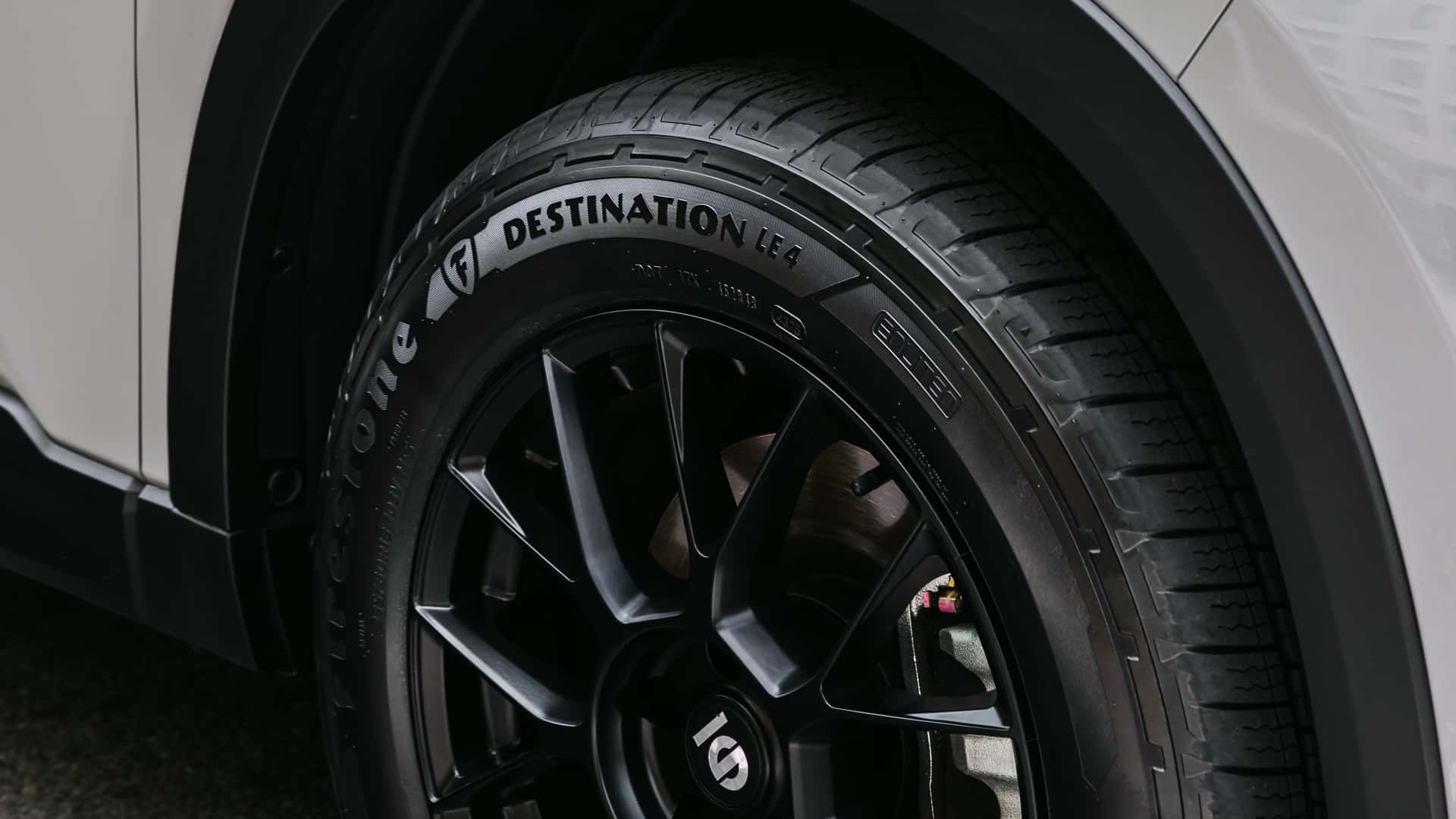
At a glance, the most noticeable changes to the LE4 reside on its contact patch. Engineers meticulously optimized the width of the tire’s circumferential ribs to distribute load more evenly across the footprint, directly extending the tire’s operational life. This was paired with a deeper initial tread depth, giving the tire more usable rubber from day one.
To tackle adverse weather, Firestone integrated thinner 3D sipes. These interlocking micro-slits lock together under high cornering and braking loads to maintain block rigidity, yet they open up just enough to bite into water films and light snow accumulations. The result is a marked improvement in wet-weather handling and winter-weather competence compared to the outgoing LE3.
2. Internal Construction and Rubber Compounds
Beneath the tread, the LE4 utilizes a reinforced carcass featuring high-strength body plies and robust steel cords designed to withstand the heavy loads and high torque outputs of modern trucks and SUVs.
Furthermore, Firestone achieved a higher degree of ingredient consistency throughout the rubber compound mixing process. By ensuring a more uniform dispersion of polymers, silica, and carbon black within the compound, the engineers reduced localized weak points. This molecular uniformity directly translates to enhanced grip across varying temperature ranges and a significantly slower, more even rate of tread wear.
3. Performance Metrics and Benchmarks
Firestone’s internal testing data paints a compelling picture of the LE4’s dominance over both its predecessor and several key competitors in the all-season highway category:
- Treadwear Longevity:
- The LE4 delivers an estimated 16 percent longer tread life than the outgoing Destination LE3.
- Compared to external rivals, the LE4 lasts 9 percent longer than the General Grabber H/T.
- Most impressively, it outlasts the BFGoodrich Advantage Control HT tire by a staggering 43 percent.
- Dry Stopping Performance:
- The LE4 achieved a 2.6 percent reduction in dry stopping distance, pulling up 2.0 feet shorter than the LE3.
- In direct comparisons, the LE4 stopped 2.0 feet shorter in the dry than the BFGoodrich Advantage Control HT.
- Wet and Multi-Surface Braking:
- When compared to the Toyo Open Country H/T II, the Firestone LE4 stopped a remarkable 8.0 feet shorter in combined wet and dry testing conditions.
- Against the BFGoodrich Advantage Control HT, the LE4 managed to stop 4.0 feet shorter in wet braking scenarios.
Official Responses and Industry Perspectives
The reception from industry insiders and the manufacturing team underscores the strategic importance of this launch.
"Firestone has a long-standing heritage of building tires that resonate with the everyday American driver," noted a representative during the product unveiling. "With the Destination LE4, we didn’t just want to refresh a successful product; we wanted to redefine what drivers can expect from an all-season highway tire. By focusing heavily on compound consistency, structural integrity, and measurable stopping distance reductions, we are giving families an extra layer of safety and peace of mind on every single commute."
Automotive analysts and aftermarket experts have also weighed in, noting that the timing of the LE4’s release aligns perfectly with shifting consumer purchasing habits. As vehicle prices—particularly for new SUVs and trucks—continue to soar, consumers are holding onto their vehicles longer. Consequently, the demand for high-durability, long-lasting replacement tires that do not sacrifice safety or comfort has never been higher.
Implications for Consumers and the Market
The launch of the Firestone Destination LE4 carries several broader implications for the automotive aftermarket and everyday vehicle owners:
1. Redefining Value Through Longevity
In an era marked by economic fluctuations and rising cost-of-living concerns, vehicle maintenance expenses are under a microscope. Tires represent one of the most substantial recurring costs of vehicle ownership. By pushing tread life up by 16 percent over the LE3—and crushing competitors by up to 43 percent—Firestone is offering a compelling value proposition. Consumers will theoretically go significantly longer between tire replacement cycles, lowering the total cost of vehicle ownership over time.
2. Safety as a Competitive Differentiator
Stopping distances measured in feet can mean the difference between a safe commute and a costly fender-bender. By shaving up to 8 feet off stopping distances compared to established rivals like the Toyo Open Country H/T II, Firestone is sending a clear message: comfort and longevity do not need to come at the expense of active safety. This aggressive focus on wet and dry braking performance is expected to pressure competing manufacturers to accelerate their own research and development cycles.
3. Broad Market Adaptability
With 65 distinct sizes covering 15- to 22-inch wheel diameters, the LE4 bridges the gap between older passenger vehicles and the massive, high-rim-diameter setups found on modern luxury SUVs and heavy-duty pickup trucks. This expansive sizing strategy ensures that independent tire shops and major service chains can stock a single product line that satisfies the vast majority of their walk-in customer base.
Conclusion
The automotive world is often captivated by high-horsepower sports cars and ultra-capable off-road rock crawlers, yet the unsung heroes of daily mobility are the tires rolling quietly beneath family haulers and work trucks. With the Destination LE4, Firestone has taken its most successful formula and refined it with surgical precision.
Backed by impressive longevity gains, superior braking metrics across both wet and dry surfaces, and a massive array of fitments for America’s favorite vehicles, the Firestone Destination LE4 is poised to dominate driveways, parking lots, and highways across the nation for years to come. For consumers currently eyeing replacement rubber for their crossover, SUV, or light truck, the LE4 sets a formidable new standard in the all-season highway segment.