Main Facts
The maritime industry is no stranger to flash, trend-chasing design, and high-tech novelties that look exceptional on a boat show dock but falter miles offshore. Yet, every so often, a vessel arrives that rejects fleeting gimmicks in favor of hard-nosed maritime heritage. Enter the Maritimo M50 enclosed-bridge yacht—a 52-foot long-range cruiser that stands as the living embodiment of founder Bill Barry-Cotter’s uncompromising engineering philosophy.
Built for discerning yachtsmen—frequently those stepping up from 40- to 45-foot express cruisers or open flybridge boats—the M50 is designed to answer a singular demand: how to travel long distances comfortably, efficiently, and, above all, dependably. Maritimo equips the M50 with twin 800-horsepower Volvo Penta D13 diesel engines coupled to conventional straight shafts, a deliberate choice favoring mechanical simplicity and rugged durability over complex pod drives.
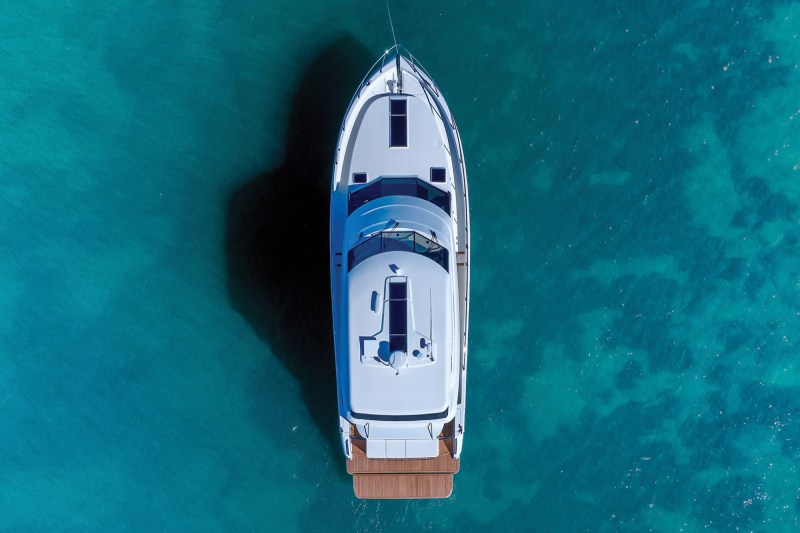
Measuring 52 feet overall, the yacht pairs traditional offshore seaworthiness with modern luxuries: a brilliant galley-aft configuration acting as a social anchor, an expansive enclosed bridge accessed via an internal staircase, a full-beam master stateroom with 6 feet, 4 inches of headroom, and a forward VIP suite featuring a clever manually adjustable berth. Achieving a top speed of nearly 29 knots and a highly efficient long-range displacement capability that sips a mere 6.5 gallons per hour at 7.5 knots, the M50 is engineered for serious blue-water voyaging.

Chronology: The Genesis and Evolution of a Blue-Water Philosophy
From the Racetrack to the Drawing Board
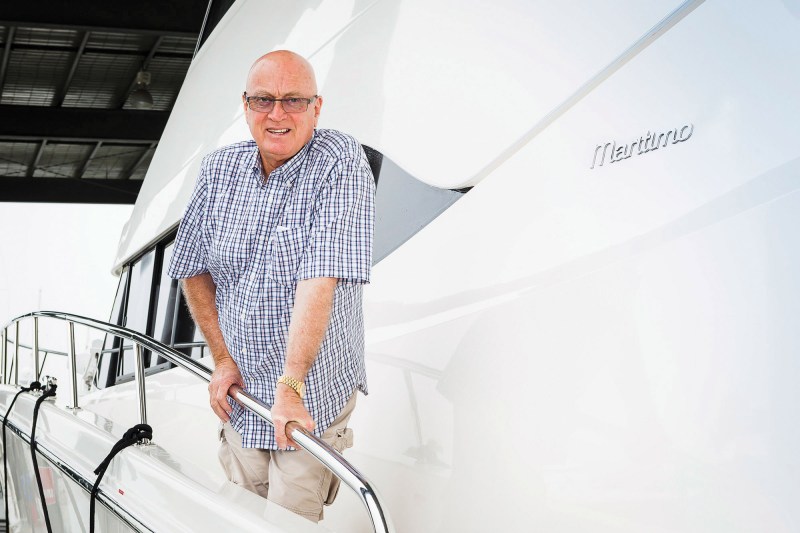
To understand the Maritimo M50, one must look back to the origins of its creator. Before establishing Maritimo in 2003, Bill Barry-Cotter was a formidable name in competitive sailing and offshore powerboat racing. In the brutal world of offshore racing, equipment failure is not merely an inconvenience—it is a dangerous liability. Hulls, engines, and electrical systems are pushed to their absolute limits across hundreds of miles of violent, unforgiving ocean.
This crucible of speed and stress forged Barry-Cotter’s foundational design philosophy: simplicity, over-engineering, and uncompromising reliability. When he transitioned from racing hulls to luxury motor yachts, he carried those lessons with him. Maritimo’s corporate mission became clear: build vessels capable of handling the harsh, rapidly changing coastal and open-ocean conditions typical of Australia, where long distances and rugged weather demand boats that can take a beating and keep moving forward.
Putting Theory to the Test: The Fort Lauderdale Run
The ultimate proof of any yacht’s construction pedigree lies in how it handles real-world sea states. Those core principles were recently put through their paces during a punishing summer test run off Fort Lauderdale, Florida.
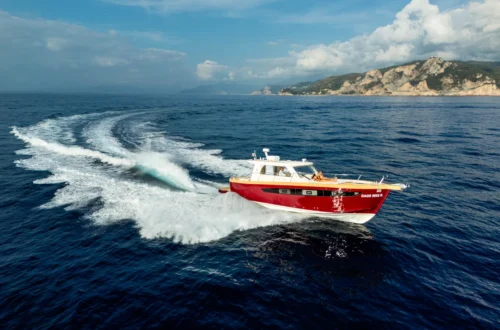
The Atlantic Ocean offered no favors, greeting the M50 with a persistent 10- to 15-knot breeze that roiled the Gulf Stream into confused 2- to 4-foot seas, topped with a stiff wind chop and occasional, much larger swells. While not treacherous enough to keep seasoned cruisers pinned to the dock, it was precisely the kind of choppy, mixed-energy environment that ruthlessly exposes structural flex, poor weight distribution, and design shortcuts. The M50 sliced through the turbulence with quiet composure, validating decades of racing-derived hull development.
Supporting Data & Technical Performance
The true measure of a long-range cruiser is found in its numbers—fuel burn, range, decibel levels, and operational flexibility. During trials in demanding Atlantic waters, the M50’s technical specifications proved formidable.
Propulsion and Efficiency
Maritimo equipped the M50 with conventional straight shafts driven by twin Volvo Penta D13 diesels, punching out 800 horsepower each. This tried-and-true mechanical layout was paired with proportional Vetus bow and stern thrusters, operated seamlessly via joystick for effortless close-quarters maneuvering.
- Top Speed: While Maritimo officially rates the M50 for a 30-knot top end, sea trials recorded a swift 28.6 knots at wide-open throttle, keeping pace with expectations even under a heavy fuel and water load.
- Fast Cruise: Throttling back to 2,120 rpm (80 percent engine load) yielded a comfortable 22-knot cruise. At this speed, the engines burned roughly 65 gallons per hour, providing a safe cruising range of 282 miles while maintaining a vital 10-percent fuel reserve.
- Displacement Passagemaking: For owners looking to stretch their legs across extended passages, dropping the speed down to 7.5 knots saw fuel burn plummet to an astonishing 6.5 gallons per hour.
- Acoustic Comfort: At displacement speeds, sound levels at the lower helm registered a remarkably hushed 63 decibels—ensuring that long, multi-day cruising legs remain relaxing and conversation-friendly.
Dimensions and Accommodations
- Length Overall (LOA): 52 feet
- Owner’s Stateroom Headroom: 6 feet, 4 inches
- Helm Electronics: Three 19-inch Garmin multifunction displays
- Capacities: Generous refrigeration and massive cabinetry provisions built for weeks—not days—away from port.
Official Responses & Design Insights
Maritimo’s product development team has consistently emphasized that the M50 was conceptualized around how modern owners actually live and cruise aboard their yachts.
"Extended cruising isn’t just about having large fuel tanks; it’s about having the physical infrastructure to remain comfortably independent for weeks at a time," notes the Maritimo design team. "From massive refrigeration capacity to provisions storage that doesn’t require constant restocking, the M50 is outfitted for true autonomy."
The vessel’s interior layout highlights a deliberate shift away from complex, failure-prone electronic actuators in favor of reliable mechanical engineering:
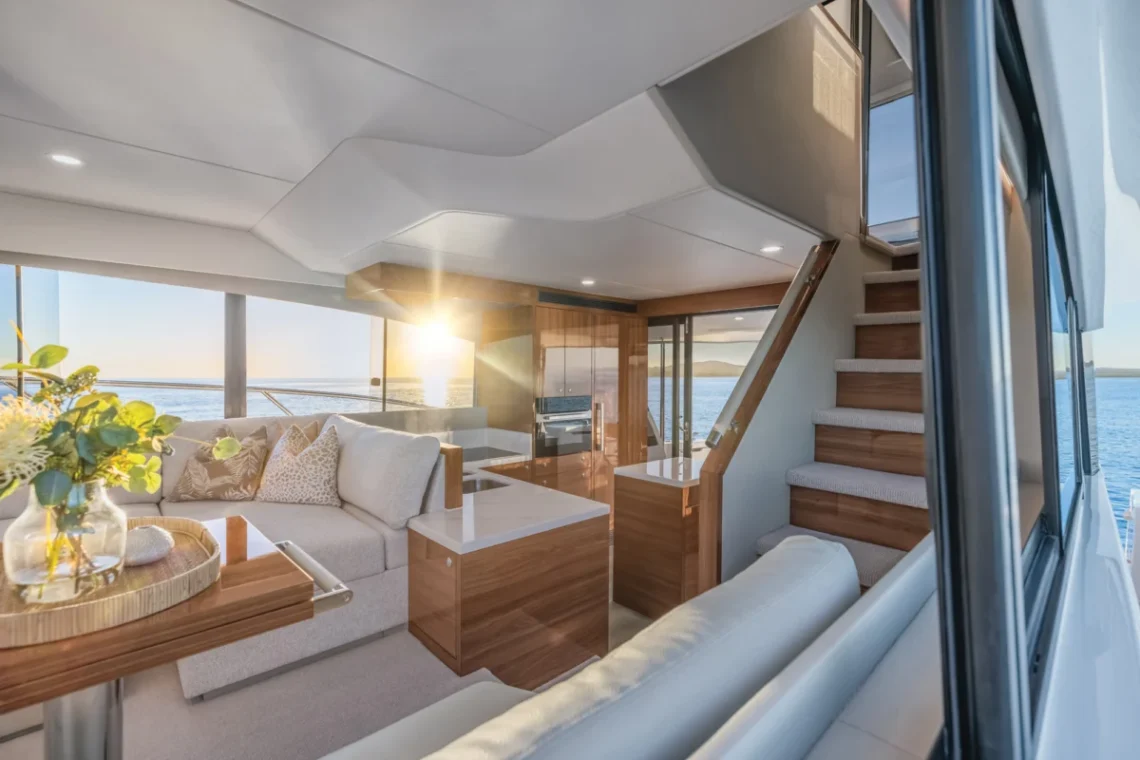
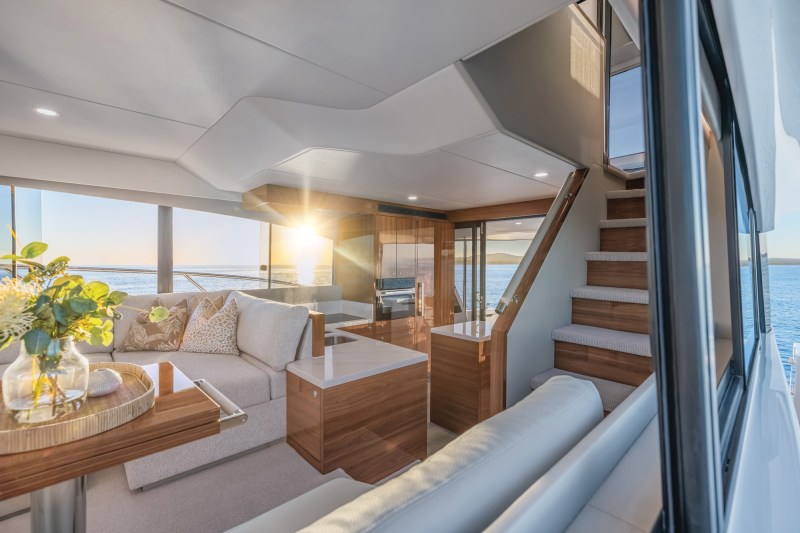
- The Galley-Aft Hub: Positioned to seamlessly connect the salon, the interior dining space, and the cockpit, the galley serves as the social heart of the yacht while making meal preparation and outdoor service effortless.
- Simplified Electronics and Hardware: Eschewing motorized TV lifts that can fail at sea, Maritimo designed a manual flip-up mechanism for the salon television. Similarly, the forward VIP stateroom features a mechanically adjustable queen berth that splits into twin beds with the simple flip of a lever—eliminating hidden switches and motors.
- Ergonomic Electrical Access: Rather than forcing operators to crouch awkwardly into deep, dark lockers, Maritimo positioned the electrical breaker panel at eye level right beside the internal staircase leading to the enclosed bridge.
- Seakeeper Ride Integration: Equipped with optional Seakeeper Ride rotary blade interceptors, the yacht makes hundreds of automatic adjustments every second. Sensors continuously monitor pitch and roll, deploying independent blades to suppress bow rise during acceleration and flatten out beam rolls while underway.
Implications for the Luxury Yacht Market
The introduction of the Maritimo M50 sends a clear signal to the 50-foot motor yacht segment. As a growing demographic of boaters seeks to transition from smaller express cruisers into vessels capable of true weekend-to-weeks-long independence, they are increasingly wary of over-complicated "smart" systems that require specialized service technicians at every port of call.
By doubling down on mechanical simplicity—relying on straight shafts, manual latches, oversized hinges, and easily accessible service points—Maritimo is carving out a distinct market niche. The M50 proves that luxury does not have to be fragile. For owners eyeing the Great Loop, island-hopping excursions, or challenging coastal passages, this 52-foot enclosed-bridge cruiser offers a compelling masterclass in how racing pedigree translates into ultimate peace of mind on the water.