
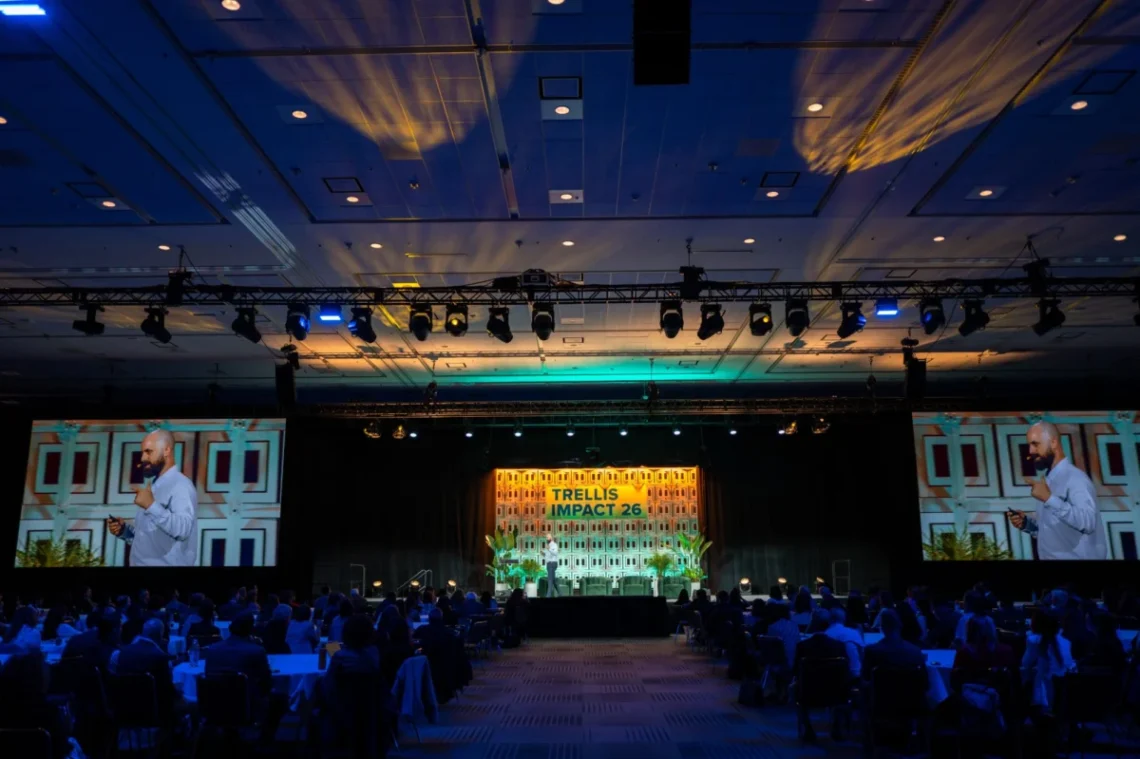
The dust has settled on Trellis Impact 26, but the echoes of the event continue to reverberate across the corporate sustainability landscape. In the weeks following the conference, a distinct shift in the collective consciousness of industry leaders has become apparent. If the last decade of corporate environmental, social, and governance (ESG) strategy was defined by the lofty rhetoric of "net-zero" commitments and the architecture of carbon-neutral roadmaps, the current era is defined by the grit of the ground game.
Analysis of post-event discourse—spanning hundreds of LinkedIn reflections, industry white papers, and executive commentary—reveals a decisive pivot. The buzzwords of yesteryear have been supplanted by a pragmatic, operational vocabulary: implementation, infrastructure, resilience, and integration. For sustainability practitioners, the conversation has moved beyond the "why" of environmental stewardship and firmly into the "how" of operational reality.
The Shift: Moving Beyond the Manifesto
For years, the sustainability sector was dominated by the "pledge phase." Companies competed to publish the most ambitious climate targets, often looking toward 2030 or 2050 horizons. While these frameworks were necessary to galvanize stakeholders and set long-term directions, they often lacked the tactical depth required for daily business operations.
Trellis Impact 26 served as a crucible for this transition. Attendees consistently noted that the boardroom appetite for abstract climate goals has diminished, replaced by a voracious demand for scalable, cost-effective, and resilient execution. As one attendee aptly summarized, "We’re no longer debating whether circularity matters. We’re wrestling with the logistics of how to make it work in a complex, globalized supply chain."
This transition is not merely a change in tone; it is a structural realignment. Whether the focus is on AI deployment, supply chain decarbonization, or circular economy initiatives, the primary challenge is no longer defining the objective—it is reconciling those objectives with the hard constraints of cost, regulation, and market volatility.
AI as an Infrastructure Challenge: A New Industrial Ecosystem
Perhaps the most significant catalyst for this transition is the meteoric rise of Artificial Intelligence. Previously viewed through the lens of software and digital transformation, AI is now being framed by sustainability leaders as a fundamental infrastructure challenge.
The integration of AI into corporate operations is testing the physical limits of our power grids, water supplies, and cooling systems. The enthusiasm for AI-driven efficiency is currently being tempered by the sobering reality of its physical footprint. As one executive noted during the conference, "The scale and speed of AI deployment are creating a new industrial ecosystem, with constraints in power, materials, and talent driving innovation rather than just software development."
This recognition marks a departure from treating "climate" and "technology" as separate silos. Today’s leaders view the grid capacity, the permitting of data centers, and the energy intensity of cooling technologies as inextricable parts of the same sustainability equation. Building the physical backbone for a digital future has become the most urgent sustainability project of the decade.
The New Social Contract: Why Social License is Paramount
As AI infrastructure expands into local communities, the "S" in ESG has taken on a renewed, practical urgency. Technical expertise is no longer the sole arbiter of success. Infrastructure projects—whether data centers, wind farms, or advanced manufacturing plants—are increasingly vulnerable to local opposition if they fail to secure a "social license to operate."
Data from post-event reflections suggest that community engagement is no longer a peripheral corporate social responsibility (CSR) task; it is a core business risk. Attendees emphasized that local trust, earned through early engagement and transparent dialogue, is becoming as critical as power, water, and permitting.
In an era of skepticism, the ability to navigate local concerns and prioritize human-to-human relationships is emerging as a competitive differentiator. Projects that are technically sound but socially disconnected are increasingly stalling, proving that in the "implementation era," you cannot build the future without the permission of the present.
Data as the New Currency of Credibility
The shift toward implementation has necessitated a move away from vague promises toward granular, defensible data. "Show me the data" has become the mantra for stakeholders—including investors, regulators, and consumers—who are increasingly weary of "greenwashing" allegations.
In the past, a commitment was the headline. Today, the headline is the audit trail. Attendees at Trellis Impact 26 were unified in the belief that technology does not replace the need for human judgment or verifiable evidence. The demand for transparency is forcing companies to invest in more robust data collection systems, moving from manual, sporadic reporting to real-time, automated, and audited metrics.
As one participant noted, "Promises are cheap. Data is the new credibility." This evolution toward empirical accountability is the bedrock of the current era. It demands that companies back their environmental claims with the same level of rigorous financial reporting that investors expect from a balance sheet.
The Power of the "Team Sport": Scaling through Collaboration
The complexity of current sustainability challenges—ranging from scope 3 emissions to circular material flows—has rendered the "go-it-alone" approach obsolete. Cross-sector collaboration is no longer a "nice-to-have" partnership; it is a fundamental requirement for operational success.
The discourse post-Trellis emphasized the necessity of bridging the gap between utilities, technology providers, policy makers, and end-users. The circular economy, in particular, is frequently described as a "team sport," where the success of one company’s waste-reduction strategy is entirely dependent on the infrastructure provided by a partner in the supply chain.
Effective organizations are now those that can navigate these interconnected systems, forming long-term alliances that extend far beyond traditional vendor-client relationships. The era of implementation requires a shift from competitive posturing to collaborative problem-solving.
Resilience: The New Business Case
Perhaps the most profound takeaway from Trellis Impact 26 is the convergence of sustainability with business resilience. Sustainability is no longer a standalone department or an ethical pursuit; it is being integrated into the core of operational risk management.
Mitigation (reducing emissions) and adaptation (preparing for climate impacts) are increasingly seen as two sides of the same coin. A company that invests in renewable energy to lower its carbon footprint is also securing its own energy resilience against grid instability. A company that optimizes water usage is also insulating its operations from the physical risks of drought.
By reframing sustainability as a resilience issue, leaders are finding it easier to secure executive buy-in. Resilience provides the "business case" that bridges the gap between environmental stewardship and the fiduciary responsibility to protect long-term value. It moves the conversation from "why we should care about the planet" to "how we ensure our business survives and thrives in a changing climate."
Implications for the Next Decade
The transition from the "ambition era" to the "implementation era" is a maturation of the sustainability field. It signals that corporate leaders have moved past the honeymoon phase of goal-setting and into the challenging work of systemic change.
For the C-suite, the implications are clear:
- Prioritize Operational Literacy: Sustainability leaders must possess a deep understanding of operations, logistics, and engineering, not just policy and PR.
- Invest in Infrastructure: The future of corporate sustainability will be won or lost in the grid, the data center, and the factory floor.
- Cultivate Trust: Local community relations must be elevated to a strategic imperative.
- Mandate Data Integrity: If it cannot be measured, it cannot be managed. The move toward rigorous, evidence-based reporting is irreversible.
- Embrace Interdependence: Success in the next decade will be predicated on a company’s ability to lead and participate in collaborative ecosystems.
The last decade of corporate sustainability was defined by the ambition of what could be. The next decade will be defined by the reality of what we deliver. Trellis Impact 26 made it clear: the era of talking about sustainability has ended; the era of building it has begun. The challenge ahead is significant, but the prevailing sentiment among today’s leaders is not one of doubt, but of pragmatic, calculated optimism. The work is harder, the stakes are higher, and the solutions are more complex—but for the first time, we are truly in the trenches of implementation.