As the automotive landscape shifts toward electrification and highly versatile utility designs, manufacturers are constantly looking for innovative ways to maximize interior cabin space and exterior cargo capacity. Nissan appears to be eyeing a clever blast from the past to secure a major competitive advantage in the highly contested midsize truck segment.
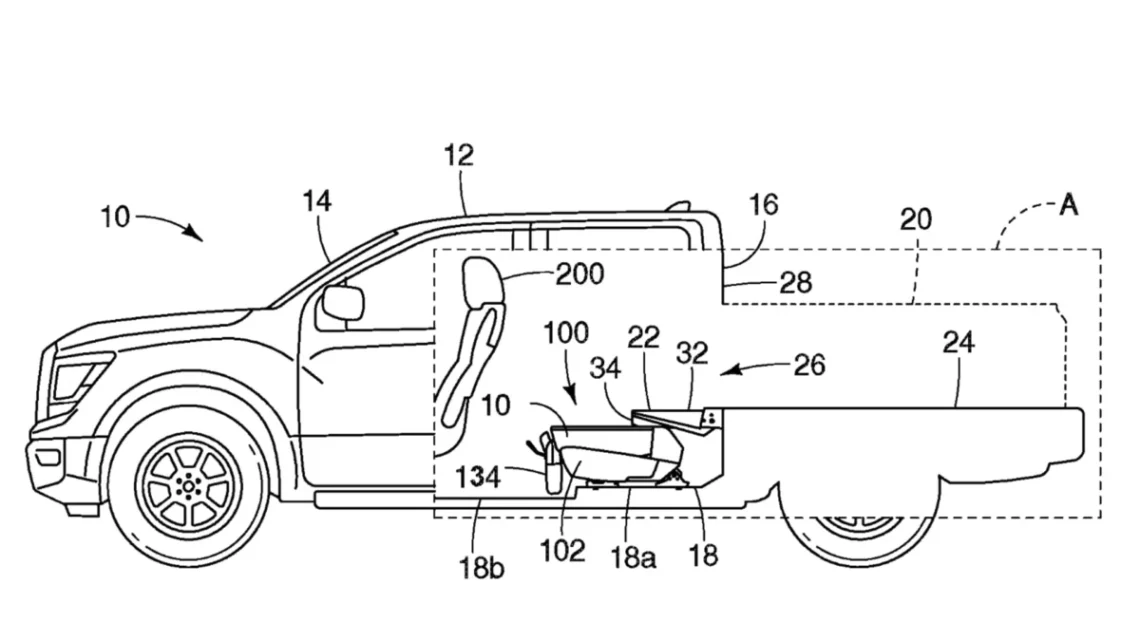
According to a recently uncovered patent filing with the United States Patent and Trademark Office (USPTO), the next-generation Nissan Frontier—slated to arrive by the end of the decade—might feature a built-in "midgate." This transformative passthrough system connects the truck bed directly to the cabin, offering unprecedented storage flexibility for oversized gear, long lumber, and outdoor adventure equipment.
Main Facts: Unlocking the Next-Generation Frontier
The details of Nissan’s inventive engineering approach come straight from patent documentation (US Patent Application 20260274351). While the current-generation Frontier continues to rely on a traditional, fixed cab-and-bed layout, planning for the truck’s next major lifecycle iteration points toward a clean-sheet redesign. Industry insiders expect the upcoming Frontier to transition to a brand-new vehicle platform equipped with an electrified powertrain, aligning with global industry trends and stringent emissions regulations.
However, the real head-turner in the recent patent filing is the integrated midgate mechanism. The filing outlines a system where the rear passenger seatbacks fold completely flat, allowing a specialized partition to deploy seamlessly. Once opened, this creates a continuous, unobstructed flat floor space that bridges the gap between the interior cabin and the exterior truck bed.
Mechanically, the design is a single-piece assembly. This means that to utilize the passthrough feature, both rear seats must be folded down simultaneously. While the patent text—initially brought to light by automotive publication CarBuzz—indicates that the underlying engineering could theoretically be adapted for various vehicle body styles beyond traditional trucks, its application in a midsize pickup represents an intriguing paradigm shift.
Chronology: The Evolution of the Automotive Midgate
While Nissan’s potential adoption of a midgate feels like a modern stroke of genius, the feature has a storied, albeit rare, history within the North American automotive sector. To understand where Nissan’s new design fits, it helps to look back at how the concept evolved over the last three decades:
- Late 1990s – Early 2000s: The midgate concept was heavily explored by designers as automakers searched for ways to combine the comfortable ride of an SUV with the utility of an open-bed pickup truck. Concept cars of this era frequently played with flexible walls.
- 2002: General Motors pioneered the mainstreaming of the midgate by introducing it on the Chevrolet Avalanche. The Avalanche utilized a removable rear window and folding midgate to switch between a short-bed crew cab and a long-bed cargo hauler.
- Mid-2000s: Buoyed by the initial success of the Avalanche, GM integrated similar midgate functionalities into other luxury and utility models, most notably the Cadillac Escalade EXT and the Hummer H2 SUT.
- 2010s: As consumer preferences shifted and vehicle generations turned over, models utilizing midgates were slowly phased out, largely due to structural rigidity challenges, sealing issues against weather elements, and shifting market demand. For over a decade, the midgate virtually disappeared from new vehicle showrooms.
- The Electric Era (Present Day): The midgate has experienced a renaissance, championed almost exclusively by GM on its latest heavy-hitting electric truck platforms, such as the Chevrolet Silverado EV and GMC Sierra EV.
- Late 2020s and Beyond: Nissan’s recent patent filing suggests that internal combustion engine (ICE) or electrified midsize trucks could soon adopt the technology, potentially bringing the feature down to more accessible, mass-market segments.
Supporting Data: The Current Midsize Truck Landscape and Market Rarity
To truly appreciate the significance of Nissan’s patent, one must examine the current state of the midsize truck market. Today, if a consumer walks onto a dealership lot searching for a midsize truck equipped with a factory midgate, they will walk away empty-handed. The feature simply does not exist in the segment.
+-------------------------------------------------------------------------+
|                  MIDSIZE TRUCK MARKET MIDGATE AVAILABILITY              |
+--------------------------+---------------------+------------------------+
| Manufacturer / Model     | Segment             | Midgate Available?     |
+--------------------------+---------------------+------------------------+
| Toyota Tacoma            | Midsize             | No                     |
| Ford Ranger              | Midsize             | No                     |
| Chevrolet Colorado       | Midsize             | No                     |
| GMC Canyon               | Midsize             | No                     |
| Jeep Gladiator           | Midsize             | No                     |
| Nissan Frontier (Current)| Midsize             | No                     |
| Nissan Frontier (Next-Gen)| Midsize (Future)   | Patent Pending (Maybe) |
+--------------------------+---------------------+------------------------+
As the data illustrates, the midgate is currently exclusive to full-size, heavy-duty electric trucks like the Chevrolet Silverado EV and GMC Sierra EV. By introducing a midgate to the midsize Frontier, Nissan would instantly carve out a unique selling proposition. Midsize trucks are inherently constrained by their physical footprint; owners frequently struggle with hauling items that exceed standard bed lengths—such as kayaks, surfboards, mountain bikes, or building materials—without leaving the tailgate down.
A midgate solves this problem without forcing owners to upgrade to a massive full-size truck, thereby striking a delicate balance between compact maneuverability and exceptional cargo flexibility.
Official Responses and Industry Outlook
Automakers patent hundreds of technological innovations every year, and the vast majority of them never make it past the digital drawing board. Nissan has not officially confirmed whether the midgate detailed in patent application 20260274351 is locked in for production on the upcoming Frontier architecture.
However, industry analysts note that filing exhaustive, highly detailed functional schematics—such as the single-piece folding seat mechanisms and precise partition seals outlined in Nissan’s paperwork—often points to a higher level of internal feasibility testing than a simple speculative design concept.
When reached for comment on future product timelines, Nissan representatives emphasized the brand’s ongoing commitment to listening to truck owners. "Versatility, durability, and value remain at the core of the Frontier’s identity," a corporate spokesperson noted. "As we look toward the future of our truck lineup, we are continuously evaluating engineering solutions that enhance customer utility without compromising safety or comfort."
Implications: What a Midgate Means for the Future of Nissan
Should Nissan pull the trigger and bring this patent to life, the implications for the midsize truck market could be profound.
1. Disrupting the Status Quo
Competitors like Toyota, Ford, and General Motors have dominated headlines with rugged off-road trims, hybrid powertrains, and clever onboard technology. However, none have managed to crack the code for interior-to-bed pass-throughs in the midsize category. Introducing a functional midgate would give Nissan an immediate marketing talking point, appealing directly to DIYers, campers, and outdoor lifestyle enthusiasts.
2. Engineering and Manufacturing Hurdles
Integrating a midgate is no small feat. Engineers must ensure that removing or folding a major structural bulkhead between the cabin and bed does not compromise the torsional rigidity of the vehicle frame. Furthermore, acoustic dampening, cabin heating and cooling efficiency, and weatherproofing against rain and dust intrusion present significant design challenges. If Nissan’s patent successfully addresses these engineering barriers, it could establish a new blueprint for how manufacturers approach cabin-bed integration.
3. The Verdict from Industry Experts
From the perspective of automotive analysts, Nissan has a golden opportunity to punch above its weight class. In a segment where buyers are notoriously value-conscious and hyper-focused on getting the absolute most utility out of their hard-earned dollar, a midgate transforms the Frontier from a conventional workhorse into a versatile Swiss Army knife of trucks.
Whether or not the feature ultimately transitions from a USPTO filing to a showroom-ready reality remains to be seen. But for fans of the Nissan Frontier and midsize trucks in general, the prospect of a midgate revival proves that innovation in the pickup truck space is far from finished.