
By Maritime Editorial Desk
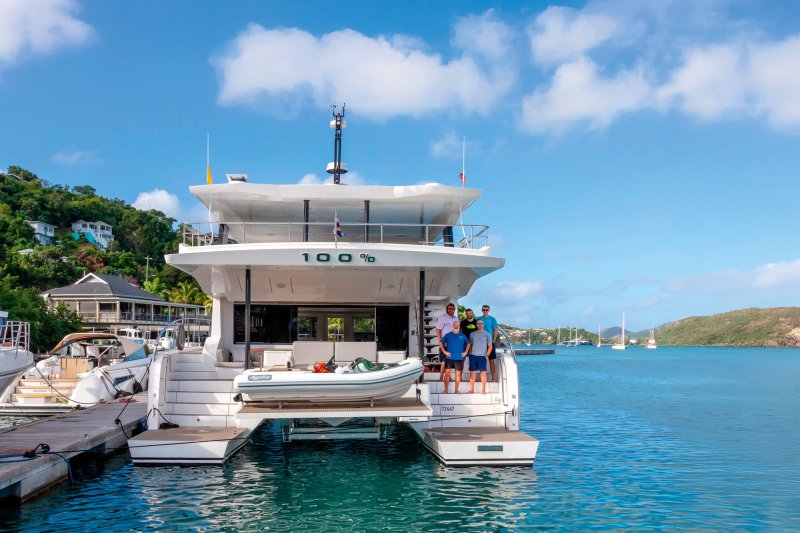
The marine industry has long debated the practical limits of sustainable propulsion, particularly when scaling up to ocean-crossing vessels. Recently, Silent Yachts provided a definitive answer. Their solar-electric catamaran, the Silent 62, successfully completed a five-week transatlantic crossing from Europe to the Caribbean. Spending more than 70 percent of its voyage operating exclusively on battery power and consuming fewer than 1,500 gallons of fossil fuel, the journey generated an unprecedented archive of performance data.
For Silent Yachts Chairman Steve Bell, who joined the owner and a two-person crew for the expedition, the journey was far more than a bucket-list adventure. It was a rigorous empirical test designed to evaluate how far solar-electric marine technology has evolved, measure real-world energy consumption, and chart the future of eco-conscious blue-water cruising.
Main Facts: The Numbers Behind the Crossing
The successful passage of the Silent 62 underscores a massive leap forward in alternative-energy propulsion. Operating in challenging offshore conditions, the catamaran proved that sustainable yachting is no longer confined to coastal day-tripping or sheltered island-hopping.

- Total Duration: Five weeks (completed during November and December).
- Fuel Consumption: Less than 1,500 gallons of total diesel used.
- Battery Propulsion Uptime: Over 70 percent of the entire trans-Atlantic distance was navigated silently on battery power alone.
- Daily Energy Consumption: Ranged between 350 and 600 kWh, directly tied to cruising speed and vessel load.
- Solar Array: Equipped with 42 high-efficiency solar panels.
- Construction Lead Time: Approximately 12 months for a semi-custom build, with orders currently booked through early next year.
While critics often question why a yacht of this size cannot operate entirely without a backup generator, Bell offers a pragmatic explanation rooted in basic physics. "We have 42 solar panels on our yacht. We would have to tow over 200 to do solar alone," Bell notes. Because nearly 50 percent of a transatlantic crossing occurs in absolute darkness, and because solar efficiency is constrained by the sun’s angle—particularly during winter months—combining solar generation with a backup marine generator remains a necessary engineering reality.
Chronology: The Transatlantic Route and Leg-by-Leg Breakdown
To take advantage of favorable seasonal weather while steering clear of the Atlantic hurricane belt, the crew timed their departure for late autumn. This window exposes mariners to the Northern Equatorial Current, which runs from Cape Verde toward the Caribbean, providing a helpful one-knot push alongside steady trade winds. However, it also presents a lower winter sun angle, reducing peak solar absorption.
The voyage was broken down into strategic legs, each presenting unique meteorological challenges and varying energy efficiencies:
Leg 1: Gibraltar to Morocco (Outrunning Weather)
- Distance: 475 nautical miles
- Average Speed: 7.1 knots
- Propulsion Split: 57 percent battery, 43 percent generator
- Objective: The initial leg required a higher average speed to outrun adverse weather systems, resulting in heavier generator utilization.
Leg 2: Morocco to the Canary Islands (Headwinds and Swell)
- Distance: 253 nautical miles
- Average Speed: 6.1 knots
- Propulsion Split: 65 percent battery, 35 percent generator
- Objective: The crew encountered strong headwinds and rolling swells, testing the catamaran’s structural resilience and energy management systems against heavy seas.
Leg 3: Cape Verde to Antigua (Riding the Currents)
- Distance: 2,110 nautical miles
- Average Speed: 6.1 knots
- Propulsion Split: 77 percent battery, 23 percent generator
- Objective: Spanning the bulk of the Atlantic, this marathon leg benefited from 15 knots of stern wind and equatorial currents, allowing the vessel to run predominantly on silent, harvested solar energy.
Supporting Data: Comparative Progress and Real-World Reliability
To truly gauge the technological advancement of the Silent 62, Bell looked backward before looking forward. Four years prior, a smaller Solar Wave 64 from the same shipyard completed a similar transatlantic crossing. By comparing notes with the captain of that historical voyage, Bell identified a dramatic improvement in efficiency.

"I talked to that captain," Bell recalls. "It used double the fuel. We’ve got more solar panels, so that’s just an improvement in the efficiency of the technology."
Despite the rigorous nature of a five-week offshore passage—where marine equipment is notorious for failing—the Silent 62’s crossing was remarkably uneventful. Rather than dealing with catastrophic mechanical breakdowns, the crew experienced minor software glitches typical of modern, heavily digitized vessels.
"It’s a software-driven vessel. When your computer doesn’t work, you turn it off and turn it back on. We did that a couple of times," Bell explains. "And we had to change a generator impeller. We had enough spares on board to build another yacht. We ended up not needing them."
The data harvested during the trip revealed valuable insights into human endurance and energy management. While slowing the yacht down by 1.5 knots could have extended the trip by another week and reduced fuel burn even further, crew fatigue and the psychological toll of long-term isolation ("stir-craziness") make five weeks an optimal psychological window for ocean passages.

Official Perspectives: Chairman Steve Bell on the Future of Silent Yachts
As Chairman, Steve Bell views the crossing not just as a marketing triumph, but as a massive research and development asset. The sheer volume of telemetry data recorded during the five-week voyage has already sparked numerous innovations for future builds.
"Some of the people who buy our yachts are geeky," Bell says with a smile. "They want to see all the data, know exactly what they’ve used, what they will use. The software development is huge in what we’re trying to do. We’re thinking about maintenance on a daily basis, where it logs like a full-service history. My brain was spinning about how to make all of that better."
Bell emphasizes that while ocean crossings capture headlines, they do not represent the everyday use case for most Silent 62 owners. For typical cruising—such as a multi-day island-hopping itinerary through the Bahamas from the Exumas up to New Providence, covering 30 miles a day over three to four hours of cruising—the yacht operates entirely off-grid.
"If you have no job and you have the luxury where you can just go cruising, then you manage it like an off-grid house," Bell explains. "It’s a huge opportunity for people who want to cruise efficiently."
Furthermore, Bell envisions a future where eco-conscious explorers can tackle true global circumnavigations, drawing parallels to traditional blue-water institutions like the Oyster World Rally or rugged expedition trawlers like Nordhavn.
"I’d love to go through Panama, go down to the Galapagos and over to Fiji—you could do that," Bell says. "Passagemaking and ocean cruising is a different breed, and it can absolutely be done. We can design the 62 with bigger fuel tanks, add a second fuel tank or another generator. This is a very different yacht that’s capable of doing expeditions."
Implications: What This Means for the Future of Sustainable Maritime Travel
The success of the Silent 62’s transatlantic journey carries profound implications for the global yachting community:
- Shifting Perceptions of Electric Mobility: For decades, electric and hybrid propulsion in large yachts was dismissed as a coastal novelty. By demonstrating a 70%+ battery-driven transatlantic crossing with minimal fossil fuel consumption, Silent Yachts has fundamentally shifted the benchmark for what alternative-energy vessels can achieve.
- The Evolution of Smart Yachting: The integration of advanced data logging and daily energy consumption monitoring points toward a future where luxury yachts operate with the predictive maintenance and user-friendly interface of modern electric vehicles.
- Customization Meets Sustainability: With a 12-month build cycle that accommodates highly bespoke interior layouts—ranging from multi-cabin configurations to specialized lower-deck galleys—owners no longer have to compromise luxury or layout flexibility to embrace sustainable technology.
- Redefining Expedition Cruising: Proving that the Silent 62 can handle 15- to 16-foot waves and sustained offshore winds opens up new horizons for eco-tourists and adventure-seekers who want to explore remote regions of the globe without leaving a heavy carbon footprint.
As the shipyard’s order books remain full well into the coming year, the Silent 62 stands as living proof that the future of yachting is not only electric—it is ready for the open ocean.