
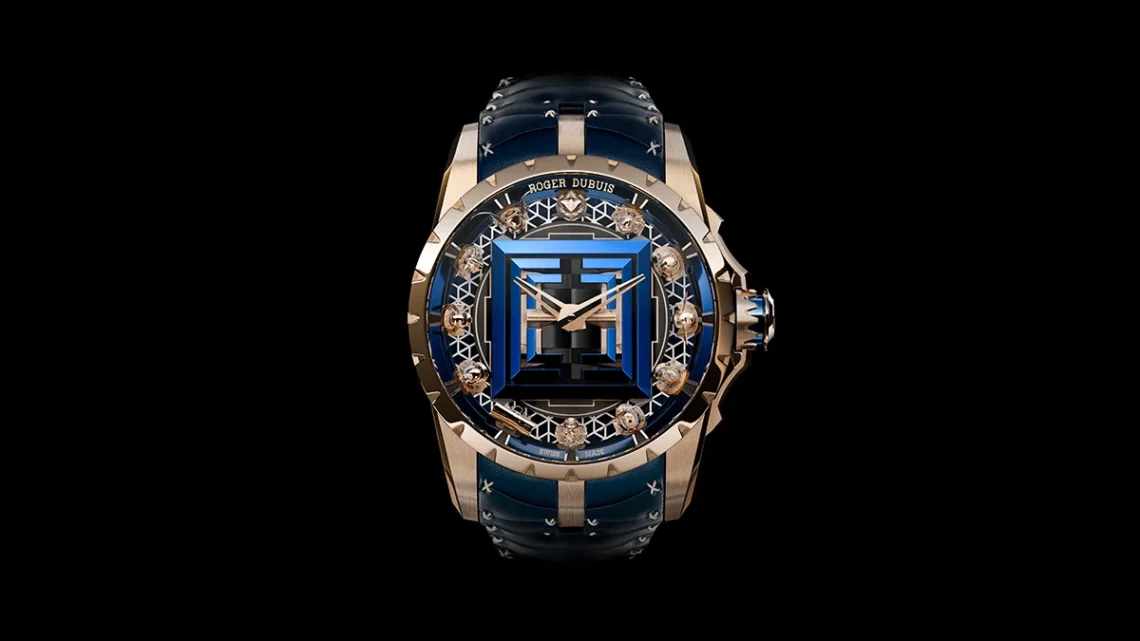
In the rarefied world of haute horlogerie, the line between a timekeeping instrument and a sculptural masterpiece is often blurred. Yet, rarely does a manufacture bridge the gap between historical narrative and technical mechanical prowess with such audacity as Roger Dubuis. With the unveiling of the limited-edition Excalibur Kabuto Legacy, the Swiss maison has transcended traditional watchmaking, inviting collectors on a visceral journey back to 17th-century Japan—a transformative era defined by the rise of the samurai, the unification of a fractured nation, and the aesthetic intensity of the Edo period.
A Convergence of Eras: The Core Concept
The Excalibur Kabuto Legacy is not merely a watch; it is a wearable archive. Measuring a bold 45 mm, the timepiece serves as a canvas for the métiers d’art that Roger Dubuis has mastered. The watch centers its narrative on the bushō—the samurai commanders who, through a delicate balance of iron-fisted martial authority and sophisticated cultural patronage, steered Japan away from decades of civil war toward a lasting peace under the Tokugawa shogunate.
At each hour marker, the watch features a meticulously hand-sculpted samurai commander. These figures are not mere ornamentation; they are micro-engineering marvels. Each helmet—the kabuto—is crafted from 18-karat pink gold. The level of detail required for these components is staggering; artisans dedicate two to three full days to the creation of a single helmet. This is an exercise in extreme patience, reflecting the same discipline demanded of the samurai themselves.
Chronology: The Historical Architecture of the Dial
To understand the Excalibur Kabuto Legacy, one must understand the history it honors. The 17th century in Japan was a crucible of transformation. The country had been fractured by the ambitions of rival warlords, but through the unification efforts of three pivotal leaders—Oda Nobunaga, Toyotomi Hideyoshi, and eventually Tokugawa Ieyasu—a new order emerged.

Roger Dubuis has anchored this history on the dial:
- 12 o’clock: The position is occupied by the legendary Tokugawa Ieyasu, the architect of the Tokugawa Shogunate. His kabuto is adorned with a fern motif, a symbol of longevity and the endurance of his political legacy.
- 1 o’clock: Representing the pinnacle of loyalty is Honda Tadakatsu. His helmet is distinguished by iconic deer antlers, which in Japanese tradition serve as a symbol of divine protection and spiritual guidance on the battlefield.
- The Statesman’s Wisdom: Sakai Tadatsugu, honored for his strategic brilliance, is represented by a kabuto featuring a sword—a metaphor for the ability to "cut away" ignorance and evil, ensuring righteousness in governance.
- The Martial Virtue: Sakakibara Yasumasa, renowned for his sound judgment, completes this cohort. His helmet, also adorned with swords, serves as a poignant reminder of the samurai’s soul: the inseparable bond between the warrior and his blade.
The center of the dial offers an abstract, layered reinterpretation of Edo Castle, the seat of the Tokugawa power for over 260 years. Coated in a deep, lustrous blue—an homage to the indigo dyes historically favored by the samurai class for their armor lacquering—the dial creates a sense of depth that draws the eye toward the heart of the movement.
Supporting Data: The Engine Beneath the Armor
While the aesthetics capture the spirit of the Edo period, the mechanical heart of the Excalibur Kabuto Legacy is quintessentially Swiss. The watch is powered by the RD821 automatic caliber. This movement is a triumph of space management; its slim profile allowed Roger Dubuis’s designers the vertical clearance necessary to accommodate the intricate, raised sculptural elements on the dial without compromising the watch’s structural integrity.
The technical specifications are equally impressive:

- Power Reserve: 60 hours, ensuring the timepiece remains operational even after a weekend of rest.
- Frequency: 4 Hz (28,800 vibrations per hour), a standard for precision.
- Finishing: The movement features 14 distinct hand-finishing techniques. This rigorous attention to detail has earned the watch the Poinçon de Genève (Geneva Seal), one of the most demanding certifications in the industry, which guarantees that every component—visible or not—has been finished to the highest possible standard of quality.
The case, rendered in warm pink gold, is complemented by a blue calfskin leather strap. In a final nod to the inspiration, the strap features stitched tiles designed to mimic the overlapping plates of traditional samurai armor, effectively wrapping the wrist in the same protective aesthetic as the warriors of old.
Expert Insight: Bridging Cultures
The accuracy of the Excalibur Kabuto Legacy was not left to chance. Roger Dubuis enlisted the expertise of Frederik Cryns, a renowned professor of Japanese history and a consultant for the critically acclaimed series Shōgun.
"Samurai culture produced some of the most extraordinary wearable art in human history," Professor Cryns stated in a press release regarding the collaboration. "That this tradition of master craftsmanship now meets the art of haute horlogerie feels entirely fitting. Both disciplines demand the same uncompromising pursuit of excellence, whether it is the folding of a blade or the calibration of a balance spring."
This consultation ensures that the watch is not merely "Japanese-themed," but a historically respectful homage that correctly identifies the symbolism of the kamon (crests) laser-engraved on the caseback. These crests, including the water plantain and the genko wheel, are rendered on a blue-coated pink-gold ring, providing a hidden layer of detail for the wearer to discover.

Implications: A Limited Legacy
The release of the Excalibur Kabuto Legacy underscores a shift in the luxury watch market toward "narrative-driven scarcity." With only 28 pieces being produced globally, the watch is destined to become a "holy grail" for collectors who prioritize cultural heritage alongside mechanical rarity.
The implications for Roger Dubuis are significant. By moving beyond traditional luxury tropes and engaging with deep-seated historical narratives, the manufacture is positioning itself as a storyteller of global significance. This watch is not competing for the attention of the casual luxury buyer; it is speaking directly to the connoisseur—the individual who understands that a watch is a repository of values, history, and art.
As we look at the intersection of the Edo period’s philosophy and 21st-century micro-engineering, the Excalibur Kabuto Legacy stands as a testament to the fact that while technology changes, the human desire to capture beauty, honor, and time in a physical object remains constant. For the 28 individuals who will eventually secure one of these pieces, they are not simply acquiring a timekeeper; they are inheriting a piece of a legacy that spans centuries, continents, and the very definition of what it means to be a master of one’s craft.
In a world of mass production, the Excalibur Kabuto Legacy serves as a sharp, well-crafted reminder that when excellence meets tradition, the result is truly timeless.