The history of the internal combustion engine is punctuated by moments of genuine mechanical transcendence. From the V-12s of Maranello to the flat-sixes of Stuttgart, certain architectures have defined the soul of the automotive industry. Yet, perhaps no engine in the 21st century has commanded as much awe—or represented as much engineering audacity—as Bugatti’s W-16. This week, in a somber yet celebratory ceremony at the marque’s historic Molsheim atelier, that era officially reached its conclusion.
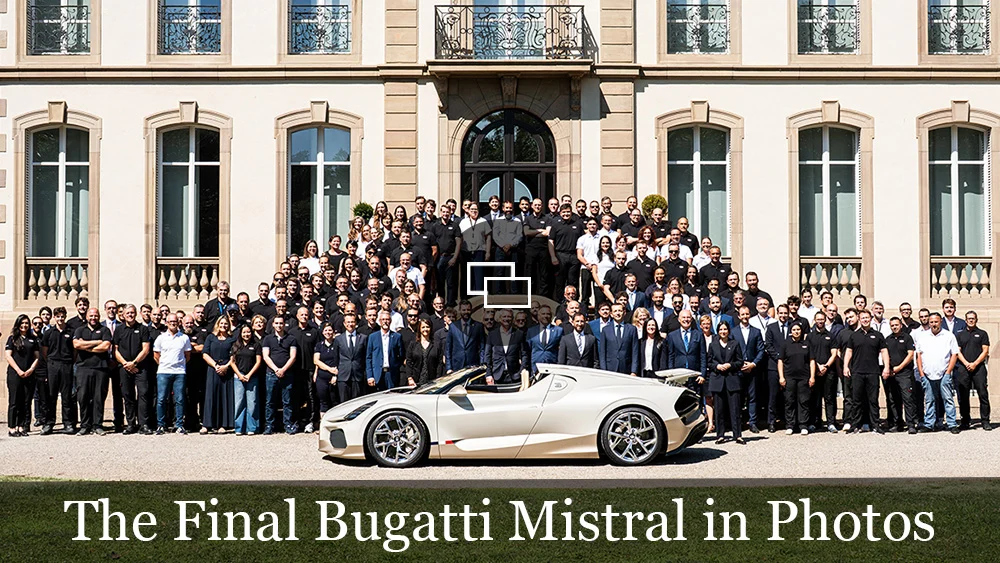
Bugatti has unveiled the 99th and final unit of the Mistral, a roadster that stands as the ultimate testament to the W-16’s quarter-century reign. Aptly titled "The Last of Its Kind," this $5 million masterpiece marks the final series-production vehicle to emerge from the French hypercar manufacturer’s gates featuring the legendary 8.0-liter quad-turbocharged power plant.
A Legacy Forged in Molsheim: The W-16 Chronology
To understand the weight of this departure, one must look back to the late 1990s. When the Volkswagen Group acquired the rights to the Bugatti name in 1998, they faced a gargantuan challenge: how to resurrect a brand synonymous with opulence and record-shattering performance. The answer arrived in the form of the W-16—a complex, four-bank engine configuration that essentially fused two V-8 blocks into a single, cohesive unit.
The Dawn of the Veyron (2005)
The W-16 debuted in the Bugatti Veyron, a car that effectively invented the modern hypercar segment. With its 1,001 horsepower, the Veyron shattered the 250-mph barrier, making the impossible, production-ready. It was a statement of intent: Bugatti was not merely building cars; it was building monuments to physics.

The Refinement of the Chiron (2016)
In 2016, the torch was passed to the Chiron. The W-16 was evolved, refined, and pushed to even greater heights. With the introduction of sequential turbocharging, the engine’s power output climbed steadily, eventually pushing the Chiron Super Sport past the 300-mph mark in testing, cementing its status as a pinnacle of internal combustion development.
The Grand Finale: The Mistral (2024–2026)
The Mistral, the final chapter of this lineage, took the W-16 to its open-top conclusion. It was designed not just as a swan song, but as the fastest open-top production car in history. By hitting a verified 282 mph, the Mistral ensured that the W-16 would exit the stage on its own terms: at the top of the performance food chain.
Supporting Data: Engineering the Impossible
The "Last of Its Kind" Mistral is more than a collector’s item; it is a mechanical relic. The 8.0-liter engine housed within its carbon-fiber chassis produces an earth-shattering 1,578 horsepower and 1,180 ft-lbs of torque. To put these figures into perspective, the acceleration from 0 to 62 mph is achieved in a blistering 2.4 seconds.
The exterior aesthetic of this final unit is finished in a bespoke two-tone "Pearl and Sparkle" theme, a visual representation of the transition from the old world to the new. Inside, the cabin is draped in Magnolia and Grey Carbon Matt leather, with the signature of Ettore Bugatti painstakingly stitched into the headrests—a nod to the founder’s original vision, now realized through the lens of modern hyper-engineering.

The Winds of Change: From VW to Rimac
The retirement of the W-16 is not merely an engineering decision; it is a structural one. The automotive landscape is shifting, and Bugatti is not immune to the gravitational pull of electrification.
Earlier this year, the industry watched as Porsche sold its 45 percent stake in Bugatti Rimac. This divestment officially ended the Volkswagen Group’s direct oversight of the brand, signaling a new, independent chapter under the leadership of Mate Rimac. The partnership with Rimac—a company synonymous with electric performance—has accelerated the transition toward hybridization.
The successor to the W-16 era, the Tourbillon, has already been revealed. It represents a radical departure from the "W" configuration, opting instead for a three-foot-long, naturally aspirated V-16 engine paired with a trio of high-torque electric motors. This hybrid powertrain is designed to offer the visceral, high-revving experience of the past while embracing the instantaneous torque and efficiency of the electric future.
Official Perspectives: Looking Toward the Horizon
While the company has not released a singular "statement" regarding the end of the W-16, the actions of the leadership at Molsheim speak volumes. The transition is being framed as an evolution rather than a loss.

"The W-16 engine allowed us to define the modern hypercar," an internal spokesperson noted during the unveiling. "But our duty to the brand’s legacy is to remain at the absolute vanguard of technology. The Tourbillon is the next logical step in a story that has always been about pushing boundaries."
Despite the transition to hybrid power, the company remains acutely aware of the "collector’s itch." For those who refuse to let the W-16 fade entirely, Bugatti has introduced Programme Solitaire. This bespoke, one-off, and few-off division allows the world’s most elite clients to commission vehicles that still utilize the W-16 architecture. The Brouillard and the FKP Hommage are early indicators of this program’s success—proving that for the right price, the W-16 will continue to roar in private collections for decades to come.
Implications for the Hypercar Market
The conclusion of the W-16’s production run has immediate and profound implications for the supercar market.
- Investment Value: Vehicles powered by the W-16, particularly the final iterations like the Mistral and the Super Sport 300+, are expected to see their secondary market values skyrocket. As the last of the "pure" internal combustion giants, they represent a finite supply of automotive history.
- The Hybrid Standard: The market is now looking to the Bugatti Tourbillon to see if a hybrid hypercar can capture the same emotional resonance as its predecessor. The success of this transition will likely determine the roadmap for other ultra-luxury manufacturers.
- Technological Shift: Bugatti’s departure from the W-16 signals that even the most conservative of high-performance marques have accepted that the future of speed is inherently tied to electricity.
Conclusion: A Legacy That Will Not Fade
The "Last of Its Kind" Mistral is a reminder that in the world of high-performance automobiles, endings are rarely absolute. While the assembly line in Molsheim moves on to the era of the Tourbillon, the W-16 will remain the heartbeat of the brand’s modern identity.

For 25 years, the W-16 has been the "Gold Standard" by which all other performance engines were measured. It forced competitors to innovate, it pushed tire manufacturers to develop new compounds capable of withstanding record-breaking heat and stress, and it inspired a generation of enthusiasts.
As the final Mistral pulls out of the atelier, it leaves behind a legacy of uncompromising power. The W-16 era is over, but in the annals of automotive history, the roar of those four banks of cylinders will echo for a long, long time. The era of the "hyper-hybrid" has arrived, but it will forever be walking in the shadow of a giant.