
In the high-stakes boardroom environments of the world’s largest corporations, a quiet but profound shift is underway. For the better part of a decade, the "corporate sustainability" agenda was characterized by expansion, ambition, and a broadening scope that encompassed everything from carbon neutrality to complex social equity frameworks. However, fresh research from BSR and GlobeScan, based on a survey of sustainability professionals at firms with over $1 billion in annual revenue, indicates that this era of unchecked expansion has reached a definitive inflection point.
Corporate sustainability is moving into a period of strategic pruning. The data suggests that large organizations are no longer asking how many sustainability commitments they can make, but rather how many they can realistically—and profitably—sustain.
Main Facts: The Scaling Back of Corporate Ambition
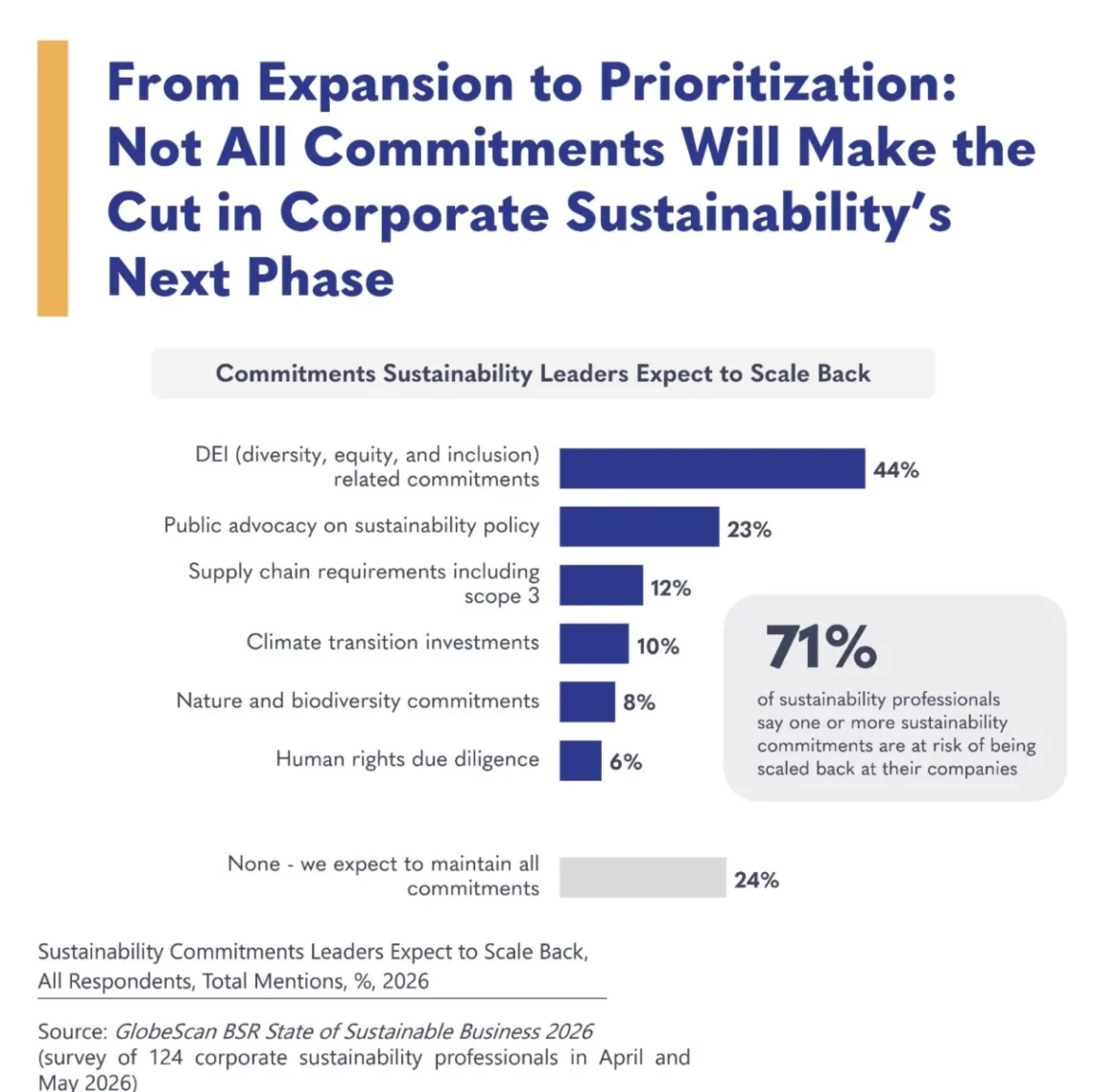
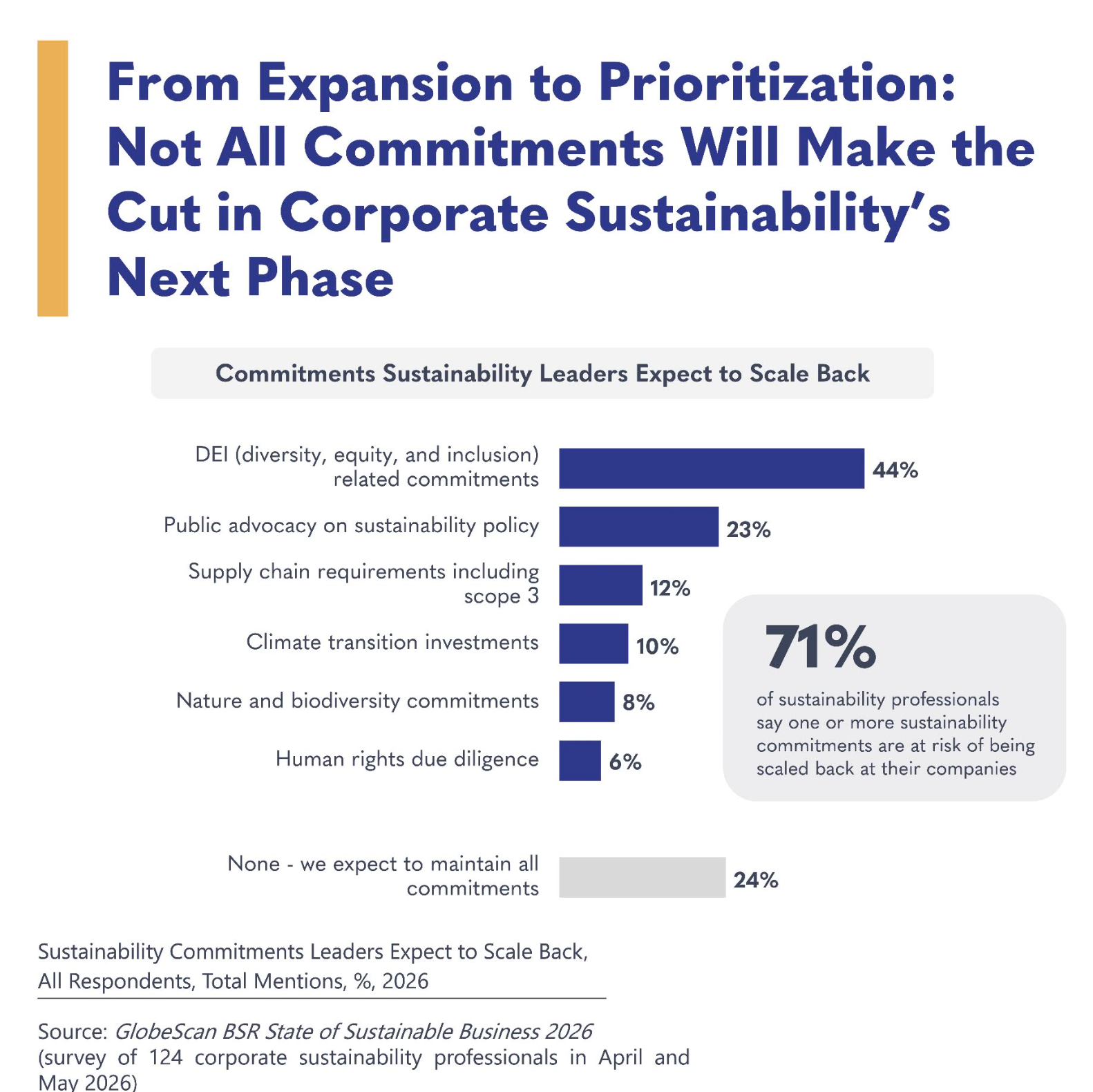
The most striking revelation from the BSR and GlobeScan study is the sheer scale of the retreat. A clear majority—71 percent—of sustainability professionals working within billion-dollar enterprises report that at least one of their company’s existing sustainability commitments is at risk of being scaled back. By contrast, less than 25 percent of respondents believe their organizations will successfully maintain the entirety of their current ESG (Environmental, Social, and Governance) portfolios.
This is not a minor adjustment; it is a fundamental reassessment of corporate priorities. As economic volatility persists and the geopolitical landscape complicates supply chains, the "do-it-all" approach to sustainability is being discarded in favor of a more surgical, selective, and pragmatic model. The data indicates that the "broad-tent" era of ESG is being replaced by a "core-competency" era, where sustainability teams are being forced to justify the business value of every initiative under a microscope.
A Chronology of the Sustainability Pivot
To understand how we arrived at this moment, one must look at the evolution of corporate sustainability over the last decade.
2016–2020: The Era of Expansive Pledges
Following the Paris Agreement and the adoption of the UN Sustainable Development Goals, the corporate world entered a period of "virtue signaling" that eventually matured into formal, science-based targets. During this phase, sustainability was largely viewed as a reputational asset. Companies competed to see who could announce the most aggressive net-zero timelines and the most comprehensive diversity, equity, and inclusion (DEI) metrics.
2021–2023: The Regulatory Awakening
As the COVID-19 pandemic reshaped global economies, regulators began to move from voluntary reporting frameworks to mandatory disclosure requirements (such as the EU’s CSRD and the SEC’s climate disclosure rules). This transition changed the game: sustainability was no longer just a marketing exercise; it became a matter of legal and financial compliance.

2024–2025: The Efficiency Crunch
As interest rates rose and inflation pressured corporate margins, the "low-hanging fruit" of sustainability was exhausted. Companies began to find that the costs of deep decarbonization and complex social auditing were higher than initially estimated. Simultaneously, political pushback against ESG in certain markets, particularly in the United States, began to chill the appetite for public advocacy.
2026: The Pragmatic Realignment
The current data from mid-2026 marks the arrival of the "Pragmatic Realignment." Corporations are now shedding commitments that are deemed "non-essential" to the core business model to preserve resources for regulatory compliance and essential operational resilience.
Supporting Data: Where the Cuts Are Happening
The BSR/GlobeScan research highlights a clear hierarchy of vulnerability among sustainability commitments. Not all initiatives are being treated equally by executive leadership teams.
- DEI Initiatives (44% at risk): DEI-related commitments are the most frequent targets for reduction. The confluence of legal challenges and a shifting political climate has made these programs the most "politically sensitive" for large organizations.
- Public Advocacy (23% at risk): Corporations are increasingly hesitant to take public stances on sustainability policy. The fear of brand polarization has led many firms to retreat from the public square, preferring to handle sustainability as an internal operational matter rather than a public-facing political position.
- Supply Chain and Climate Investment (Lower risk): Notably, core operational requirements—such as supply chain resilience and fundamental climate transition investments—are flagged less frequently. This suggests that while companies are shedding the "social" and "advocacy" aspects of ESG, they are doubling down on the "environmental" and "governance" aspects that directly impact their operational viability and long-term regulatory standing.
Official Responses and Industry Perspectives
While the names of specific companies remain confidential in the survey, the professional sentiment from those on the ground is uniform. James Morris, who leads GlobeScan’s San Francisco office, notes that the current environment is forcing a maturation of the sustainability function.
"We are seeing a clear move away from the ‘announcement phase’ of the last decade," says Morris. "The professionals we surveyed are not necessarily less committed to sustainability; they are simply more focused on what is defensible in a boardroom setting. The challenge now is to bridge the gap between high-level pledges and the cold, hard reality of operational budgets."
Industry analysts observe that this is not necessarily a "defeat" for sustainability, but rather a "honing" process. Many of the commitments made in 2020 were aspirational, made without the benefit of the regulatory or technological foresight that exists today. The current retraction is, in many ways, an act of "corporate de-risking"—clearing out the clutter to ensure that what remains is robust, defensible, and tied directly to the company’s bottom line.
Implications: The Future of the Sustainability Profession
The findings carry significant implications for the future of the sustainability profession and the organizations they serve.
1. Integration over Isolation
The era of the "Sustainability Department" as a siloed entity is ending. To survive, sustainability leaders must embed their work into the core functions of the business: finance, procurement, R&D, and operations. If a sustainability goal cannot be mapped directly to a P&L statement or a risk-mitigation strategy, it is now viewed as a luxury that the company can no longer afford.
2. The Rise of the "Pragmatic Practitioner"
Sustainability professionals will increasingly need to speak the language of the CFO. The ability to demonstrate ROI (Return on Investment) through resource efficiency, lower capital costs, and risk reduction will be the primary metric of success. The "idealist" archetype of the sustainability officer is being replaced by the "pragmatic strategist" who understands that in a constrained economy, sustainability must be an engine for growth, not a cost center.
3. Focus on Resilience
As climate change continues to impact supply chains, companies are shifting their sustainability focus toward resilience. Biodiversity and human rights due diligence are becoming less about "corporate citizenship" and more about "supply chain continuity." Companies that view these issues through the lens of business stability are finding it much easier to secure funding and executive buy-in than those framing them through the lens of ethical obligation alone.
4. A New Definition of Success
The "success" of a sustainability program will no longer be measured by the number of pledges made or the length of a sustainability report. Instead, it will be measured by the "stickiness" of the initiatives. Companies that have successfully integrated their sustainability commitments into their core business model—such as circular economy projects that reduce material costs or energy-efficiency projects that hedge against volatile utility prices—are the ones most likely to maintain their momentum.
Conclusion
The 2026 BSR/GlobeScan data acts as a mirror for the corporate world. It reflects a shift from the optimistic, expansive, and sometimes performative sustainability strategies of the early 2020s to a more sober, evidence-based approach.
For many, this may look like a retreat. However, it is more accurately described as a consolidation. The sustainability commitments that survive this period of "selective retrenchment" will be those that have proven their value. By narrowing their focus, large corporations are arguably building a more durable and effective foundation for the future. The companies that emerge from this phase will be those that have successfully transformed sustainability from an "add-on" into a fundamental, non-negotiable pillar of their long-term competitive strategy.
As the corporate world navigates this transition, the sustainability profession must adapt. The path forward is no longer about winning hearts and minds with grand announcements; it is about building resilient, profitable, and ethically sound enterprises that can weather the challenges of a volatile global market. The "Great Retrenchment" is, ultimately, the crucible in which the next generation of corporate sustainability will be forged.