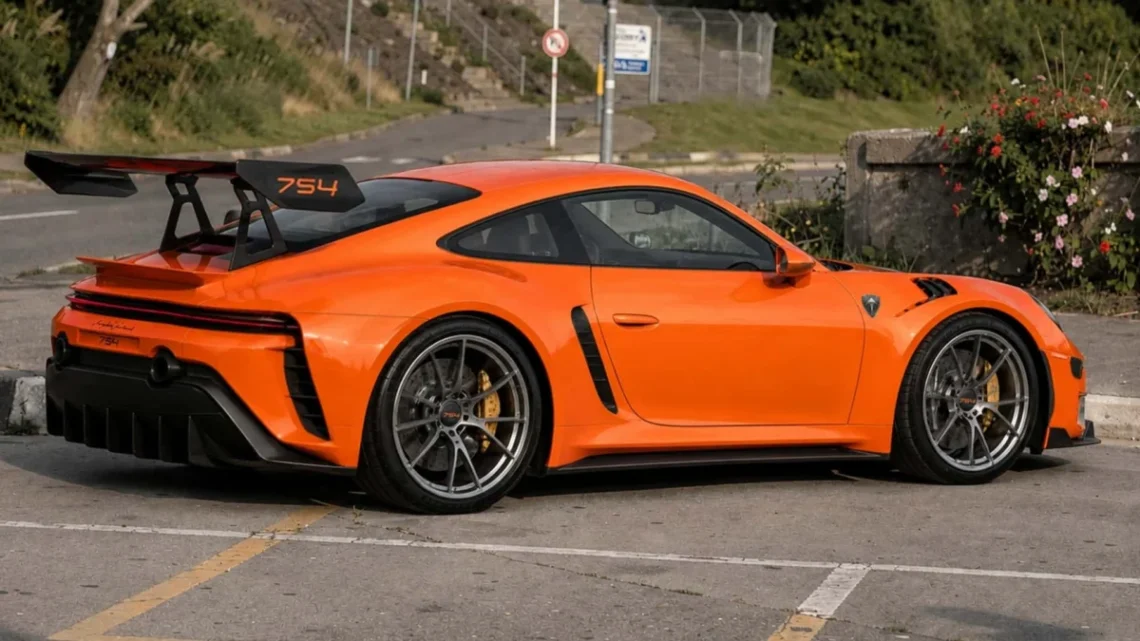
In the rarefied world of high-performance coachbuilding, the challenge is rarely just about power—it is about identity. Angelelli Automobili, an Italian engineering boutique known for pushing the boundaries of automotive technology, has officially unveiled its latest endeavor: Project 754. With a production cap of just 50 units, the vehicle represents a radical departure from traditional automotive manufacturing, blending the heritage of the Porsche 911 platform with the bleeding edge of modern material science and generative design.
The Core Philosophy: Two Roads to the Same Peak
At its heart, Project 754 is a study in dual-character performance. Angelelli Automobili has structured the project into two distinct mechanical configurations, each tailored to a specific driving philosophy. The "754 R" preserves the traditional rear-engine layout, a configuration that has defined the 911’s character for decades. By optimizing weight distribution and suspension geometry, the R is engineered to offer explosive traction and that quintessential, aggressive corner-exit behavior favored by traditionalists.
In contrast, the "754 M" shifts the engine toward the center of the chassis. This mid-engine transformation is designed to optimize the vehicle’s center of gravity, offering a more balanced, neutral handling profile. While the R variant appeals to those who crave the visceral, tail-happy nature of a rear-biased sports car, the M variant is a surgical instrument, built for those who prioritize precision, mid-corner stability, and the ability to maintain speed through complex sequences of bends.
Both versions are designed to churn out between 700 and 800 horsepower. This output, when paired with the car’s extreme weight-saving measures, places the Project 754 in the upper echelons of the supercar hierarchy, challenging established titans with a power-to-weight ratio that borders on the extreme.
Chronology of Development: From Concept to Reality
The genesis of Project 754 did not happen in a vacuum. Angelelli Automobili’s journey began with a rigorous analysis of the 991 and 992 generations of the Porsche 911. While the company maintains no official partnership with the Stuttgart-based automaker, they have identified the 911 platform as the most robust "blank canvas" available for a high-performance coachbuild.
- Phase One: Conceptualization and Digital Modeling. The design team began by stripping away the constraints of mass production. Using generative design software, they modeled the chassis to determine where structural reinforcement was necessary and where mass could be stripped away without compromising rigidity.
- Phase Two: Material Science Integration. The company moved beyond standard alloys, investing heavily in metal 3D printing. By utilizing additive manufacturing, Angelelli produced titanium and specialized alloy components that would be impossible to cast using traditional methods.
- Phase Three: Prototyping and Wind Tunnel Testing. The development team focused on the aerodynamic signature of the vehicle. Every body panel was redesigned, not merely for aesthetic appeal, but to manage airflow for high-speed downforce and thermal regulation for the high-output engines.
- Phase Four: Bespoke Commissioning. Currently, the project has entered its final phase: the customer-centric build stage. Each of the 50 slots is being filled by buyers who participate in the final tuning of their specific vehicle, from the suspension damping curves to the tactile finish of the interior materials.
Supporting Data: The Science of Lightweighting
The most compelling aspect of Project 754 is its aggressive approach to weight reduction. Modern supercars often face a "bloat" problem, where increased power is offset by the weight of luxury features and safety systems. Angelelli counters this by treating the entire vehicle as a modular system.
The use of topology optimization—a mathematical method that optimizes material layout within a given design space—has allowed engineers to create components that are significantly lighter than their mass-produced counterparts. By "growing" parts through 3D printing, the company removes material from areas that do not contribute to structural integrity, resulting in a chassis that is remarkably stiff yet light.
Furthermore, the extensive use of carbon fiber is not merely for aesthetics. The material is utilized for the primary body shell, which serves to lower the center of gravity. When combined with the proprietary suspension systems developed by the company, the result is a vehicle that feels more agile and responsive than the donor platform upon which it is based.
Official Responses and Strategic Positioning
Angelelli Automobili has been clear about its intentions regarding the 911 base. By choosing to work with existing platforms rather than building a "clean sheet" chassis, the company sidesteps the monumental costs associated with crash testing and regulatory compliance for an entirely new vehicle. This allows the firm to focus its capital on the "fun" aspects of engineering—power, handling, and driver connection.

"Our goal was never to replicate or replace what the giants have already achieved," a spokesperson for the company stated during the initial unveiling. "We are looking to extract the untapped potential of a proven architecture. Project 754 is about refinement, personal expression, and the application of manufacturing technologies that were unheard of just five years ago."
The industry reception has been one of cautious fascination. While there is a crowded market for "restomods" and specialized 911 conversions, the sheer technical depth of the Project 754—particularly the mid-engine conversion—sets it apart from companies that merely swap body panels and tune the ECU.
Implications: The Future of Coachbuilding
The emergence of projects like the 754 signals a broader trend in the automotive landscape. As the industry moves toward mass-market electrification, there is an increasing desire among enthusiasts for high-performance, internal-combustion vehicles that are unique, customizable, and "analog" in their engagement.
For the collector, the Project 754 represents a rare opportunity. With only 25 units of the R and 25 units of the M planned, the rarity is guaranteed. But beyond the exclusivity, the implication is that the future of the supercar may lie in the hands of smaller, more nimble engineering firms. These companies can pivot quickly to adopt new technologies, like metal 3D printing and generative design, in ways that large manufacturers—burdened by the requirements of high-volume production—simply cannot.
However, the path forward is not without risks. The reliance on an existing technical platform means that the company’s success is intrinsically tied to the longevity of those components. Furthermore, the high cost of entry, driven by the bespoke nature of the manufacturing process, limits the audience to the ultra-wealthy.
Conclusion
The Project 754 is a testament to the idea that the internal combustion engine and the mechanical sports car still have room for evolution. By bridging the gap between historical platforms and future-proof manufacturing techniques, Angelelli Automobili has created something that is both nostalgic and revolutionary.
For those who view the Porsche 911 as the ultimate canvas, Project 754 is the next logical step. It is a bold, uncompromising, and highly technical reinterpretation of what a sports car can be. Whether it succeeds in becoming a collector’s icon will ultimately depend on the driving experience, but if the specifications are any indication, the 50 owners of these machines are in for a masterclass in modern engineering.
As we look toward an electrified future, the Project 754 serves as a poignant reminder that there is still a place for the artisan, the engineer, and the driver who refuses to settle for the standard. It is, quite simply, a high-octane farewell to the status quo.