Main Facts
The definition of luxury at 35,000 feet is undergoing a profound structural evolution. On a transatlantic flight from Chicago to London aboard American Airlines flight AA86, the defining characteristic of the carrier’s newly introduced business class was not merely the inclusion of a sliding privacy door—a feature that once represented the pinnacle of premium airline design. Instead, the true standout was the sheer volume of physical space behind it.
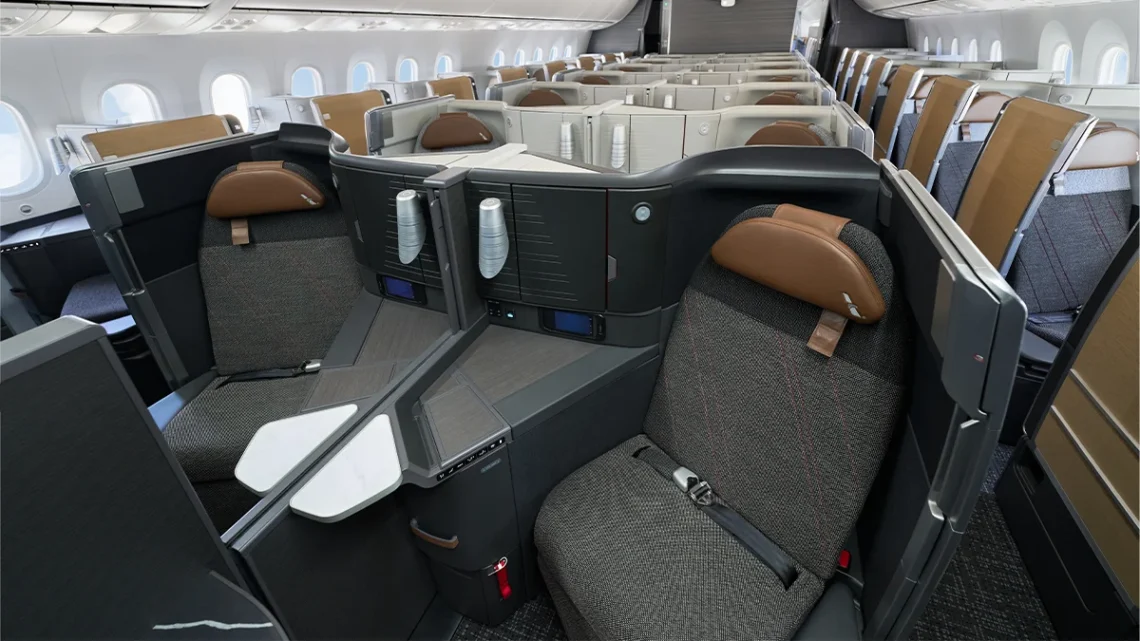
Occupying Seat 10L—one of eight exclusive "Flagship Suite Preferred" seats aboard American’s cutting-edge Boeing 787-9—reveals a deliberate shift in how major global carriers conceptualize premium cabins. Positioned within the aircraft’s intimate second business-class cabin, the Preferred configuration boasts an open, expansive footprint that yields staggering spatial dividends: according to American Airlines, these premier suites offer 19 percent more bed space and a 42 percent increase in overall living area compared to the standard Flagship Suite.
American introduced this new Boeing 787-9 interior in the latter half of 2025, swiftly designating the Chicago-to-Heathrow corridor as a premier showcase market. Yet, American is far from alone. Across the global aviation industry, legacy carriers are systematically dismantling the egalitarian model of business class—where every passenger received an identical hard product, save for the luck of early booking—and replacing it with a stratified, multi-tiered marketplace.

From United Airlines’ Polaris Studio and Lufthansa’s modular Allegris concept to ANA’s ultra-wide "The Room FX," modern business class is no longer just about enduring a long-haul flight horizontally. It is about architectural diversity, localized haute cuisine, tactile luxury, and environments meticulously designed for waking hours as much as for deep sleep.
Chronology
To understand how modern business class arrived at this multi-tiered era, it is helpful to trace the milestones of cabin evolution over the past two decades:
- The Flat-Bed Revolution (Late 2000s–2010s): For years, the ultimate differentiator in premium travel was a binary question: Does the seat lie fully flat? Once flat beds became the industry standard across nearly all long-haul business cabins, airlines needed a new metric to justify premium pricing.
- The Door Era (Late 2010s–Early 2020s): British Airways introduced its groundbreaking Club Suite on refurbished Boeing 777-200ERs, phasing out the legacy Club World layout. Featuring forward-facing 1-2-1 configurations, direct aisle access, and sliding doors, the product established a new baseline for enclosed privacy. Similar doors quickly became ubiquitous across premier carriers.
- The Rise of Domestic First-Class Alternatives (2023–2024): As multiple international carriers outright eliminated traditional first-class cabins, business class absorbed that lost real estate. Airlines began designing front-row upgrades featuring larger entertainment screens, ottomans for companions, and significantly expanded square footage.
- The Multi-Tiered Pivot (2025–Present): Airlines began rolling out advanced widebody interiors—such as American Airlines’ 787-9 Flagship Suites, United’s redesigned 787-9 featuring Polaris Studios, Lufthansa’s highly modular Allegris cabins, and ANA’s "The Room FX." These products intentionally subdivided the business cabin into standard suites and ultra-premium, up-charged sanctuary tiers.
Supporting Data
The physical specifications of these next-generation business-class products highlight the intense engineering race among global carriers to maximize comfort, privacy, and personal territory:

- American Airlines Flagship Suite Preferred: Offers a 19 percent larger bed space and a 42 percent larger living area than standard Flagship Suites. Features include a 17-inch 4K entertainment screen, wireless charging, Bluetooth connectivity, black-marble accent counters, upgraded bedding, mattress pads, specialized pajamas, and enhanced amenity kits.
- British Airways Club Suite: Standardized on aircraft like the Boeing 777-200ER, providing 1-2-1 direct aisle access, sliding privacy doors, 79-inch fully flat beds, and approximately 40 percent more storage space than legacy configurations.
- United Airlines Polaris Studio: Positioned at the front of redesigned Boeing 787-9 cabins, these suites are 25 percent larger than standard Polaris seats. They feature privacy doors, massive 27-inch 4K OLED screens, and—in six of the eight suites—an integrated ottoman designed to seat a traveling companion. Standard Polaris suites behind them feature 19-inch 4K screens and privacy doors.
- Lufthansa Allegris: Features five distinct business-class seating variations within the same cabin. Options include a front-row suite with closing doors, integrated wardrobe, and minibar; high-privacy seats; and extra-long beds stretching past seven feet. Dividers and doors reach an impressive 4.6 feet in height, supplemented by seat heating, cooling, wireless charging, and Bluetooth.
- ANA "The Room FX": Engineered specifically for the Boeing 787-9, this configuration features 48 business-class seats with privacy doors and a sofa-like reclining bed design. Its standout metric is seat width: up to 41.5 inches across—nearly double the width of competing products—allowing passengers to comfortably roll over while sleeping. It is paired with a 24-inch 4K screen.
Official Responses and Perspectives
Airlines are fundamentally rethinking the psychological and sensory environment of long-haul travel, moving away from purely functional metrics toward emotional well-being.
"The objective was not just to add features and build the most souped-up seat," Raphael Girardoni, American Airlines’ managing director of customer experience product and design, told Robb Report. "It was to create an environment that feels calm and elevated to our customers."
This philosophy is reflected in the subtle design choices within American’s Preferred suites. Rather than relying on flashy gimmicks, the extra room is distributed thoughtfully across a larger sleeping footprint, dedicated storage cubbies, and open floor space. Even material choices—such as matte black-marble counter surfaces—were vetted meticulously to ensure they project understated elegance rather than sensory clutter.

Service and gastronomy are likewise stepping up to fill the gap as physical seat hardware grows increasingly uniform. On a subsequent transatlantic crossing aboard British Airways flight BA294 from Chicago to Heathrow, the physical suite was beautifully complemented by attentive, non-intrusive cabin service and a refined catering program featuring contemporary English-inspired cuisine and artisanal cocktails.
Similarly, United Airlines has leveraged strategic partnerships—most notably with chefs featured in the Netflix series Chef’s Table—to transform airborne dining. By introducing rotating, regionally inspired seasonal menus crafted by celebrated culinary figures like Nancy Silverton of Osteria Mozza and Tashi Gyamtso of Jimgu, United is actively leveraging fine dining as a primary differentiator within its elevated cabin tiers.
Implications
The systematic subdivision of business class carries profound implications for the future of commercial aviation economics and passenger psychology.

For decades, the dominant trend in premium travel was homogenization: airlines competed to offer a uniform product that guaranteed every premium passenger an identical baseline of comfort. Today, that model is obsolete. By introducing distinct pricing and spatial tiers within the business-class cabin—such as American’s Preferred suites, United’s Polaris Studios, and Lufthansa’s multi-variation Allegris layout—airlines have created an effective up-charge monetization strategy. Passengers are no longer merely buying a ticket from point A to point B; they are bidding for architectural exclusivity, square footage, and individualized luxury.
This shift mirrors the broader disappearance of traditional first-class cabins across many commercial fleets. As business-class suites absorb the privacy, space, and service levels once reserved for first class, airlines must find new ways to extract higher yields from elite travelers willing to pay top dollar.
Ultimately, the baseline question for premium flyers has permanently shifted. The era of asking "Does the seat lie flat?" is long gone. In its place lies a new, highly competitive calculus: Just how much territory around your seat are you willing to pay for, and how seamlessly can an airline transform a metal tube into a private, restorative sanctuary?