The architectural landscape of Santa Cruz de Tenerife is a palimpsest of styles, where the rigid geometries of rationalism often intersect with the ornate flourishes of eclecticism. At the heart of this stylistic dialogue stands "House Hotelito," a residential project recently revitalized by the architectural firm FIVE OH FIVE. Originally conceived in the 1930s by the esteemed architect Domingo Pisaca y Burgada, this structure is more than a mere dwelling; it is a fragment of Canary Island history.
As urban centers grapple with the dual pressures of modernization and heritage preservation, House Hotelito serves as a masterclass in how to breathe new life into historic fabric without erasing its soul. By navigating the strict regulations of the "Site of Cultural Interest" (BIC) designation, the architects have successfully bridged a ninety-year gap, creating a space that honors the 20th-century "garden city" ideal while meeting the demands of 21st-century domesticity.
Main Facts: A Landmark Intervened
House Hotelito is situated within the prestigious Los Hoteles–Pino de Oro district, a neighborhood characterized by its lush greenery and high-standing villas. The project involves the comprehensive interior renovation and exterior restoration of a villa that belongs to a specific typology known locally as "hotelitos"—small, elegant urban mansions that were popular among the rising middle and upper classes in the early 1900s.
Key Project Details
- Original Architect: Domingo Pisaca y Burgada (1930s).
- Renovation Architects: FIVE OH FIVE.
- Location: Los Hoteles–Pino de Oro District, Santa Cruz de Tenerife, Spain.
- Style: A hybrid of Modernism and Eclecticism with contemporary minimalist interventions.
- Legal Status: Protected as a Site of Cultural Interest (Bien de Interés Cultural – BIC) under the category of Historic Ensemble.
- Core Materials: Natural wood, integrated LED lighting, original masonry, and restored wrought iron.
The intervention by FIVE OH FIVE focused on "cleansing" the interior of decades of haphazard additions while meticulously restoring the facade to its original 1930s glory. The result is a home that feels both ancient and brand new, where the weight of the stone walls is balanced by the lightness of modern carpentry.
Chronology: From Bourgeois Expansion to Modern Revitalization
To understand the significance of House Hotelito, one must trace the timeline of its district and the evolution of its architectural identity.
1. The 1930s: The Vision of Domingo Pisaca y Burgada
During the 1930s, Santa Cruz de Tenerife underwent a significant urban expansion. Domingo Pisaca y Burgada, one of the most influential architects of the era, was instrumental in shaping this new aesthetic. Moving away from the heavy, dark styles of the 19th century, Pisaca embraced a transition toward Modernism, though he often retained Eclectic elements—such as decorative moldings and symmetrical balconies—to satisfy the tastes of his clientele. House Hotelito was part of a planned group of ten villas designed to offer a "garden city" lifestyle within the urban core.
2. Mid-20th Century: The Preservation of the ‘Los Hoteles’ District
As the city grew, the Los Hoteles–Pino de Oro district remained an enclave of architectural quality. While other parts of Santa Cruz saw the rise of brutalist apartment blocks in the 1960s and 70s, this district was increasingly recognized for its historical value. The "hotelitos" became synonymous with the city’s golden age of residential architecture.
3. The 21st Century: Recognition and Decay
By the early 2000s, the district was officially designated as a Site of Cultural Interest. However, many of the original villas faced challenges: they were often too large for modern families, energy-inefficient, or in need of structural repair. House Hotelito required a sensitive hand to ensure it did not fall into disrepair or lose its character through a generic renovation.
4. 2024–2026: The FIVE OH FIVE Intervention
The firm FIVE OH FIVE was commissioned to adapt the house for a contemporary lifestyle. The project, completed and published in mid-2026, involved a deep study of the original plans. The architects spent months stripping back layers of paint and partition walls to rediscover the original volumes envisioned by Pisaca y Burgada.

Supporting Data: Architectural Language and Materiality
The success of House Hotelito lies in its contrast. The architects used a specific palette of materials to differentiate the "old" from the "new," a technique often referred to in preservation circles as "honest intervention."
The Exterior: Restoring the Eclectic Shell
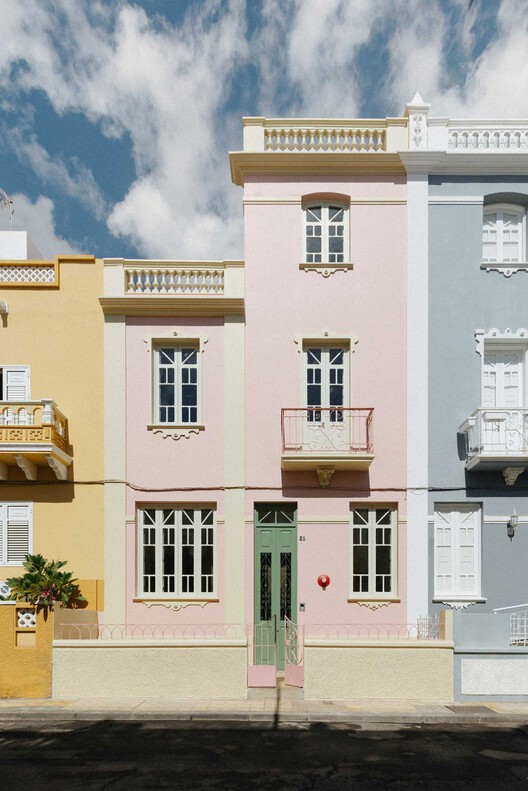
The facade remains the most visible link to the 1930s. The architects restored the original lime-based renders and the intricate metalwork of the balconies. The windows, while upgraded for thermal performance, retain the proportions and rhythmic spacing dictated by Pisaca’s original design. This ensures the building continues to contribute positively to the "Historic Ensemble" of the neighborhood.
The Interior: The Warmth of Wood
Inside, the story changes. The architects at FIVE OH FIVE opted for a radical simplification of the floor plan.

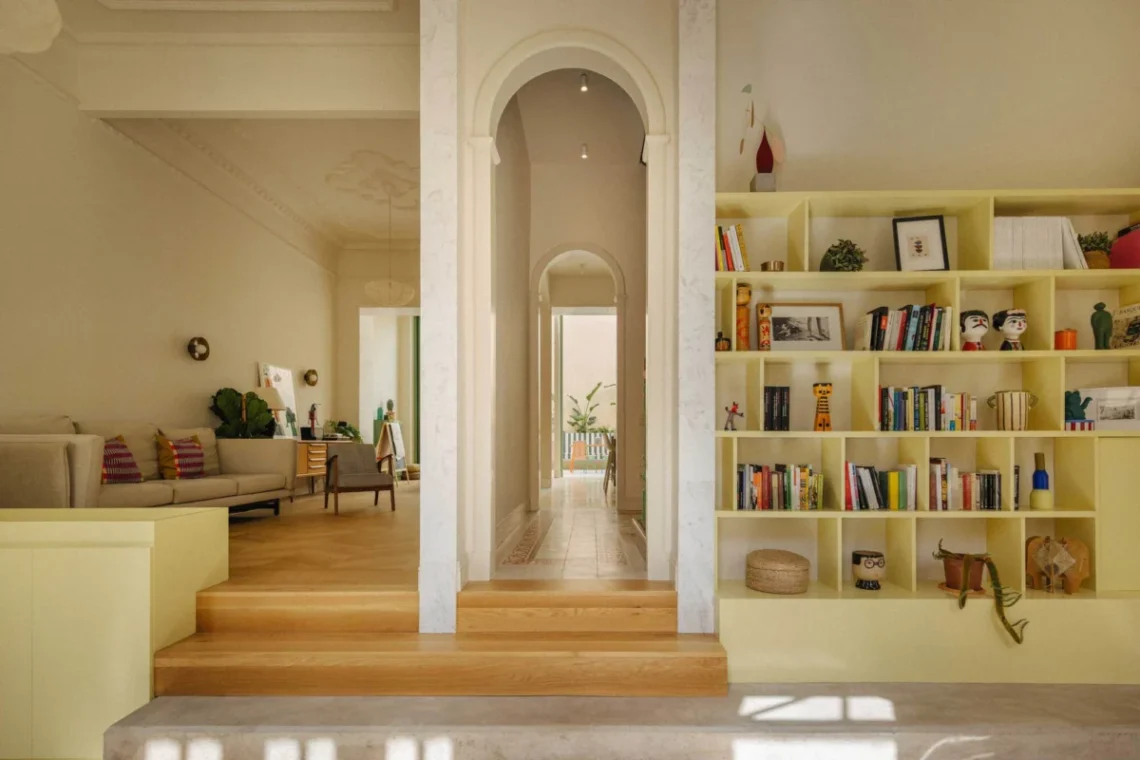
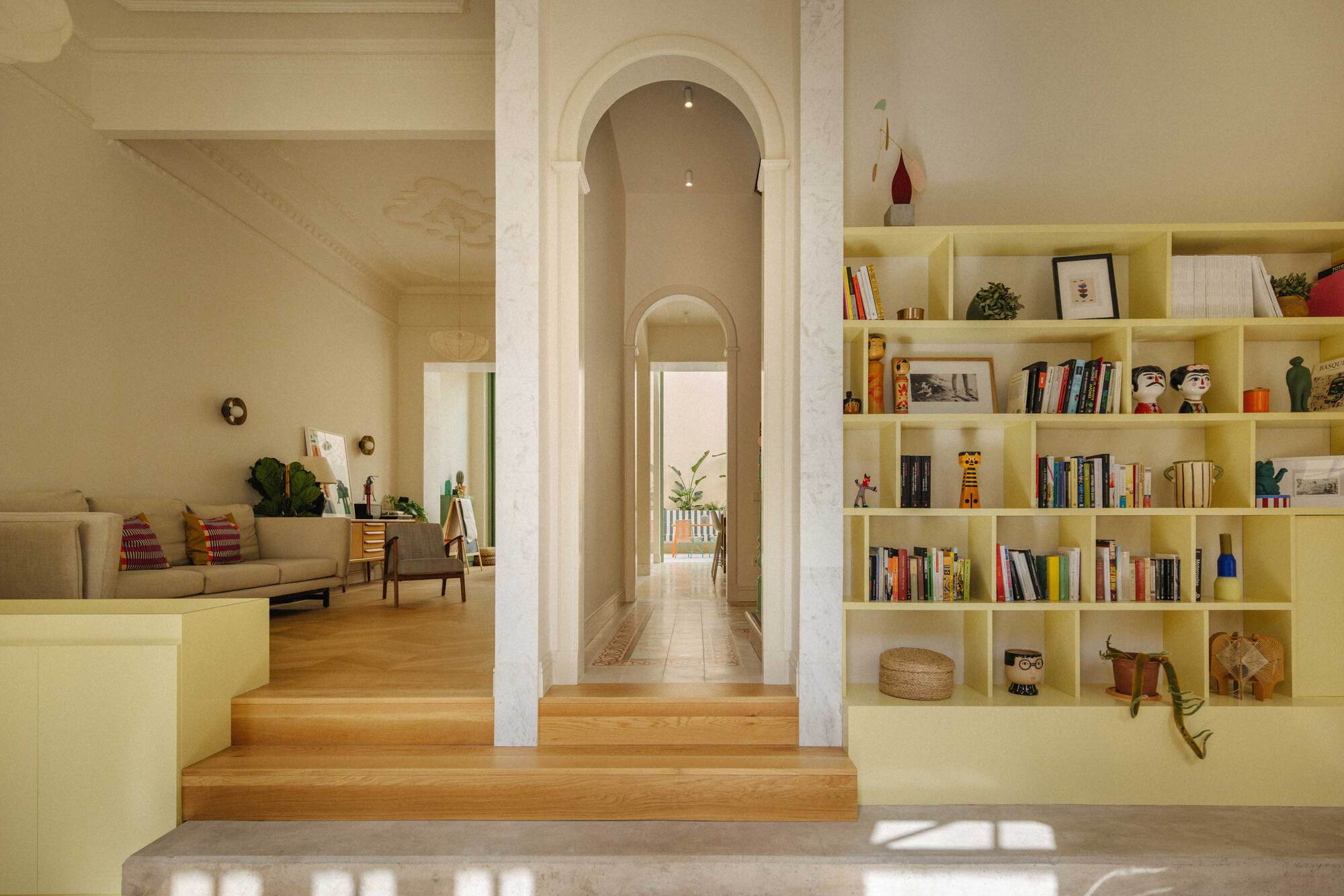
- Wood as a Connector: Light-toned wood (likely oak or a similar local variant) is the protagonist of the interior. It is used not just for flooring, but for expansive shelving units, custom-built furniture, and the central staircase.
- Lighting Design: Eschewing traditional chandeliers, the project utilizes recessed LED strips and minimalist fixtures. This highlights the textures of the original stone walls while providing a soft, ambient glow that feels distinctly modern.
- Spatial Flow: By removing unnecessary corridors, the architects created a "fluid" ground floor where the kitchen, dining, and living areas bleed into one another, centered around the original architectural features like the large windows that overlook the garden.
Official Responses and Conservation Framework
Working on a building with a "Site of Cultural Interest" (BIC) designation involves a complex web of approvals from local heritage boards and the Cabildo de Tenerife.
The Regulatory Challenge
Under Spanish law, a BIC designation means that any intervention must be "conservative" in nature. Architects are often restricted from changing the volume, the facade, or the structural essence of the building. FIVE OH FIVE’s approach was to treat the exterior as a "museum piece" and the interior as a "living laboratory."
Expert Commentary
Architectural critics have noted that House Hotelito avoids the common pitfall of "pastiche"—the act of trying to make new things look old. Instead, by using contemporary materials like glass and minimalist wood, the architects make it clear what is 1930s heritage and what is 2026 innovation. This transparency is highly valued by heritage commissions, as it allows the history of the building to remain legible.

"The intervention in House Hotelito demonstrates that heritage is not a static monument, but a living entity," says a spokesperson for the local architectural collective. "By allowing FIVE OH FIVE to modernize the interior while protecting the facade, the city ensures that these historic villas remain inhabited and loved, rather than becoming empty relics."
Implications: The Future of Urban Heritage
The completion of House Hotelito has broader implications for urban planning in the Canary Islands and beyond.
1. Sustainable Urbanism through Adaptive Reuse
Renovating an existing structure is inherently more sustainable than demolition and new construction. House Hotelito proves that even century-old villas can be brought up to modern energy standards (through improved insulation and smart home systems) without compromising their aesthetic value.

2. Combatting Urban Sprawl
By making historic city centers attractive to modern residents, projects like this help combat urban sprawl. When people choose to live in restored "hotelitos" rather than new suburban developments, they contribute to the vitality of the existing urban fabric, supporting local businesses and reducing the need for long commutes.
3. A Template for the ‘Los Hoteles’ District
There are dozens of similar villas in the Los Hoteles–Pino de Oro district that are currently underutilized. House Hotelito serves as a template for other property owners and architects. It shows that the "BIC" designation does not have to be a barrier to modern living; rather, it is a framework that adds prestige and value to a renovation.
4. Cultural Identity
In an era of globalized architecture where many new luxury homes look identical regardless of whether they are in Dubai or Madrid, House Hotelito maintains a "sense of place." It is a uniquely Tinerfeño building, rooted in the specific history of the Canary Islands’ 20th-century development.
Conclusion
House Hotelito is a triumph of sensitive design. It honors the legacy of Domingo Pisaca y Burgada by ensuring his work survives for another century, but it also establishes FIVE OH FIVE as a firm capable of navigating the delicate boundary between history and progress. As the sun sets over the Los Hoteles district, the warm light emanating from the villa’s restored windows serves as a beacon for the future of architectural preservation—a future where the past is not just remembered, but lived.