
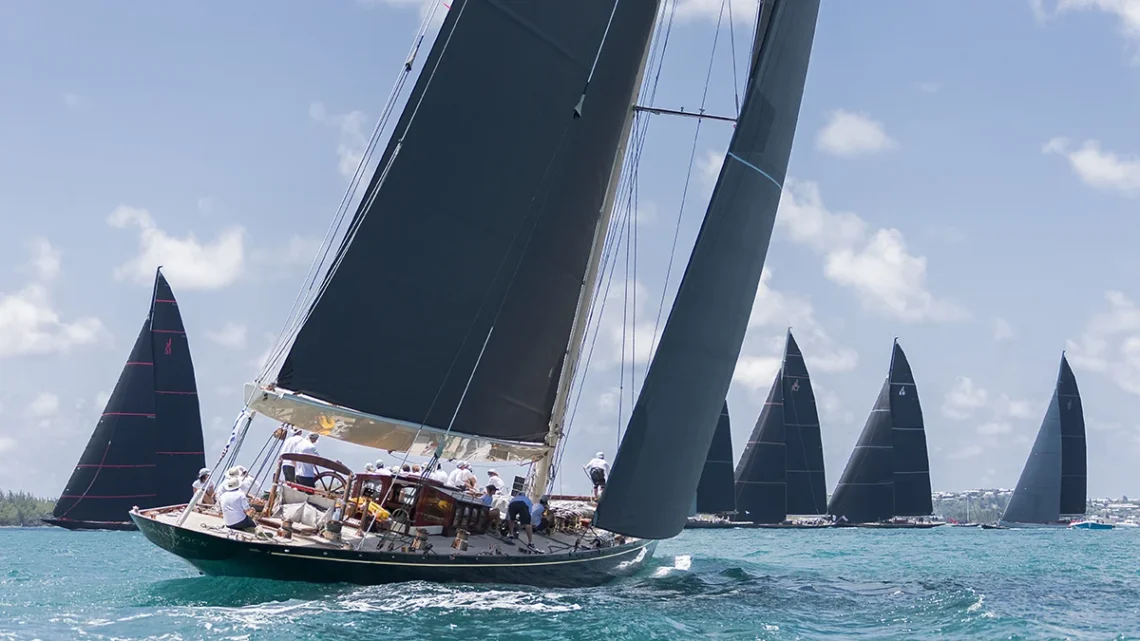
When the J-Class yachts unfurl their sails—deploying up to 7,500 square feet of high-tech canvas—they transform from mere vessels into living, breathing monuments to maritime history. These towering spinnakers, genoas, and mainsails billow above sleek, curved hulls that were first conceived nearly a century ago, creating a silhouette that is as intimidating as it is elegant. On deck, the choreographed chaos of a 25-person crew working in absolute unison provides a visceral reminder that these are not just luxury playthings; they are high-performance racing machines that demand total mastery.
As they cut through the Mediterranean swells this year, the sight of a J-Class fleet in full flight serves as a bridge across time. It is a spectacle of power and grace that feels both anachronistic and entirely relevant to the modern sailing elite.
The Architecture of Power: Main Facts
The J-Class represents the pinnacle of 1930s naval architecture. Ranging from 119 to 140 feet in length, these yachts were built to compete in the America’s Cup during an era when the competition was defined by extreme engineering and immense budgets. They are characterized by long overhangs, towering masts, and deep, slender hulls that allow them to slice through the water with unmatched momentum.
Today, the fleet is a blend of surviving originals and faithful modern replicas. While the original vessels were built of steel and wood, many of the modern incarnations utilize advanced aluminum hulls, composite rigging, and state-of-the-art sail materials. Despite these modern technological leaps, the fundamental essence—the "J" rating rule—remains unchanged. They are the ultimate manifestation of wind-powered kinetic energy, a testament to a time when naval architects pushed the boundaries of physics to claim the most coveted trophy in sports.
A Century of Sail: A Chronological Evolution
To understand the significance of today’s J-Class resurgence, one must look back to the 1930s. At the height of the Great Depression, the J-Class were the crown jewels of the yachting world, owned by titans of industry like Harold Vanderbilt and Sir Thomas Lipton. They were the fastest, largest, and most expensive racing yachts ever built.
The Lean Years and the Great Salvage
Following the shift in racing regulations after World War II, the J-Class fell out of favor. Of the ten original yachts built, only three—Shamrock V, Endeavour, and Velsheda—survived the era. The rest were dismantled, their metal sold for scrap to fuel the post-war industrial recovery. For decades, they were little more than ghosts of the sea.
The Renaissance of the 1980s
The tide turned in the early 1980s, largely due to the efforts of American heiress Elizabeth Meyer. Recognizing that these vessels represented an irreplaceable piece of cultural heritage, Meyer spearheaded the restoration of Shamrock V and Endeavour. Her work ignited a firestorm of interest, proving that the J-Class still held the capacity to captivate modern audiences.
The Modern Era: Replicas and Refits
The current century has seen a steady increase in both restorations and new builds. By applying 1930s design plans to 21st-century manufacturing, naval architects—most notably the Dutch firm Dykstra—have brought long-lost designs back to life. With the recent launch of vessels like the 143-foot Svea and the restoration of Shamrock V, the fleet is nearing its historical strength of ten, with a replica of the 1930 defender Yankee currently under construction.
The Competitive Landscape: Supporting Data
The modern J-Class fleet is not merely a museum piece; it is a fierce competitive circuit. The current resurgence is fueled by a new generation of owners who prefer to take the helm themselves rather than observe from the sidelines.

- The Contenders:
- Rainbow: A 2012 replica of the 1934 original, now captained by Peter Harrison, CEO of Richard Mille EMEA.
- Hanuman: A 2009 replica of the 1937 Endeavour II, recently acquired by Italian sailor Giovanni Lombardi Stronati.
- Svea: Launched in 2017, this 143-foot giant is the longest J-Class ever built and has become a dominant force in modern regattas.
- Lionheart: A crowd favorite built in 2010 to historic specifications, consistently performing at the top of the leaderboard.
- Shamrock V: Recently completed a four-and-a-half-year restoration requiring 247,000 man-hours of labor, signaling its return as the fleet’s queen.
These vessels meet at the world’s most prestigious regattas, including the Superyacht Cup Palma and Les Voiles de Saint-Tropez. The data from these races confirms that despite their age, these boats are capable of intense, high-speed duels that rival any modern carbon-fiber racer.
Voices from the Helm: Official Responses
The passion driving the J-Class revival is best expressed by those closest to the vessels. Louise Morton, class secretary of the J-Class Association, encapsulates the emotional draw of the fleet: "To see four, five, or seven yachts racing is simply so beautiful it takes your breath away."
For the owners, the appeal transcends the mere thrill of competition. The owner of Shamrock V, a seasoned sailor, reflects on the experience of piloting a piece of history: "You come off the boat feeling as if you’ve honored the elements and the core of our sport. There is an ear-to-ear grin whenever we’re sailing in a blow."
From the design perspective, Wick Hillege of Dykstra Naval Architects emphasizes the balance between tradition and performance. "We focus on making sure their maximum performance potential can be achieved," Hillege notes. "The styling is something that somehow always works—especially that link to the past."
The Legacy of the J: Cultural and Economic Implications
The resurgence of the J-Class is not without its challenges. The costs for maintenance, support, and specialized crew are astronomical, often exceeding the price of a small superyacht. Yet, for this new generation of stewards, these costs are seen as a necessary investment in preserving a vanishing art form.
A Masterclass in Restoration
The restoration of Shamrock V stands as a benchmark for the industry. The 247,000-man-hour project was more than a refit; it was an act of archaeological preservation. By keeping these boats on the water, owners are maintaining a living repository of craftsmanship that might otherwise be lost to history.
The Future of the Class
With the 38th America’s Cup in Naples on the horizon, plans are already in motion for the J-Class to make high-profile guest appearances. These events serve to introduce a new generation to the grandeur of traditional sail. Furthermore, the successful transition of these vessels into reliable cruising yachts—as evidenced by Velsheda’s trans-Pacific journeys—proves that they are more than just racing trophies; they are functional, long-range vessels capable of traversing the globe.
A Bridge Between Eras
Ultimately, the J-Class resurgence reflects a broader cultural desire to reconnect with the tangible, high-stakes elegance of the past. In an age of digital automation, the sight of a 140-foot hull leaning into the wind, managed by the collective will and physical effort of 25 sailors, remains a powerful statement. Whether they are tearing across the Mediterranean or appearing as majestic guests at global regattas, the J-Class yachts remain the undisputed monarchs of the sea, proving that when engineering meets artistry, the result is truly timeless.