
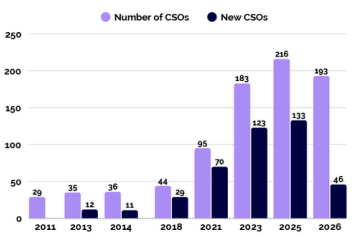
For the first time in fifteen years, the ranks of Chief Sustainability Officers (CSOs) at publicly listed U.S. companies have contracted. According to the latest data from the Weinreb Group—a preeminent authority on executive sustainability recruitment—the number of CSOs fell by 10 percent, dropping from 216 in 2025 to 193 as of July 1, 2026. This data point, which marks a stark reversal of a decade-long trend of consistent, if sometimes gradual, growth, has sent tremors through the corporate ESG (Environmental, Social, and Governance) community, prompting a broader debate about the future of sustainability in the boardroom.
A Chronology of the CSO Rise and Stall
To understand the current retraction, one must look at the meteoric rise that preceded it. During the 2010s, the role of the CSO evolved from a niche position—often relegated to communications or public relations departments—into a strategic executive function. By the early 2020s, as investor pressure regarding climate risk and social equity reached a fever pitch, the number of CSOs surged. This period, characterized by rapid growth in the first half of the decade, saw companies rushing to signal their commitment to decarbonization and sustainable supply chains.
The Weinreb Group, which conducts this comprehensive survey every 18 to 24 months, has tracked this trajectory with precision. In the years following 2020, the "CSO boom" was fueled by a convergence of regulatory pressure, changing consumer sentiment, and a tightening labor market for green talent. However, the data released in July 2026 indicates that the momentum has not only slowed; it has pivoted.
The decline reported this summer is not necessarily the result of mass layoffs or sudden departmental shutdowns. Instead, Ellen Weinreb, founder of the Weinreb Group, suggests the phenomenon is largely one of attrition. When a CSO moves on to a new role, companies are increasingly choosing not to backfill the position, effectively allowing the role to wither away through vacancy.
The "Sustainability Recession" and Political Headwinds
The thinning of these executive ranks has been labeled by industry observers as a symptom of a "sustainability recession." This term describes a broader cooling in corporate enthusiasm for aggressive ESG commitments, driven by a complex web of political and economic pressures.
The current U.S. administration has taken a more skeptical stance on mandatory climate disclosures and ESG-linked investments, creating a climate of uncertainty for corporations. This political environment, coupled with the legacy of anti-ESG activism led by prominent GOP figures over the last few years, has empowered some boards to step back from public commitments that previously felt like a competitive necessity.

Critics of the current trend argue that for many organizations, the CSO role was a reactive measure—a product of optics rather than operational necessity. When the external pressure to be seen as a climate leader dissipated, the justification for maintaining a high-level C-suite role vanished along with it. In this light, the departure of a CSO is not a strategic pivot but a retreat to a pre-sustainability status quo, where environmental impacts were considered secondary to quarterly earnings.
Operationalization: A Silver Lining?
However, industry experts like Ellen Weinreb caution against interpreting these numbers as a simple death knell for corporate sustainability. There is a more nuanced, and perhaps more optimistic, explanation for the decline: the operationalization of sustainability.
In some organizations, the "sustainability" mandate has become so deeply embedded in the company’s core business model that a standalone CSO is no longer viewed as a separate requirement. Instead, the responsibilities are being distributed across the C-suite. We are seeing a trend where environmental, social, and governance goals are being integrated directly into the mandates of Chief Operating Officers (COOs), Chief Financial Officers (CFOs), and even CEOs.
A prime example occurred in May 2026, when Tara Hemmer transitioned from her role as CSO at the environmental services firm WM to become the company’s Chief Operating Officer. This move is emblematic of a shift where sustainability expertise is seen as a prerequisite for general management rather than a siloed specialty. When a sustainability expert is promoted to a broader operational role, the firm is signaling that sustainability is not a side project, but the very business of the company.
This shift suggests a move toward maturity. If sustainability is truly "operationalized," it means the department is no longer an island, but a set of practices woven into the company’s daily functions.
Supporting Data: The 2026 State of the Profession
The Weinreb Group findings are corroborated by the Trellis State of the Sustainability Profession in 2026 report, which surveyed more than 500 sustainability professionals at companies with at least $1 billion in annual revenue. The data provides a more granular look at the workforce behind the executive titles.
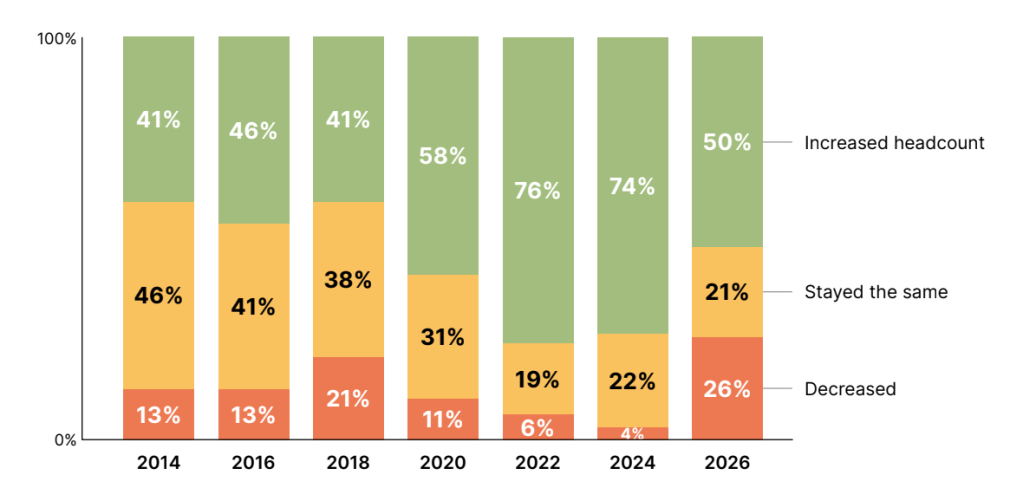
While the number of CSOs has dipped, the underlying staffing for sustainability teams remains relatively robust, albeit growing at a slower pace than in previous years. According to the Trellis report:
- 2024 Staffing: 74 percent of firms increased the size of their sustainability teams, while only 4 percent engaged in downsizing.
- 2026 Staffing: 50 percent of firms added headcount to their sustainability departments, while 26 percent saw a reduction in staff.
This indicates that while the C-suite role is being reconsidered, the "boots on the ground"—the managers, analysts, and project leads responsible for decarbonization and ESG compliance—are still being hired and retained. The slowing pace of growth reflects the broader economic caution seen across the tech and finance sectors, but it does not represent an industry-wide abandonment of sustainability goals.
Implications for the Future of ESG
The current contraction in CSO roles forces a necessary conversation about the efficacy of the position. For years, the CSO was a role defined by influence—a "change agent" tasked with convincing the rest of the company to adopt green practices. As we move into the latter half of the 2020s, the role is shifting toward implementation.
1. The Death of the "Symbolic" CSO
Companies that appointed a CSO primarily to pacify investors or improve public branding are likely the ones leading the current decline. As the market becomes more sophisticated at distinguishing between "greenwashing" and genuine decarbonization, these superficial roles are being exposed and eliminated. This is a healthy correction.
2. The Rise of the Operational Executive
We are likely to see more sustainability experts moving into roles like Chief Operating Officer or Chief Supply Chain Officer. This is the ultimate goal of the sustainability movement: to make the role of "Sustainability Officer" obsolete by ensuring that every executive is, in effect, a sustainability executive.
3. Regulatory Pressure vs. Political Volatility
While the political climate in the U.S. is currently hostile to aggressive ESG mandates, global regulatory trends—particularly in the European Union and emerging standards from the International Sustainability Standards Board (ISSB)—continue to force multinational companies to maintain high standards of reporting. A U.S.-based company cannot easily abandon sustainability if it operates in international markets that demand rigorous climate disclosure.
4. The Talent Gap
For professionals currently in the sustainability field, the shifting landscape means that "sustainability" is no longer a sufficient skill set on its own. The future demand will be for professionals who can marry sustainability goals with traditional business metrics—finance, supply chain logistics, and engineering.
Conclusion: A Maturation, Not a Retreat
Is the decline in the number of Chief Sustainability Officers a sign that the movement is failing? The data suggests the answer is no. While the "easy growth" phase of the early 2020s has ended, and the political winds have grown colder, the professional field of sustainability is showing signs of professionalization and integration.
The departure of a CSO is a headline-grabbing event, but it is often the precursor to a more structural change within an organization. Whether this represents a genuine commitment to operationalizing sustainability or a convenient excuse to cut costs remains to be seen. However, as the 2026 reports show, the workforce dedicated to these issues is still growing, and the mandates for climate action remain a core concern for the world’s largest companies. The CSO may be vanishing, but the work they started is likely just moving into the machinery of the enterprise.