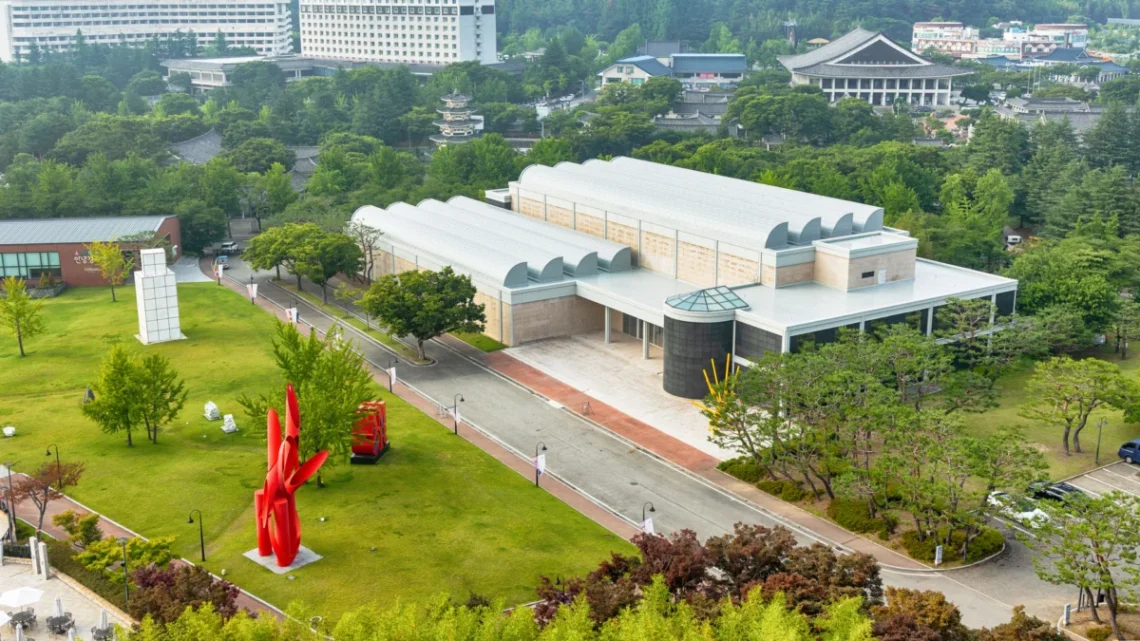
For over thirteen years, a quiet but intense legal war has been waged behind the scenes of the South Korean art world, pitting one of the nation’s most prominent collectors against a corporate entity over the possession of nearly 200 high-value artworks. The dispute, centered on the prestigious Wooyang Museum of Art in Gyeongju, has finally reached a judicial milestone, yet the verdict serves more as a complication than a resolution.
In a ruling that has sent ripples through the Korean art market, a court has ordered the Wooyang Museum of Art to return only three pieces to the museum’s founder, Jeong Hee-ja. While this represents a partial victory for the collector, it effectively denies her claim to the vast majority of the 188 works she sought to reclaim. As the legal battle continues into the appellate stage, the case highlights the murky intersection of private collection management, corporate acquisition, and the precarious nature of "loaned" property within institutional settings.
The Verdict: A Mixed Bag of Judicial Findings
The recent court ruling is a study in legal nuance. Judge Kim Chang-mo, presiding over the case, granted Jeong Hee-ja’s request for the return of three specific masterpieces: two monumental installations from Nam June Paik’s seminal 1989–91 series, My Faust, and a work by the influential German painter Sigmar Polke.
The court’s decision to return these items was rooted in tangible, indisputable evidence. The judge cited direct testimony from the art dealer who originally facilitated the sales to Jeong, corroborating testimony from a former museum curator, and, perhaps most pivotally, verified bank transfer records confirming the use of Jeong’s personal funds for the acquisitions.
However, for the remaining 185 artworks in question, the court found the evidence of ownership insufficient. The ruling underscores a recurring problem in institutional archiving: the lack of a standardized, legally binding documentation process during the museum’s formative years. For Jeong, the result is a significant setback, leaving the bulk of her claimed collection within the walls of the Gyeongju institution.
A Chronology of a Disputed Legacy
The origins of this conflict trace back to 1991, when Jeong Hee-ja, a celebrated hotelier and wife of the late Kim Woo-chong, the founding chairman of the Daewoo Group, established the Art Sonje Museum in Gyeongju. Located in a city that served as the ancient capital of the Silla Kingdom, the museum was intended to be a beacon of contemporary culture.
The Timeline of Conflict:
- 1991: Jeong Hee-ja founds the Art Sonje Museum in Gyeongju, initially operated under the umbrella of Daewoo Development.
- 1998: Jeong expands her cultural footprint by opening the Art Sonje Center in Seoul, which continues to operate independently of the Gyeongju museum today.
- 2012: A turning point occurs when Daewoo Development—the parent company of the Gyeongju museum—is acquired at auction by Wooyang Industrial Development. The museum is subsequently rebranded as the Wooyang Museum of Art.
- 2013: Jeong formally contacts the new owners, Wooyang Industrial Development, asserting that nearly 200 works housed in the museum were personal acquisitions loaned to the institution with the understanding that they could be reclaimed at any time.
- 2014–2025: A protracted period of negotiation, documentation disputes, and failed mediations ensues. During this time, the company returns nine works to Jeong and her daughter as a goodwill gesture, while digging in its heels regarding the rest.
- 2026: The court issues its initial ruling, granting the return of only three works and triggering an appeal from the museum’s current owners.
The "M" Code: A Flawed Archival System
Central to the legal drama is the cataloging system employed during the museum’s early years, when Jeong served as director. To differentiate between institutional acquisitions and private loans, Jeong implemented a specific coding system. Works identified as personal property were supposedly tagged with the code "M" (short for "museum").
In court, Jeong argued that the "M" code served as a definitive mark of ownership. However, the defense presented testimony from a curator who revealed that the "M" designation had been used inconsistently. According to the curator, the code was frequently applied to works whose provenance was unknown or whose ownership status was ambiguous at the time of accession.
The court ultimately agreed with the museum’s assessment. Judge Kim noted that the "M" codes were assigned "arbitrarily," rendering them unreliable as a legal instrument for proving ownership. This discrepancy serves as a cautionary tale for art collectors who rely on internal administrative shortcuts rather than formal, legally notarized loan agreements.
Corporate Shifts and the "Daewoo" Shadow
The dispute over these 188 artworks is not an isolated event; it is a single, albeit highly visible, chapter in a larger, more complex saga between the family of the late Kim Woo-chong and the corporate successors of the Daewoo Group.
When Wooyang Industrial Development acquired Daewoo Development at auction in 2012, it inherited not just the real estate and the operating licenses, but also the entire contents of the museum. The corporate culture of the new owners, focused on formal "objective evidence," clashed immediately with the more informal, trust-based management style that had characterized Jeong’s tenure.
For Wooyang Industrial Development, the goal is clear: to maintain the integrity and inventory of the institution they purchased. For the company, returning these works would be akin to stripping the museum of its core collection, potentially diminishing its historical value and cultural prestige. Consequently, the company has filed an appeal to challenge the court’s decision to return even the three Nam June Paik and Sigmar Polke pieces.
Broader Implications for the Art Market
The implications of this case extend far beyond the borders of South Korea. It raises critical questions for art collectors globally:
- The Fragility of Loans: Collectors who place their art in museums they have founded or supported often assume that their ownership rights will remain inviolable. This case demonstrates that in the event of corporate restructuring or ownership changes, verbal agreements and internal coding systems are rarely sufficient to protect assets.
- The Necessity of Formal Documentation: The "M" code failure serves as a stark reminder that administrative convenience is no substitute for legal provenance. For collectors, the lesson is clear: every work loaned to an institution—even one you own—should be backed by a formal, written loan agreement that is updated periodically.
- Institutional Continuity: The case highlights the vulnerability of collections when the original visionaries of a museum are no longer in control. When a museum changes hands, the new board or owners may have a different interpretation of the institution’s obligations to its founder.
Looking Ahead: The Appeal
As the case moves to the appellate court, the legal community and the art world remain divided. Some view the court’s reliance on "objective evidence" as a necessary move toward professionalizing the art market, while others express sympathy for the founder whose vision created the institution in the first place.
For now, the three works ordered for return remain in limbo as the appeal process begins. The resolution of this case will likely set a precedent for how Korean courts handle disputes involving institutional art holdings in the future. Whether the Wooyang Museum of Art will be forced to relinquish more of its collection, or if the court will solidify its current stance, remains to be seen. One thing is certain: the legacy of the Art Sonje Museum will forever be tied to this bitter, expensive struggle for the ownership of its own walls.