By Maritime & Conservation Reporting Desk
Updated October 2026
Main Facts
The New Jersey-based luxury boatbuilder Viking Yacht Company is aggressively lobbying the National Oceanic and Atmospheric Administration (NOAA) to accelerate the modernization of federal vessel-speed regulations designed to protect the critically endangered North Atlantic right whale. Viking argues that blanket speed restrictions—which have governed U.S. East Coast waters for nearly two decades—are outdated, economically burdensome to recreational boaters, and ultimately unnecessary in the face of modern, high-tech marine mammal detection systems.
At the heart of Viking’s advocacy is the integration of cutting-edge detection technology, including high-resolution marine radar, infrared thermal imaging, acoustic monitoring, and artificial intelligence (AI) classification software. Rather than forcing vessels 65 feet and longer to slow to a restrictive 10 knots (11.5 mph) across vast Seasonal Management Areas (SMAs), Viking contends that real-time tracking can pinpoint whale locations dynamically. This allows boaters to maintain safe speeds while actively avoiding marine life only when and where it is present.
This high-stakes policy debate has been galvanized by a recent executive order signed on September 17, which directs the Department of Commerce and NOAA to leverage private-sector technological advancements in marine mammal avoidance. Capitalizing on this directive, Viking sent a formal letter on September 18 to NOAA Administrator Neil Jacobs, urging the agency to fast-track its ongoing rulemaking process and collaborate directly with marine electronics developers and boatbuilders who have spent years testing practical solutions on the water.
Chronology of the Right Whale Speed Rule and Industry Pushback
2008: The Baseline Regulation Takes Effect
NOAA originally established the North Atlantic right whale vessel-speed rule in 2008 in response to alarming population declines driven largely by vessel strikes and commercial fishing gear entanglements. The regulation mandated that most vessels measuring 65 feet and longer must reduce their speed to 10 knots or less when traveling through designated Seasonal Management Areas along the U.S. Atlantic seaboard during times when whales are statistically most likely to be present. While well-intentioned for conservation, the rule created friction with recreational sportfishing and cruising communities, who argued that a blanket 10-knot limit compromised vessel handling in rough seas and severely restricted travel times without accounting for actual whale locations.
2022: Viking Launches the WAVS Taskforce
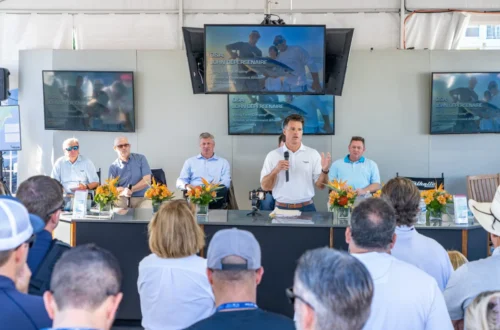
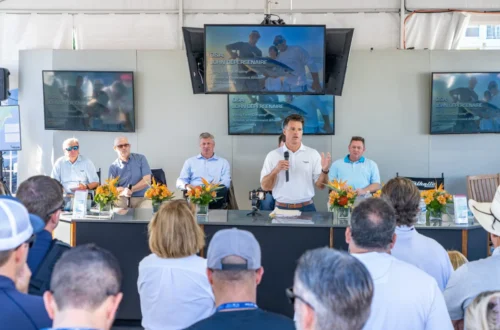
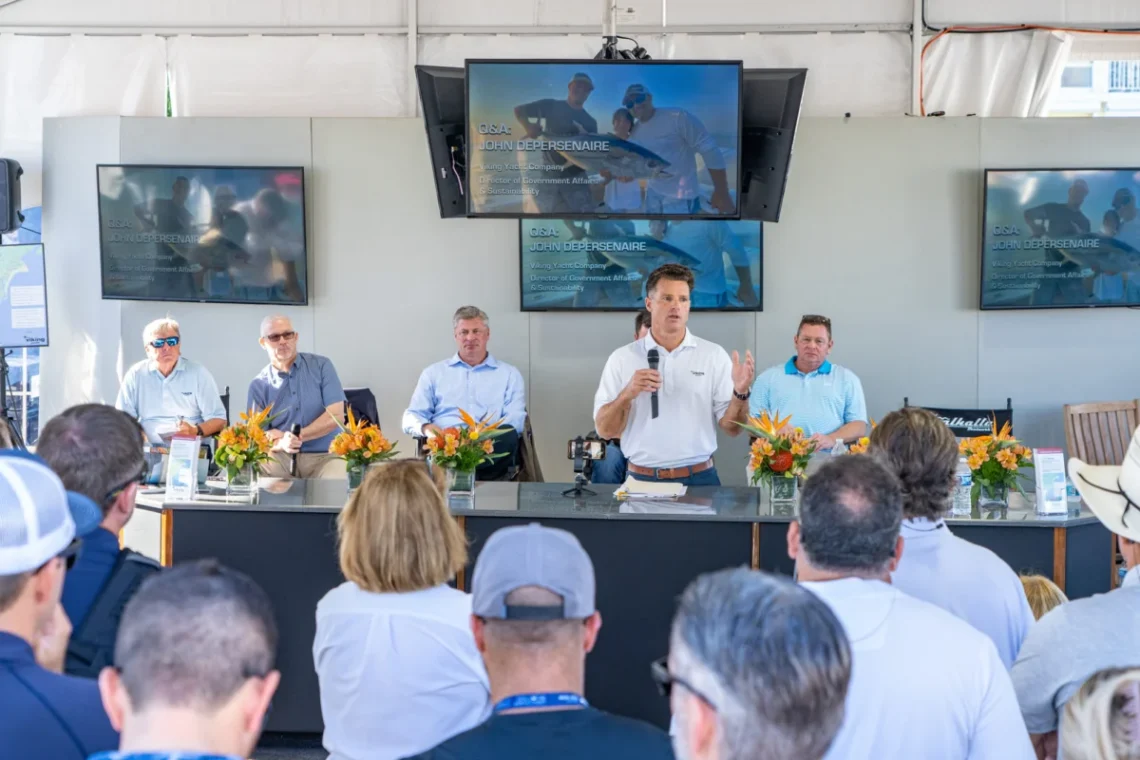
Recognizing that the regulatory stalemate was unlikely to resolve through conventional political lobbying alone, Viking Yacht Company took a proactive approach. During the 2022 Fort Lauderdale International Boat Show, Viking launched the Whale and Vessel Safety (WAVS) Taskforce. Headed by John DePersenaire, Viking’s Director of Government Affairs and Sustainability, the task force was created to bridge the gap between marine conservation and modern boating operations.
To test viable alternatives, the WAVS Taskforce outfitted a 24-foot Contender research boat with advanced electronics suites, infrared cameras, and experimental AI software designed to pick up whale blows and fin breaches against dynamic ocean backdrops.
March 2026: NOAA Opens Advance Notice of Proposed Rulemaking
After years of pressure from maritime stakeholders, conservationists, and boating associations, NOAA took a major step toward regulatory reform in March 2026. The agency opened an Advance Notice of Proposed Rulemaking (ANPR) to solicit public and industry input regarding potential modifications to the 2008 framework. NOAA indicated it was actively exploring whether blanket seasonal restrictions could be supplemented—or even replaced—by alternative management zones and technology-based strike-avoidance frameworks.
September 2026: Executive Action and Viking’s Formal Appeal
The debate accelerated dramatically in mid-September 2026. On September 17, the White House issued an executive order mandating that the Department of Commerce and NOAA incorporate private-sector innovations into marine mammal protection strategies. Capitalizing on this momentum, Viking fired off its September 18 letter to NOAA Administrator Neil Jacobs. The letter called for immediate action to integrate the technological milestones achieved by the WAVS Taskforce and other marine electronics pioneers over the previous 18 years.
Supporting Data and Technological Evolution
To understand Viking’s urgency, one must examine how far marine electronics have advanced since 2008. When the original speed rule was enacted, real-time electronic detection of marine mammals was in its infancy, relying primarily on visual spotters aboard slow-moving ships or passive acoustic monitoring arrays that could register whale vocalizations hours after an animal had passed through an area.
Today, the landscape is entirely transformed. Through the WAVS Taskforce, Viking and its partners—including major marine electronics manufacturers and software developers—have demonstrated that multi-sensor fusion can reliably detect whales from a distance:
- Artificial Intelligence and Machine Learning: Modern AI software can ingest high-definition video feeds, filtering out whitecaps, seabirds, and floating debris to specifically identify the distinct silhouette or blow (spout) of a North Atlantic right whale in real time.
- Thermal Infrared Imaging: Infrared cameras allow vessels to spot the heat signature of a whale’s blow or dorsal surface even in low-visibility conditions, such as fog or night operations, when visual spotting fails entirely.
- Advanced Radar Integration: Specialized marine radar algorithms can detect surface anomalies and biological returns that correlate with large marine mammals, alerting operators well before a visual sighting is possible.
- Dynamic Data-Sharing Networks: Modern systems do not rely solely on onboard sensors; they tap into crowdsourced sightings, aerial drone patrols, and acoustic buoy networks, compiling a live heat map of whale locations that can be broadcast directly to a boat’s multi-function display (MFD).
Proponents of this technology argue that a dynamic, tech-enabled management approach offers vastly superior conservation outcomes compared to static 10-knot boundaries. Under the current rule, a vessel can be forced to slow down in an enormous zone for months, even if not a single right whale is within 100 miles. Conversely, technology allows for targeted slow-down zones or immediate course corrections only when an animal’s exact GPS coordinates are confirmed in the vessel’s immediate path.
Official Responses and Perspectives
Viking Yacht Company
Viking leadership has maintained a dual commitment: protecting an endangered species while ensuring that recreational boating and sportfishing remain viable, safe industries.
"We have been working on this since 2022 because technology has to be part of the solution," said Viking President and CEO Pat Healey. "We want to protect the whales, we want to make boating safer and we want a rule that reflects how today’s recreational boats operate."
John DePersenaire echoed this sentiment, emphasizing that eighteen years of technological innovation cannot be ignored by federal regulators.
"Technology has emerged as a way to address this important conservation issue without unnecessarily restricting boaters," DePersenaire stated following the September executive order. "We have made great progress since the rule took effect 18 years ago, and it’s time to acknowledge that progress and modernize the rule accordingly."
NOAA and Federal Regulators
NOAA faces a complex balancing act. On one side are marine conservation organizations that point out the perilous state of the North Atlantic right whale population—which is estimated to number fewer than 370 individuals—arguing that even a single vessel strike can prove fatal to a calf or breeding female. On the other side are commercial shipping, tug-and-barge, and recreational boating industries that face financial losses, logistical bottlenecks, and safety concerns due to extended transit times.
While NOAA’s Advance Notice of Proposed Rulemaking shows a willingness to consider technological alternatives, the agency has maintained that any new framework must guarantee a level of protection equal to or greater than the current seasonal restrictions. NOAA scientists and regulators are rigorously evaluating the false-positive rates of AI detection systems, sensor reliability in heavy seas, and the logistics of verifying compliance if vessels rely on onboard electronics rather than mandatory speed cutoffs.
Implications for Boaters, Manufacturers, and Marine Conservation
If NOAA ultimately incorporates AI and detection technology into a modernized right whale rule, the implications for the maritime sector will be profound:
1. A Shift from Static to Dynamic Management
The regulatory paradigm could shift from arbitrary geographical boundaries and rigid calendar dates to real-time, adaptive management areas. Boaters would no longer face blanket 10-knot restrictions hundreds of miles offshore where no whales exist; instead, they would receive dynamic warnings and localized speed advisories based on active telemetry.
2. A Booming Market for Marine Electronics
The validation of detection technology by federal regulators would create an immediate commercial market for AI-powered avoidance systems. Marine electronics giants like Garmin, Furuno, Simrad, and Raymarine—along with specialized software startups—could see surging demand to integrate certified whale-detection suites directly into factory-installed helm electronics.
3. Enhanced Safety Beyond Whales
The very same sensor suites, thermal cameras, and AI recognition software designed to spot a 40-ton right whale can double as collision-avoidance tools for unlit navigational hazards, floating shipping containers, rogue logs, and small craft at night. Consequently, modernizing the rule could drive a broader safety revolution across the recreational and commercial marine sectors.
4. Collaborative Conservation
By demonstrating that industry stakeholders are willing to fund and build technological solutions rather than simply fighting conservation mandates in court, Viking’s initiative establishes a new model for environmental stewardship. It proves that technological innovation can reconcile the seemingly opposed goals of protecting marine biodiversity and preserving the freedom of the seas.
Next Steps in the Regulatory Process
While the executive order and Viking’s lobbying have injected fresh urgency into the debate, any formal alterations to the federal speed rule remain subject to standard administrative procedures. NOAA’s evaluation of the March ANPR feedback, combined with ongoing field trials from the WAVS Taskforce, will feed into a formal proposed rulemaking phase. That upcoming phase will include mandatory public comment periods, giving boaters, manufacturers, and conservationists an opportunity to shape the final rule before it takes legal effect.