
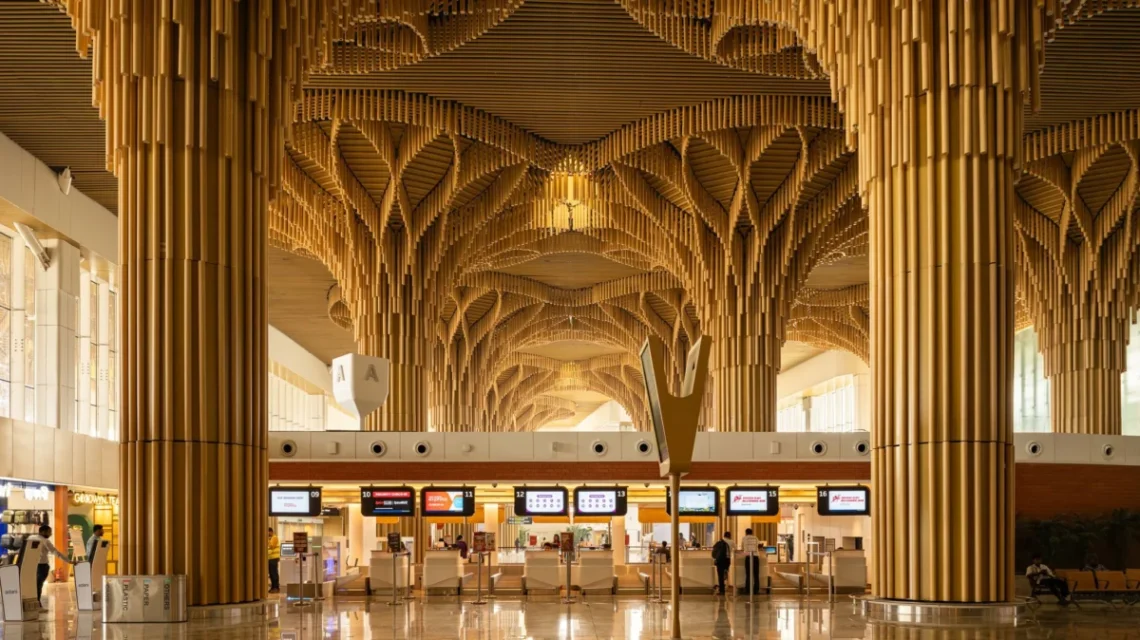
For decades, the airport terminal was viewed primarily as a functional necessity—a sterile, stress-inducing purgatory of security lines and fluorescent lighting designed only to move bodies from point A to point B. However, a new paradigm is shifting the architecture of aviation. On June 15, 2026, the prestigious Prix Versailles organization unveiled its list of the world’s most beautiful airports, highlighting a global cohort of terminals that have successfully transformed into architectural landmarks, cultural conduits, and civic assets.
From the lush, bamboo-inspired "sky forests" of northeast India to the ethereal, lotus-shaped canopies of Mumbai, these seven selected terminals—spanning China, Germany, India, Cambodia, and the United States—serve as proof that the modern airport is evolving into a destination in its own right.
The Evolution of the Airport: A New Architectural Standard
The Prix Versailles awards, which recognize outstanding contemporary design across various sectors, have signaled a definitive departure from the utilitarian designs of the 20th century. According to the organization, the seven winning terminals demonstrate a sophisticated balance: they must meet the crushing demands of high-volume global travel while simultaneously fostering a "meaningful sense of place."

Jérôme Gouadain, Secretary General of the Prix Versailles, notes that these airports have become "innovative, inescapable hallmarks of their regions and their eras."
"They are innovative because they resolve the apparent conflict between the increasing frequency of travel and the need for speed," Gouadain explains. "They provide a singularity of form in a type of tourism that aims to be accessible, valuing people’s time in spaces that can no longer be described as mere ‘transfer’ zones."
These structures are not just buildings; they are economic and cultural engines. By integrating local landscapes, sustainable materials, and intuitive flow, they aim to unify disparate societies and leave a positive, lasting footprint on the land they occupy.
.jpg)
Chronology of Design and Delivery
The road to these architectural masterpieces was long, involving years of planning, massive engineering feats, and a complete rethink of how passengers experience movement.
- 2020–2022: Initial planning phases focused on modularity and sustainability, with projects like Frankfurt’s Terminal 3 aiming for long-term adaptability.
- 2023–2024: Major construction milestones were hit globally, particularly in Asia, where land reclamation (Navi Mumbai) and complex structural engineering (Techo, Cambodia) defined the year’s progress.
- 2025: A "banner year" for aviation architecture, seeing the opening of the Navi Mumbai International Airport and the near-completion of major American transit hubs like Pittsburgh and San Diego.
- June 2026: The official unveiling of the Prix Versailles List, cementing these seven terminals as the gold standard for global airport design.
The Global Winners: A Deep Dive into the Design
1. Guangzhou Baiyun International Airport, Terminal 3 (China)
Known as the "City of Flowers," Guangzhou has set a new benchmark for transport scale. Designed by Artelia in collaboration with the Guangdong Architectural Design and Research Institute, T3 is a symphony of clouds, water, and blossoms. The terminal’s organic forms act as natural wayfinders, guiding passengers through light-filled atriums. The standout feature is the airport’s open-air public observation deck—the highest in China—which allows travelers to reconnect with the mechanical wonder of flight.
2. Frankfurt Airport, Terminal 3 (Germany)
Architect Christoph Mäckler envisioned a terminal that functions like a city. Instead of long, monotonous corridors, the terminal is organized around plazas and neighborhood squares, offering travelers intuitive orientation. The interior is punctuated by massive, rotating aluminum rings that provide a sense of movement. Crucially, the terminal is built on a modular system, ensuring the building can evolve as passenger demographics and aviation technologies shift.

3. Lokapriya Gopinath Bardoloi International Airport, Terminal 2 (India)
In Guwahati, the terminal pays homage to the bamboo orchid. Architect Nuru Karim has created an indoor landscape beneath sweeping vaulted ceilings, evoking the dense vegetation of northeast India. The patterns etched overhead trace the course of the Brahmaputra River, turning the ceiling into a navigable map. The inclusion of Indigenous art and tribal stories throughout the lounges has successfully converted waiting areas into vibrant, informal galleries.
4. Navi Mumbai International Airport, Terminal 1 (India)
Designed by the legendary Zaha Hadid Architects, this terminal is a marvel of engineering. The roof is designed as a blooming lotus, with petals appearing to float above the terminal structure. The project required monumental interventions, including the redirection of rivers and the reclaiming of marshland. Inside, the lotus motif extends to fluted, flower-like columns that provide a sense of organic grace to the high-traffic terminal halls.
5. Techo International Airport (Cambodia)
Foster + Partners have designed a structure that mimics the grandeur of a Cambodian palace. The undulating canopy uses traditional basketry-inspired ceilings to filter sunlight, significantly reducing the reliance on artificial lighting. Giant structural columns branch out like trees, and native rumduol trees—Cambodia’s national flower—are integrated into the terminal’s core. The layout is deliberately simple, prioritizing short, clear walking paths.

6. Pittsburgh International Airport (United States)
Pittsburgh’s new terminal draws inspiration from the Allegheny Mountains. Beneath a rolling roofline, 38 steel columns branch out to create a "man-made forest." Designed by Gensler and HDR in association with Luis Vidal + Architects, the terminal emphasizes natural light through vast glass walls. The project also features a "Petal Tunnel," an immersive art installation that mimics the cinematic reveal of the city’s skyline, effectively linking the airport to the identity of the city.
7. San Diego International Airport, Terminal 1 (United States)
San Diego’s expansion is defined by an 800-foot-long curved glass wall. Developed by Gensler and artist James Carpenter, the design brings the city’s legendary sunshine indoors while utilizing specialized glazing to keep the space cool. The structural efficiency of the design allowed for the removal of numerous columns, creating an airy, open space that reduced the building’s carbon footprint by 30%.
Supporting Data: Why Design Matters
The focus on "beautiful" airports is not merely an aesthetic vanity project; it is grounded in economic and psychological data. Research from organizations like the International Air Transport Association (IATA) suggests that high-quality, biophilic design (the integration of nature into buildings) can reduce passenger stress levels by as much as 20%.

Furthermore, these airports are achieving superior efficiency. For example, San Diego’s 30% reduction in carbon footprint via smart structural design proves that sustainability and aesthetic excellence are not mutually exclusive—they are often interdependent.
Official Responses and Industry Implications
The aviation industry is taking note. As airlines compete for passenger loyalty, the "airport experience" has become a competitive differentiator.
"We are seeing a move away from the ‘machine for travel’ model," says an industry consultant present at the Paris reveal. "The airport is now the first and last impression a traveler gets of a country. These winning terminals aren’t just housing airplanes; they are housing culture, art, and the history of their regions."

The Prix Versailles committee confirmed that three of these seven projects will be awarded additional world titles for interior and exterior design later this year. This competitive environment is pushing architects to take more risks, resulting in buildings that function as museums, gardens, and community hubs rather than simple warehouses for passengers.
Implications for the Future
The implications of these projects are profound. As urbanization continues and air travel volume is projected to double by 2040, the "airport-as-a-city" model is likely to become the standard.
The successful implementation of these designs suggests three core trends for the coming decade:

- Biophilic Integration: The use of trees, water features, and natural light will become the minimum requirement for new, high-end terminal construction.
- Cultural Storytelling: Airports will continue to act as "gateways" to local culture, utilizing art and architecture to tell the story of the host region.
- Flexibility and Modularity: As technology changes (from baggage handling to security screening), airports must be modular enough to adapt without the need for massive, disruptive renovations.
As we look toward 2026 and beyond, the message from the Prix Versailles is clear: the era of the bland airport terminal is over. In its place rises a new generation of transit infrastructure—one that seeks to soothe, inspire, and connect, proving that the journey can be just as memorable as the destination.