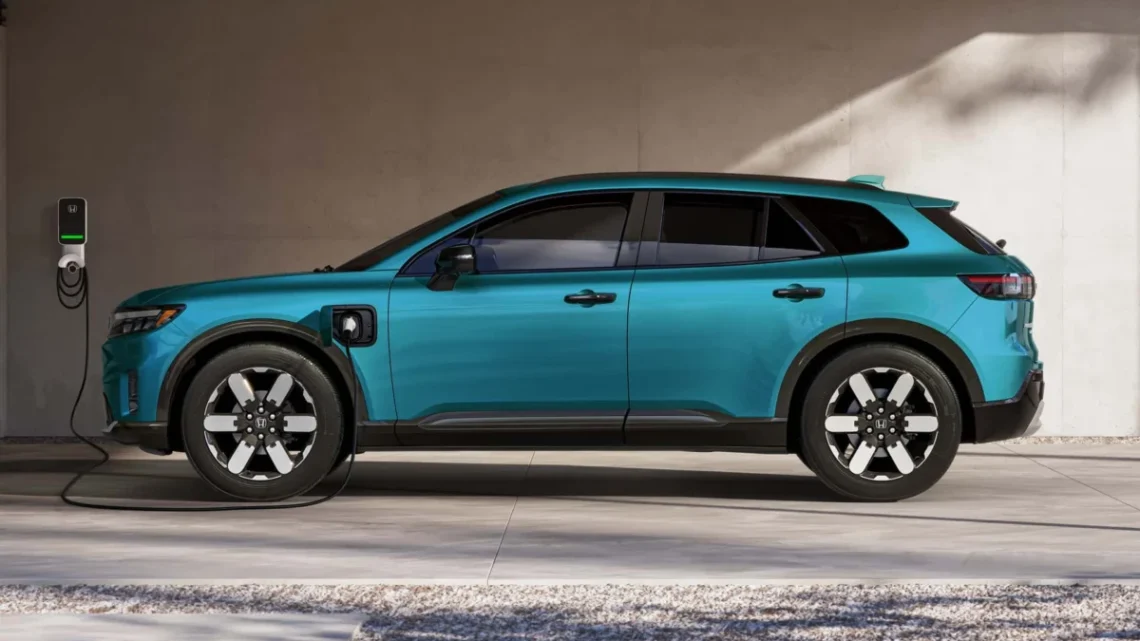
The landscape of the American automotive industry is undergoing a seismic shift, and Honda—a company long celebrated for its engineering pragmatism—has just signaled a total change in direction. In a move that confirms weeks of industry speculation, Honda has officially announced the discontinuation of the Prologue, its first and only mass-market battery-electric vehicle (BEV) in the United States.
With the Prologue’s end-of-life set for the conclusion of the 2026 model year, the Japanese automaker finds itself in an unusual position: as of 2027, the company will have zero fully electric vehicles in its U.S. showroom. This pivot marks a definitive retreat from the aggressive electrification timelines that defined the industry’s outlook just two years ago, signaling a massive corporate reallocation of resources toward the company’s hybrid and internal combustion engine (ICE) heritage.
The Chronology of a Short-Lived Era
The rise and fall of the Honda Prologue is a case study in how quickly market sentiment can oscillate in the modern automotive era. Developed in a strategic partnership with General Motors, the Prologue utilized GM’s Ultium platform, allowing Honda to rapidly deploy an EV to meet immediate consumer demand and regulatory pressures.
When the Prologue arrived in early 2024, it was heralded as the "dawn of a new era" for the brand. It was designed to bridge the gap between Honda’s loyal internal-combustion customer base and the burgeoning EV movement. However, the window for this specific transition proved to be remarkably narrow.
- 2023: Honda begins aggressive marketing campaigns for the Prologue, positioning it as the spearhead of a new electric lineup.
- Early 2024: The Prologue launches to generally favorable reviews, though it enters a market already showing signs of EV saturation and cooling buyer interest.
- Late 2024–2025: High interest rates, the expiration of federal tax incentives for many models, and persistent infrastructure anxieties lead to a significant slowdown in EV adoption across the U.S.
- March 2025: Acura (Honda’s luxury division) confirms that the planned electric RSX crossover is being scrapped.
- Late 2025: The Acura ZDX, the Prologue’s premium counterpart, is officially pulled from the market.
- Mid-2026: Honda formally confirms the end of production for the Prologue.
- 2027: The final units of the Prologue are expected to clear dealer lots, leaving Honda with a purely gasoline and hybrid portfolio.
The "Shift in Demand": Explaining the Withdrawal
The rationale behind the cancellation is as much about economics as it is about engineering. In a statement provided to CarBuzz and Motor1, a Honda representative noted that "customer demand for EV models has shifted significantly over the past 18 months."
This corporate sentiment reflects a broader industry reality. The initial "early adopter" phase of the EV transition—where enthusiasts were eager to purchase the latest technology regardless of price or charging limitations—has largely concluded. The "mass market" consumer, whom Honda relies on for its volume sales, has proven to be more cautious.
For the average American buyer, the barrier to entry for EVs remains high. Between the higher sticker prices compared to traditional equivalents and the fluctuating availability of federal subsidies, consumers have increasingly turned back to the familiar reliability of hybrids. Honda, recognizing this, has decided not to force a transition that the market is not yet ready to fully embrace.
Implications: A Strategic Reinvestment in Hybrids
With the electric experiment paused, Honda is doubling down on its hybrid strategy. The company has announced a massive capital expenditure—approximately ¥4.4 trillion (roughly $28 billion)—to overhaul its powertrain lineup by 2030.
The goal is to launch 15 new models powered by a next-generation hybrid system by the end of the decade. This new system promises to be roughly 10 percent more fuel-efficient than the current architecture, which was only introduced in 2023. By focusing on hybrids, Honda is betting that the consumer desire for lower fuel consumption and reduced emissions can be satisfied without the need for expensive, heavy, and charging-dependent battery packs.
This strategy serves two purposes. First, it allows Honda to maintain its reputation for high fuel economy and reliability without the volatility associated with the current EV market. Second, it provides the company with a buffer, allowing it to continue generating the high profit margins associated with its ICE and hybrid lineups while waiting for the next generation of battery technology to mature.
The Shelved Future: What Could Have Been
The cancellation of the Prologue is not an isolated incident; it is part of a wider pruning of Honda’s electric aspirations. During the height of the "EV rush," Honda teased several ambitious projects, including the "0 Series"—a suite of futuristic, purpose-built electric vehicles that were supposed to redefine the brand’s design language.

The 0 Series sedan and SUV concepts, which were presented with great fanfare in Tokyo, were meant to be the technological flagships of the company. However, these vehicles have now been shelved, likely indefinitely. The decision to halt these projects indicates that Honda is not merely pausing the Prologue; it is reconsidering the entire infrastructure of its electric vehicle strategy.
For the time being, the "0 Series" remains a design study rather than a production reality. This decision underscores the severity of the company’s pivot: Honda is essentially "hitting reset" on its electrification journey, opting to wait until it can produce EVs that are more profitable, more efficient, and better suited to the infrastructure realities of the American market.
The Dealer Network and Customer Support
For those who already own a Prologue or were considering one, Honda has moved to mitigate concerns regarding long-term ownership. The company’s official stance is that current Prologue owners will be fully supported.
"Prologue customers will continue to receive full support through our dealer network, including service, parts, and warranty coverage," the company stated. While the car is being removed from the new-vehicle lineup, Honda is legally and operationally committed to maintaining the vehicle for the duration of its expected lifecycle. This is a critical assurance, as the depreciation of "orphaned" vehicles—models that are discontinued shortly after purchase—is a major fear for potential buyers.
Industry Outlook: Is This a Trend?
Honda is not the only manufacturer reconsidering its pace. Ford, General Motors, and even some European luxury brands have recently adjusted their electric production targets in the face of cooling demand.
However, Honda’s move is particularly striking because it represents a complete temporary exit from the segment. While other manufacturers are slowing their growth, they are maintaining their EV presence. Honda’s decision to go from a portfolio that included an EV to one that has none is a testament to the company’s conservative, long-term approach to business.
Industry analysts suggest that Honda’s move is a "wait-and-see" approach. By focusing on hybrids, the company can satisfy emissions regulations and consumer demand simultaneously. If the market shifts again in five or ten years, Honda will be in a strong financial position to jump back into the EV space with a more mature, cost-effective product, rather than struggling to force a product into a market that isn’t buying.
Final Thoughts: The Road Ahead
The death of the Honda Prologue is a sobering reminder that the automotive industry’s transition to electrification will not be a straight line. It is a complex, multi-decade process prone to detours, pivots, and corrections.
For Honda, the message is clear: they are not abandoning the future, but they are refusing to be dictated by the hype cycle of the present. By refocusing on their core competency—the highly efficient, reliable, and affordable internal combustion engine and hybrid—Honda is prioritizing stability in an era of uncertainty.
As we look toward 2027, the American automotive landscape will be missing a familiar electric face. Yet, for Honda, this is not an end, but a recalibration. The company is betting that the most successful automaker of the 2030s will not be the one that arrived first, but the one that arrived at the right time with the right technology. For now, that technology is the hybrid.