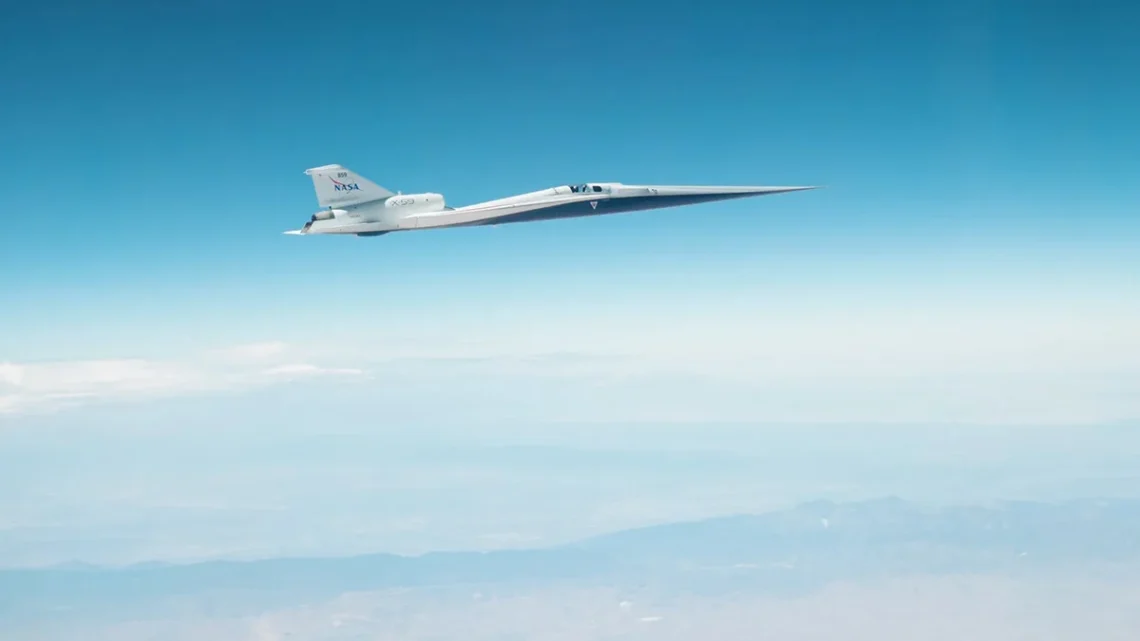
For over five decades, the skies over the United States have been strictly regulated regarding the speed of sound. Since 1973, the Federal Aviation Administration (FAA) has prohibited civil supersonic flight over land, a policy dictated by the disruptive, window-rattling "sonic boom" that defined the era of the Concorde. However, a revolutionary shift is occurring in the skies above the Mojave Desert. NASA’s X-59, an experimental aircraft developed in close collaboration with Lockheed Martin, is not merely breaking the sound barrier—it is breaking the paradigm of what supersonic travel sounds like.
The Dawn of a New Supersonic Era: Main Facts
The X-59, the centerpiece of NASA’s Quesst (Quiet SuperSonic Technology) mission, has officially entered its high-speed testing phase. During two pivotal flights in June, the aircraft proved that its radical aerodynamic design functions exactly as predicted under real-world conditions.
Unlike traditional supersonic jets that displace air into a concentrated shock wave, the X-59 utilizes a unique, needle-like geometry and wing configuration designed to prevent these shock waves from coalescing into the thunderous boom associated with high-speed flight. The goal is to reduce the sound from an explosive 105 decibels—comparable to a loud clap of thunder—to a mere "thump" of approximately 75 decibels, a noise level akin to a car door slamming in the distance.
This aircraft is not designed for passenger transport; it is a single-seat research platform. Its primary purpose is to collect acoustic data that will be used to convince regulators that the ban on overland supersonic flight is no longer necessary. If successful, the X-59 will provide the regulatory foundation for a new generation of commercial aircraft that could cut cross-country flight times in half without disturbing the communities beneath their flight paths.
A Chronology of Progress
The journey to the recent June test flights has been a multi-year engineering marathon involving some of the brightest minds in aerospace.

- October 2025: The X-59 completed its long-awaited maiden flight, a successful shakedown cruise that verified the basic flight control systems and structural integrity of the aircraft.
- Early 2026: NASA engineers spent several months analyzing telemetry data from the maiden voyage, ensuring that the jet’s flight control software and propulsion systems were ready for higher-risk maneuvers.
- June 5, 2026: The X-59 reached a major milestone by breaking the sound barrier for the first time. During an 81-minute mission originating from Edwards Air Force Base in California, the jet reached a top speed of Mach 1.1 (approximately 713 mph) at an altitude of 43,400 feet.
- June 12, 2026: Building on the success of the previous week, the team pushed the envelope further. The aircraft reached a top speed of Mach 1.4 (approximately 924 mph) at an altitude of 55,000 feet. This second flight was particularly significant, as it subjected the airframe to the exact speed and altitude parameters that will be used during upcoming public community response tests.
Engineering the “Quiet” Boom: Supporting Data
The X-59’s design is a departure from conventional aerospace aesthetics. It measures roughly 100 feet in length—about half the size of the iconic Concorde—but features an exceptionally long, thin nose that accounts for nearly a third of the aircraft’s total length.
The physics behind the "quiet" boom are grounded in the management of shock waves. In a standard supersonic jet, air pressure waves are pushed away from the aircraft in a concentrated, conical structure. When these waves reach the ground, they arrive simultaneously as a singular, intense pressure spike—the sonic boom. The X-59’s geometry is engineered to ensure that these pressure waves do not overlap. Instead, they reach the ground as a series of small, rapid pulses that the human ear perceives as a soft, muffled thud rather than a violent shock.
During the recent test flights, the X-59 was shadowed by a NASA F-15 research aircraft. The F-15, which produces a traditional sonic boom, served as both a chase plane and a benchmark. While the presence of the F-15 made it difficult to isolate the X-59’s specific sound profile during these initial tests, the upcoming "acoustic validation phase" will change that. In these next steps, the F-15 will be outfitted with a specialized shock-sensing probe designed to fly through the X-59’s wake, capturing high-fidelity data on the shape and strength of the shock-wave signature at various speeds.
Official Perspectives and Regulatory Hurdles
NASA’s leadership views the X-59 as the "missing link" in the history of civil aviation. While the technology for supersonic flight has existed for over 70 years, the inability to operate over populated areas has confined the technology to military use and niche experimental projects.
"The success of these test flights is not just about the engineering of the jet; it is about the future of global connectivity," noted a spokesperson from the Quesst program. "By providing the FAA and international aviation bodies with empirical, peer-reviewed data on the actual noise levels generated by the X-59, we are essentially building the case for a new set of noise-based regulations that favor innovation over outdated blanket bans."

The aviation industry is watching these developments with intense interest. While startups like Exosonic and Spike Aerospace are currently designing concepts for supersonic business jets, their ability to bring these to market depends entirely on whether the X-59 can prove that "quiet" is a reality rather than a theory.
Future Implications for Global Travel
While the X-59 itself will never carry passengers, its DNA will likely exist in every supersonic jet that follows it. The implications for the global economy are profound. Current transcontinental flights from New York to Los Angeles take roughly six hours. A quiet supersonic jet capable of cruising at Mach 1.4 or higher could reduce that time to under three hours.
Beyond the convenience of speed, the project represents a triumph of computational fluid dynamics. The design of the X-59 was perfected through decades of supercomputer simulations and wind-tunnel testing, allowing engineers to "shape" the air around the craft with unprecedented precision.
As the program moves toward its next phase—flying over specific U.S. communities to gather public feedback—the mission will shift from engineering to sociology. NASA intends to measure how people on the ground perceive the X-59’s sound signature in their daily lives. If the public finds the "thump" acceptable, the political and regulatory pressure to lift the ban on overland supersonic flight will likely become insurmountable.
We are currently standing at the edge of a new frontier. The work being done at Edwards Air Force Base today is laying the foundation for a future where distance is no longer a barrier, and where the sound of the future is not a boom, but a quiet, rhythmic pulse of progress. Whether this will lead to a new "Golden Age" of aviation remains to be seen, but one thing is certain: NASA’s X-59 has ensured that when we do return to the speed of sound, we will do so with a whisper, not a roar.