In the evolving landscape of corporate strategy, the role of the Chief Sustainability Officer (CSO) is undergoing a profound transformation. No longer confined to the periphery of corporate social responsibility or internal greening initiatives, sustainability leadership has moved squarely into the boardroom’s risk management core.
According to the 8th biennial CSO insights report from the Weinreb Group, the mandate for sustainability teams is shifting from a focus on cost-saving measures to a more strategic, existential function: risk mitigation. As businesses navigate a volatile global environment, CSOs are increasingly viewed not as custodians of philanthropy, but as essential architects of long-term corporate resilience.
The Strategic Shift: From Green Savings to Risk Resilience
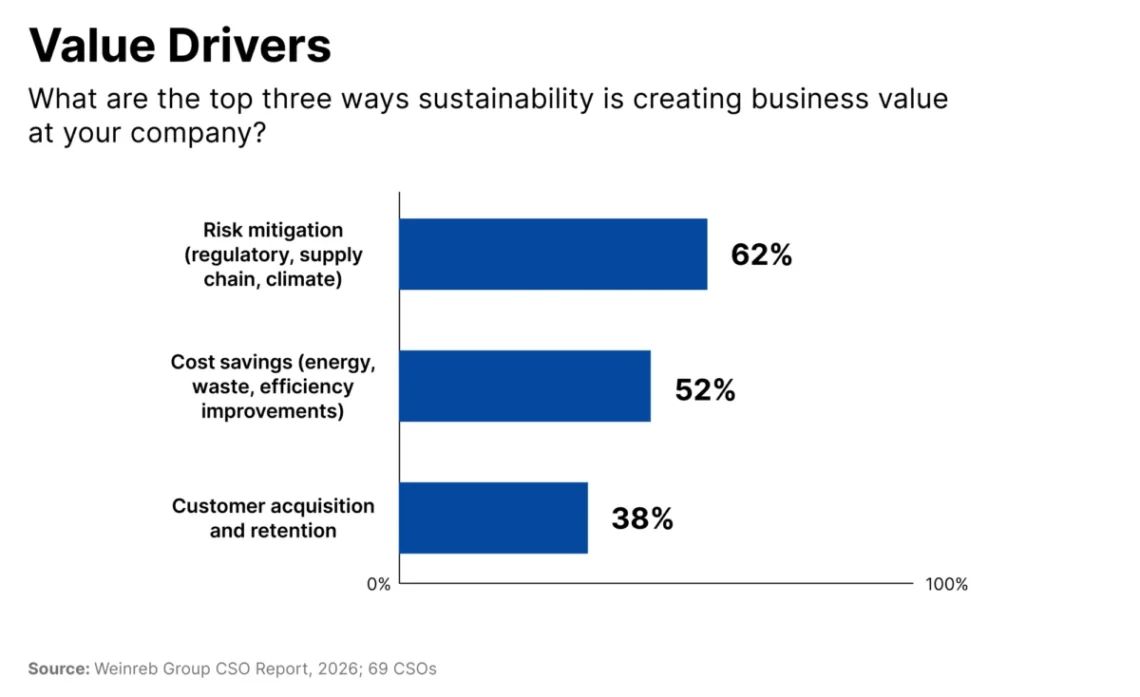
The data from the Weinreb Group’s latest study—which surveyed 69 CSOs at publicly traded U.S. companies—reveals a definitive change in priorities. While historical sustainability efforts were often justified through the lens of energy efficiency and waste reduction (traditional cost-savings), that narrative has been eclipsed.
More than 62 percent of respondents identified the ability to identify and mitigate regulatory, supply chain, and climate risks as their most significant contribution to business value. This evolution marks a departure from the "do-good" era, ushering in a "do-well" era where the CSO is tasked with safeguarding the company against the systemic shocks of the 21st century.
The Case of Suntory: A Blueprint for Integration
The shift is perhaps best exemplified by the spirits company Suntory. In January 2025, the organization took the bold step of appointing its Chief Sustainability Officer, Kim Marotta, to lead the company’s enterprise risk management (ERM) function.

This structural change is not merely cosmetic; it is functional. As Marotta noted in a recent interview, the integration allows for a holistic view of the company’s threat landscape. "What enterprise risk management has given me is the opportunity to see the big picture," Marotta explained. "Instead of just having environmental risks, they’re business risks." By collapsing the silo between sustainability and risk, Suntory has effectively elevated environmental and social concerns to the same level of urgency as financial and operational threats.
Chronology of an Evolving Profession
To understand the current state of the CSO, one must look at the trajectory of the role over the last two years. The professional landscape has reached a point of maturation that was arguably missing in the previous decade.
- 2023–2024 (The Era of Expansion): The CSO role reached its peak in terms of sheer numbers. As of 2025, there were 216 individuals holding the title at U.S. public companies. Companies were racing to formalize sustainability offices in response to burgeoning ESG (Environmental, Social, and Governance) investor interest and the promise of impending regulatory frameworks.
- January 2025 (The Pivot): Companies began realizing that sustainability was not just a separate vertical but a horizontal force. The appointment of individuals like Kim Marotta at Suntory signaled a move toward integrating sustainability into traditional corporate governance.
- Mid-2025 to July 2026 (The Consolidation): The number of dedicated CSO titles in U.S. public companies contracted slightly to 193. While this might appear as a decline, industry experts view it as a consolidation. The sustainability function is becoming embedded into existing business units rather than remaining a standalone department.
- Present Day (The Resilience Mandate): The focus has moved away from "adding headcount" to "adding perspective." Sustainability is now being treated as a core operational competency, with 42 percent of surveyed companies hiring sustainability-focused professionals directly into business units like procurement, supply chain, and product development.
Supporting Data: The Drivers and Challenges
The Weinreb Group report provides a granular look at the forces currently acting upon the sustainability profession.
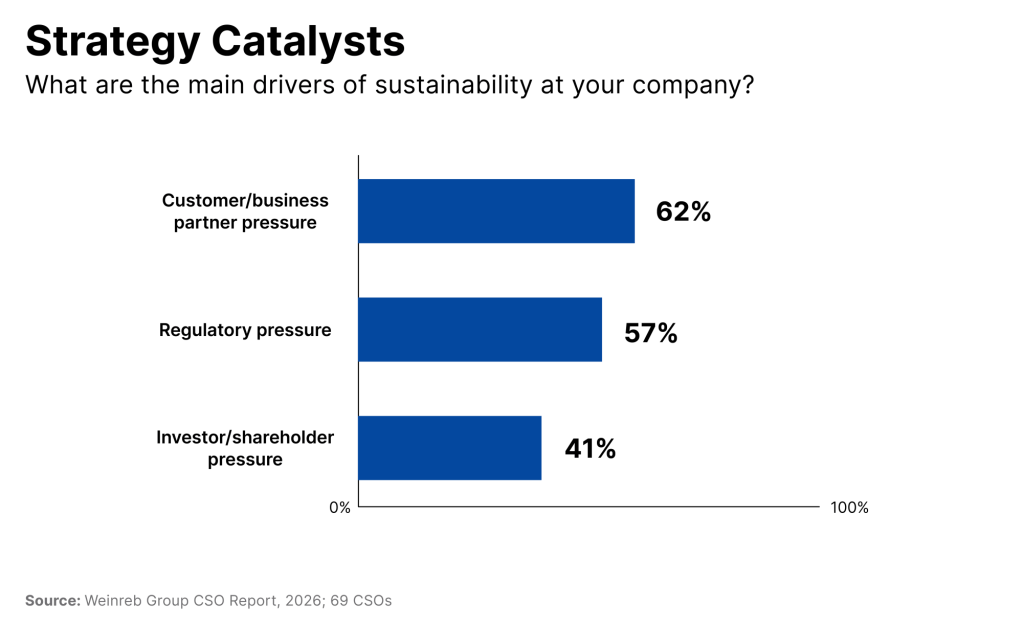
What Drives Sustainability Strategy?
The survey highlights that external pressures are the primary architects of internal strategy:
- Customer and Business Partner Pressure (62%): The market, not just the regulator, is dictating the pace of change. Organizations are being forced to adopt rigorous sustainability standards to maintain their positions in the value chain.
- Regulatory Pressure (57%): With new climate disclosure mandates coming online, compliance has become a baseline requirement for market participation.
- Investor/Shareholder Pressure (41%): Capital markets continue to demand transparency regarding how sustainability factors impact long-term asset value.
The Top Challenges
CSOs are not operating in a vacuum. They are grappling with the same macroeconomic anxieties as the rest of the C-suite:
- Market and Economic Uncertainty (62%): Volatile interest rates, shifting trade policies, and geopolitical instability make it difficult to justify long-term sustainability investments.
- Regulatory Requirements (57%): The sheer volume of reporting standards creates a "compliance fatigue" that can distract from strategic innovation.
Official Perspectives: The CSO as "Futurist"
The human element of this profession remains a point of fascination. As Ellen Weinreb, CEO of the Weinreb Group, noted, the resilience of the practitioners is what keeps the field advancing despite the lack of a traditional playbook.
Sophie Beckham, CSO of International Paper, offers perhaps the most compelling definition of the modern CSO: "CSOs are the futurists of the corporate context." Her perspective underscores that the value proposition of her role is not to react to the present, but to anticipate the future. "My mandate is to see around corners, build resilience into our business model, and create value that will help my company not just navigate but thrive when facing emerging risks and opportunities."
This sentiment is echoed by the anonymous consensus found in the survey: "We are reaching a tipping point where ‘sustainable business’ is simply ‘smart business.’"
Implications: The Structural and Cultural Shift
The implications of this shift are profound, impacting everything from how companies hire to who reports to whom.
The Changing Reporting Lines
Perhaps the most notable finding in the 2026 report is the evolution of reporting lines. In a notable shift from 18 months ago, only 14 percent of CSOs now report directly to the CEO, down from 33 percent. While this might seem like a demotion, it is more accurately described as an institutionalization of the role.
Many CSOs are now reporting to the legal department or risk management divisions. This move suggests that sustainability has moved beyond the "strategic vision" phase and into the "regulatory compliance and risk mitigation" phase. It is a sign that the function has become a core operational requirement that requires legal oversight.
The Decentralization of Sustainability
The most optimistic finding for the long-term health of corporate sustainability is the decentralization of the function. Forty-two percent of respondents reported that their organizations are hiring individuals with sustainability expertise into non-sustainability-specific roles. This is the ultimate goal of any sustainability program: to make the need for a separate "sustainability department" redundant by embedding those values into every department of the organization.
Conclusion: A New Era of Professional Maturity
The data confirms that we are witnessing the end of the "sustainability experiment" and the beginning of a period of professional maturity. The CSO of 2026 is less of a cheerleader for ethical consumption and more of a pragmatic strategist.
By centering risk mitigation, fostering cross-departmental integration, and aligning with the core operational goals of the organization, the sustainability profession has successfully carved out an essential place for itself. As the global economy continues to face the dual threats of climate change and market volatility, those companies that have empowered their CSOs to "see around corners" will likely be the ones that possess the necessary resilience to survive and thrive.
The profession has moved from the sidelines to the center of the boardroom, proving that when sustainability is treated as a strategic risk, it is no longer just a cost center—it is a competitive advantage.