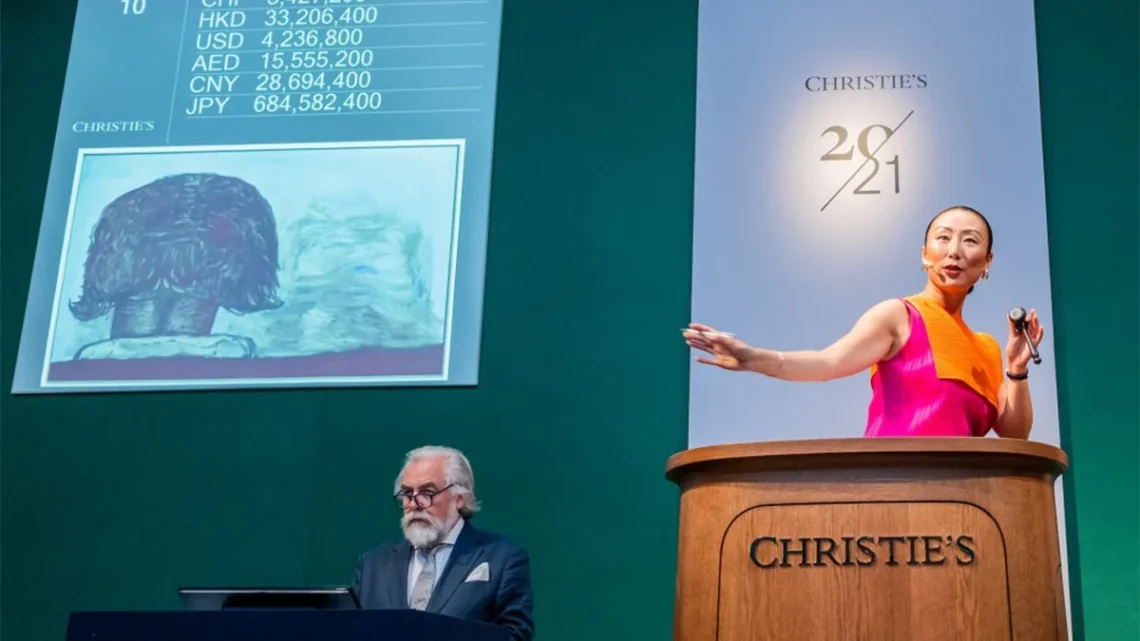
The global art market, which has spent the better part of the last two years navigating geopolitical uncertainty, high interest rates, and cautious economic sentiment, is officially finding its footing. According to newly released data from Christie’s, the world’s leading auction house has recorded a robust $4.5 billion in revenue for the first half of the year, signaling a significant resurgence in collector confidence and market liquidity.
This total, comprising $3.5 billion in public auction sales and over $1 billion in private transactions, represents the company’s most successful opening six months since 2021. With auction sales surging 71 percent year-over-year, Christie’s is not merely pointing to a "trophy" market recovery—it is painting a picture of a broad, healthy ecosystem that is firing on all cylinders across every price bracket, region, and artistic discipline.
The Core Data: A Midyear Financial Snapshot
The sheer scale of the $4.5 billion figure is impressive, but the narrative behind the numbers is arguably more significant for the health of the broader industry. Christie’s performance was anchored by the highly publicized sale of the collection of publishing magnate S.I. Newhouse, which achieved a staggering $630.8 million. However, the auction house is eager to stress that its success was not reliant on singular, headline-grabbing events.
Key Performance Indicators (H1 Results)
- Total Revenue: $4.5 billion.
- Auction Sales: $3.5 billion (up 71% YoY).
- Private Sales: Exceeded $1 billion.
- Sell-through Rate: Climbed to 91% (compared to 87% in the previous year).
- Performance vs. Estimates: Works sold for an average of 124% of their low estimates (up from 112% last year).
The increase in sell-through rates—the percentage of offered lots that actually found a buyer—is widely considered the "gold standard" for gauging market confidence. A 91 percent success rate indicates that Christie’s was not only offering high-quality material but was also pricing it effectively to meet current market appetite.

Chronology of a Recovery: From Headwinds to Momentum
The path to these results has not been without its challenges. Throughout 2023, the auction market faced a "wait and see" approach from high-net-worth individuals, leading to a tightening of supply at the very top end of the market.
The Early Stages
The year began with cautious optimism. As global inflation began to stabilize and interest rate hikes by major central banks hit a plateau, collectors began to re-engage. The first quarter focused on clearing inventory and testing the waters with refreshed marketing strategies that emphasized digital accessibility.
The Mid-Year Surge
By the second quarter, the "Newhouse effect" took hold. The marquee auctions in May and June provided the necessary momentum to draw capital back into the art market. Christie’s capitalized on this momentum by diversifying its offerings, leaning heavily into its "20th and 21st Century" departments, which saw a 79 percent revenue jump to $2.3 billion.
The Historical Context
This period represents a five-year high for the firm. Unlike the volatility seen in the post-pandemic boom, this current trajectory appears more sustainable. The growth is not concentrated in one area; rather, it is distributed across regions and categories, suggesting that the "fine art" sector is reclaiming its role as a premier asset class for diversifying portfolios.

Market Depth: Beyond the Nine-Figure Masterpieces
One of the most encouraging takeaways from the Christie’s report is the vibrancy of the "middle market." Historically, industry headlines are dominated by works selling for $50 million or more. However, the data for the first half of the year reveals that the appetite for works estimated between $20,000 and $100,000 is arguably the most resilient segment of the business.
These works achieved 148 percent of their low estimates, a 21 percent improvement from the previous year. This suggests that competitive bidding is no longer a luxury reserved for the ultra-wealthy. Instead, a new, younger generation of collectors is entering the space with significant purchasing power and a desire to participate in competitive bidding across all price tiers.
Official Responses and Strategic Vision
In a statement addressing the results, Bonnie Brennan, Chief Executive of Christie’s, emphasized that the strength of the company lies in its ability to cater to a modern, globalized audience.
"We had our best first half in five years at Christie’s, growing in all departments and regions, at every price point," Brennan stated. She specifically highlighted the firm’s commitment to digital transformation, noting that the company achieved its "strongest ever levels of international bidding and buying."

The firm’s focus on the "client journey" is evident in the data. With nearly half of all new clients now identifying as Millennials or Gen Z, Christie’s has successfully pivoted its infrastructure. Online platforms have become the primary entry point, accounting for 63 percent of all new client acquisition. This digital shift has reduced the barrier to entry, allowing collectors in emerging markets to participate in London, New York, and Hong Kong sales with the same ease as local buyers.
Implications for the Future of the Art Market
The implications of this midyear report are multifaceted, suggesting a maturation of the auction model.
1. The Institutionalization of Art Finance
Christie’s reported a notable expansion in its Art Finance division. By offering art-backed lending, the firm is providing liquidity to collectors who wish to hold onto their assets while accessing capital for other investments. As this service becomes more integrated into the auction experience, it transforms the auction house from a mere sales venue into a comprehensive financial services firm for the art world.
2. A Shift in Buying Patterns
The 34 percent increase in cross-border buying reflects a more interconnected market. Regional boundaries are blurring as bidders from Asia, the Middle East, and the Americas compete for the same lots, effectively globalizing prices and mitigating the risk of regional economic downturns.

3. Resilience of Traditional Fine Art
While "Luxury" (handbags, watches, spirits) has been a significant growth engine for Christie’s over the last decade, the 15 percent increase in this category—while healthy—was eclipsed by the 232 percent surge in Old Masters. This indicates a "flight to quality" and a renewed interest in traditional fine art, which remains the bedrock of the global art market.
The "Newhouse" Benchmark and Beyond
The sale of the S.I. Newhouse collection was, without a doubt, the catalyst for the firm’s headlines. However, the firm’s reliance on record-breaking sales of works like Jackson Pollock’s Number 7A, 1948 ($181.2 million), Constantin Brâncuși’s Danaïde ($107.6 million), and Mark Rothko’s No. 15 (Two Greens and Red Stripe) ($98.4 million) is now being balanced by the sheer volume of participation.
The record-level average of bidders per lot indicates that the "trophy" market is becoming increasingly crowded. For sellers, this is an ideal environment; for buyers, it signifies a highly competitive, fast-moving market that rewards those who have done their research and are prepared to move quickly.
Conclusion: A Barometer for Global Wealth
Christie’s midyear performance serves as a powerful barometer for the global economy. When the art market thrives, it typically reflects a sense of security among the world’s most affluent individuals. The fact that this growth is seen across every category—from the high-octane excitement of the Contemporary art evening sales to the steady, reliable interest in the Old Masters—suggests that the appetite for tangible, aesthetic assets is as strong as it has been in half a decade.

As the industry moves into the second half of the year, all eyes will be on whether this momentum can be sustained. If the current trends of increased bidder participation, a robust private sales pipeline, and the influx of younger, digitally native collectors continue, Christie’s is well-positioned to finish the year with figures that could challenge historical annual records. The "footing" the auction house has found is not just stable; it is a firm platform from which the next generation of the art market is poised to launch.